In 2026, water damage restoration costs DuPage County homeowners about $3,867 on average, with most jobs landing between roughly $1,384 and $6,384 (Angi, HomeGuide). Mitigation runs about $3.75–$7.50 per square foot and repair or rebuild adds $20–$37. Water type, square footage, and how fast you act drive the final number.
If a pipe let go in your Naperville kitchen or storm water pushed into a Lisle basement overnight, the first question is almost always the same: what is this going to cost me? It is a fair question, and the honest answer is a range, not a single price. Below is the real 2026 math, built from published cost data and the IICRC S500 restoration standard, with the local context that actually moves the number in DuPage and Will County.
What water damage restoration costs in DuPage County right now
Nationally, homeowners pay an average of $3,867 for water damage restoration in 2026, with a typical range of about $1,384 to $6,384, according to Angi’s 2026 cost data and HomeGuide. Those figures track closely with what we see across the western suburbs, because labor, equipment, and material costs here sit near the national midpoint rather than at the coastal extremes.
The range is wide for a reason. A slow supply-line drip caught the same day might cost a few hundred dollars to dry and monitor. A finished basement that took on several inches of water, sat overnight, and needs drywall and flooring replaced can climb past $10,000 once rebuild work is included. Two homes on the same Downers Grove street can get very different invoices depending on what got wet and how long it stayed wet.
To read your own estimate properly, it helps to stop thinking about one lump sum and start thinking in two phases and three water categories. That is how professional estimates are actually built.
Cost per square foot: mitigation versus repair
Every restoration job splits into two distinct phases, and they are priced very differently.
Mitigation (extraction and drying)
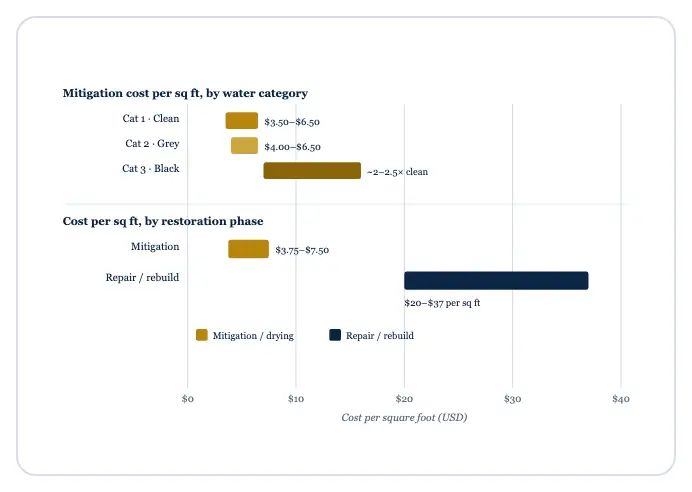
Mitigation runs about $3.75 to $7.50 per square foot. This is the emergency phase: shutting off the source, pumping and extracting standing water, setting air movers and dehumidifiers, pulling wet baseboard or carpet pad, and monitoring moisture until the structure reads dry. It is labor- and equipment-heavy but comparatively affordable, because you are drying materials rather than replacing them. Every hour that drying starts sooner is an hour of damage that never happens.
Repair and rebuild
Repair and rebuild adds roughly $20 to $37 per square foot. This is the reconstruction phase: new drywall, insulation, flooring, trim, cabinetry, and paint. It is four to five times the cost of drying per square foot, which is the single most important thing a homeowner can understand about this trade. The reason fast mitigation saves money is not marketing. It is arithmetic: dry a wall in time and you skip the expensive rebuild on it entirely.
The chart below puts the two phases side by side with the per-square-foot cost of the three water categories, so you can see where the money goes before you ever get an estimate.
Why the water category (1, 2, or 3) changes your bill
Restoration professionals classify water by how contaminated it is, following the IICRC S500 standard for water damage restoration. The category sets the sanitation scope, the protective equipment, and how much material has to be thrown out rather than dried and saved. That is why two floods of identical size can cost very different amounts.
Category 1 — clean water
Water from a sanitary source: a broken supply line, a failed water heater, an overflowing tub with no additives. Mitigation runs about $3.50 to $6.50 per square foot. Because the water is clean, more materials can be dried in place and saved, which keeps both phases affordable, as long as you move quickly.
Category 2 — grey water
Water carrying some contamination that could cause illness: washing-machine or dishwasher discharge, a toilet overflow with no solids. Mitigation runs about $4 to $6.50 per square foot. Porous materials that soaked it up, such as carpet pad and the bottom of drywall, usually get removed rather than dried, and antimicrobial treatment gets added to the scope.
Category 3 — black water
Grossly contaminated water: sewage, a drain backup, or storm water that ran across the ground before entering the home. This is the expensive one, typically two to two-and-a-half times a clean-water job. It requires full protective equipment, aggressive removal of affected materials, disinfection, and regulated disposal. One important detail the S500 flags: clean Category 1 water left standing degrades toward Category 2 or 3 within 24 to 48 hours. Time literally changes your category, and your price.
What else drives the price up or down
Category and square footage are the big levers, but several other factors show up on nearly every estimate:
- Response time. The faster extraction and drying begin, the fewer materials cross from “dryable” into “replace.” This is the difference between a mitigation invoice and a mitigation-plus-rebuild invoice.
- What got wet. Concrete and tile dry cheaply. Hardwood, engineered flooring, insulation, and finished ceilings are far more expensive to save or replace.
- Where the water sits. A basement slab is one thing; water that wicked up two feet of drywall or traveled under kitchen cabinets is another.
- Mold. Once mold takes hold, remediation is a separate line item on top of drying. The EPA advises drying wet materials within 24 to 48 hours precisely because that is the window in which mold can start to grow.
- Access and drying difficulty. Tight crawl spaces, multiple floors, and hard-to-reach wall cavities all add labor and equipment days.
Common water damage scenarios in the western suburbs
Not every leak is equal, and the cause tells you a lot about where the cost will land. A few patterns come up again and again across Naperville, Lisle, and Downers Grove:
- Burst or frozen pipe. Usually clean Category 1 water, but often behind walls or under floors, so it can travel far before you notice. Caught quickly, these sit toward the lower end of the range; discovered days later, they climb.
- Appliance failure. A water heater, dishwasher, or washing machine that lets go can release clean or grey water fast. Cost depends heavily on how long it ran and whether it reached finished space.
- Sump pump failure in a storm. The classic DuPage basement flood. The water is frequently grey or worse, and because it hits a finished lower level, both drying and rebuild tend to be larger jobs.
- Sewer or drain backup. Category 3 black water, the most expensive scenario, and the one most likely to need a separate insurance endorsement to cover.
- Roof or window leaks after wind-driven rain. These start small but can feed hidden moisture into ceilings and wall cavities, where mold risk builds if drying is delayed.
Knowing the cause also helps on the insurance side, because carriers treat a sudden burst pipe very differently from a slow, long-running leak. More on that below.
Why DuPage and Will County basements can cost more to dry
Local building patterns matter here. Naperville, Lisle, Downers Grove, Wheaton, and Bolingbrook have a high share of homes with finished basements, which is exactly the space most exposed to water damage. A finished lower level means carpet, drywall, trim, and sometimes a full living area or home office sitting at the lowest point in the house. When water gets in, there is simply more finished material in harm’s way than in an unfinished basement, so both phases of the job tend to be larger.
The region also leans hard on sump pumps. During the heavy summer and late-summer thunderstorms common across the western suburbs, a sump pump that fails, loses power, or gets overwhelmed is one of the most frequent ways a basement floods. Freeze-thaw winters add a second seasonal risk: pipes that freeze and burst. None of this makes DuPage restoration inherently pricier per square foot, but it does mean local jobs more often involve finished space, which raises the total.
For a deeper look at the full drying and rebuild process, see our water damage restoration service page, and if your emergency started in a specific town, our Naperville service area page covers local response.
A worked example: pricing a flooded Naperville basement
Ranges are useful, but a real example makes them concrete. Say a sump pump fails during a July storm and a 600-square-foot finished basement in Naperville takes on a couple of inches of clean water, caught the next morning. Here is roughly how the estimate stacks up using the 2026 figures above.
- Mitigation: 600 sq ft at the clean-water rate of about $3.50–$6.50 per square foot works out to roughly $2,100–$3,900 for extraction, air movers, dehumidifiers, and several days of drying and moisture monitoring.
- Repair and rebuild: if the bottom two feet of drywall, the carpet pad, and the trim have to be replaced, the affected reconstruction footprint might be 200–300 sq ft at $20–$37 per square foot, or roughly $4,000–$11,000 depending on finishes.
That puts the total somewhere in the $6,000–$15,000 band for a moderate finished-basement loss caught early. Now change one variable: let that same water sit for three days until it degrades toward Category 2 or 3, or until mold starts. The drying rate climbs, more material becomes unsalvageable, and remediation gets added. The same basement can easily double. This is the clearest argument for calling fast rather than waiting to see if it dries on its own.
How to read a restoration estimate (and avoid getting overcharged)
Homeowners in the western suburbs tell us the same thing on the phone all the time: they are worried about being oversold, torn out for more than they need, or caught in the middle between a contractor and an insurer. Those are fair worries. A transparent estimate is your best defense, and it should show its work rather than hand you one round number.
Look for these things on any water damage estimate, from us or anyone else:
- A written scope, not a verbal one. The document should list what is being dried, what is being removed, and why. Vague line items are how bills drift.
- Moisture readings. Reputable technicians document moisture levels at the start and monitor them daily. Drying should be verified with meters, not declared finished by feel.
- Mitigation and rebuild kept separate. Because rebuild costs several times more per square foot than drying, those phases should be itemized so you can see exactly what you are paying for.
- Removal that matches the water category. Clean-water jobs should save more material; a company recommending a full tear-out after minor clean-water exposure should be able to explain why.
- Clarity on insurance billing. Ask up front whether the company bills your carrier directly and how any deductible is handled, so there are no surprises later.
Most restoration in DuPage and Will County is priced from industry-standard estimating software that insurers also use, which is what keeps a legitimate estimate anchored to regional labor and material costs rather than guesswork. If a number looks far outside the ranges on this page, that is your cue to ask for the line-item detail behind it.
Does insurance cover water damage restoration?
Often, but not always. As a rule of thumb, sudden and accidental events such as a burst pipe or a failed appliance are typically covered, while gradual leaks, neglect, and flooding from overland water are usually excluded, per the Insurance Information Institute. Flood damage generally needs a separate flood policy, and sewer or drain backup usually requires its own endorsement. Coverage varies by policy and carrier, so read yours or ask your agent before you assume anything.
ServiceMaster Restoration Services works with insurance and can help document the loss for your claim. We do not give legal or coverage advice, but we can make the paperwork side less painful. For the full Illinois breakdown of what is and is not covered, read our companion guide: Does homeowners insurance cover water damage in Illinois?
The cheapest water damage job is the one you catch early
If there is one takeaway from the numbers above, it is that speed is the biggest cost control you have. Drying costs a fraction of rebuilding, and the window to save materials, and to keep clean water from turning dirty, is measured in hours, not days. Shut off the source if you safely can, keep people away from any standing water near electrical outlets, and get professional extraction started as soon as possible.
Water in your home right now? Don’t wait for it to spread.
ServiceMaster Restoration Services provides 24/7 emergency response across DuPage & Will County, with IICRC-aligned certified technicians. We work with your insurance. 20+ years serving the western suburbs.
Call (630) 241-1111 — 24/7 emergency response
Frequently Asked Questions
How much does water damage restoration cost?
Most homeowners pay about $3,867 on average in 2026, with a typical range of roughly $1,384 to $6,384, according to Angi and HomeGuide. Small clean-water jobs can be a few hundred dollars; a flooded finished basement that needs rebuild work can exceed $10,000.
How much does water damage restoration cost per square foot?
Mitigation (extraction and drying) generally runs about $3.75 to $7.50 per square foot, and repair or rebuild adds roughly $20 to $37 per square foot. Clean water sits at the low end of mitigation pricing; contaminated water pushes it higher.
Does clean water versus black water change the cost?
Yes, significantly. Under the IICRC S500 standard, Category 1 (clean) mitigation runs about $3.50 to $6.50 per square foot and Category 2 (grey) about $4 to $6.50, while Category 3 (black water, such as sewage) typically costs two to two-and-a-half times a clean-water job because of the added disinfection, protective equipment, disposal, and demolition.
What is the difference between mitigation and repair cost?
Mitigation is the emergency phase, drying the structure at roughly $3.75 to $7.50 per square foot. Repair and rebuild is reconstruction, at roughly $20 to $37 per square foot. Because rebuilding costs several times more than drying, fast mitigation is what keeps the expensive phase small.
Does homeowners insurance cover water damage in Illinois?
Often, when the damage is sudden and accidental, such as a burst pipe or failed appliance. Gradual leaks, neglect, and overland flooding are usually excluded, and sewer or drain backup typically needs a separate endorsement, per the Insurance Information Institute. Coverage varies by policy, so check yours. Our Illinois water damage insurance guide walks through the details.
Cost figures are 2026 estimates from Angi and HomeGuide and are provided for general guidance; your actual price depends on the scope of your loss. ServiceMaster Restoration Services, 924 Ogden Ave, Lisle, IL · (630) 241-1111.