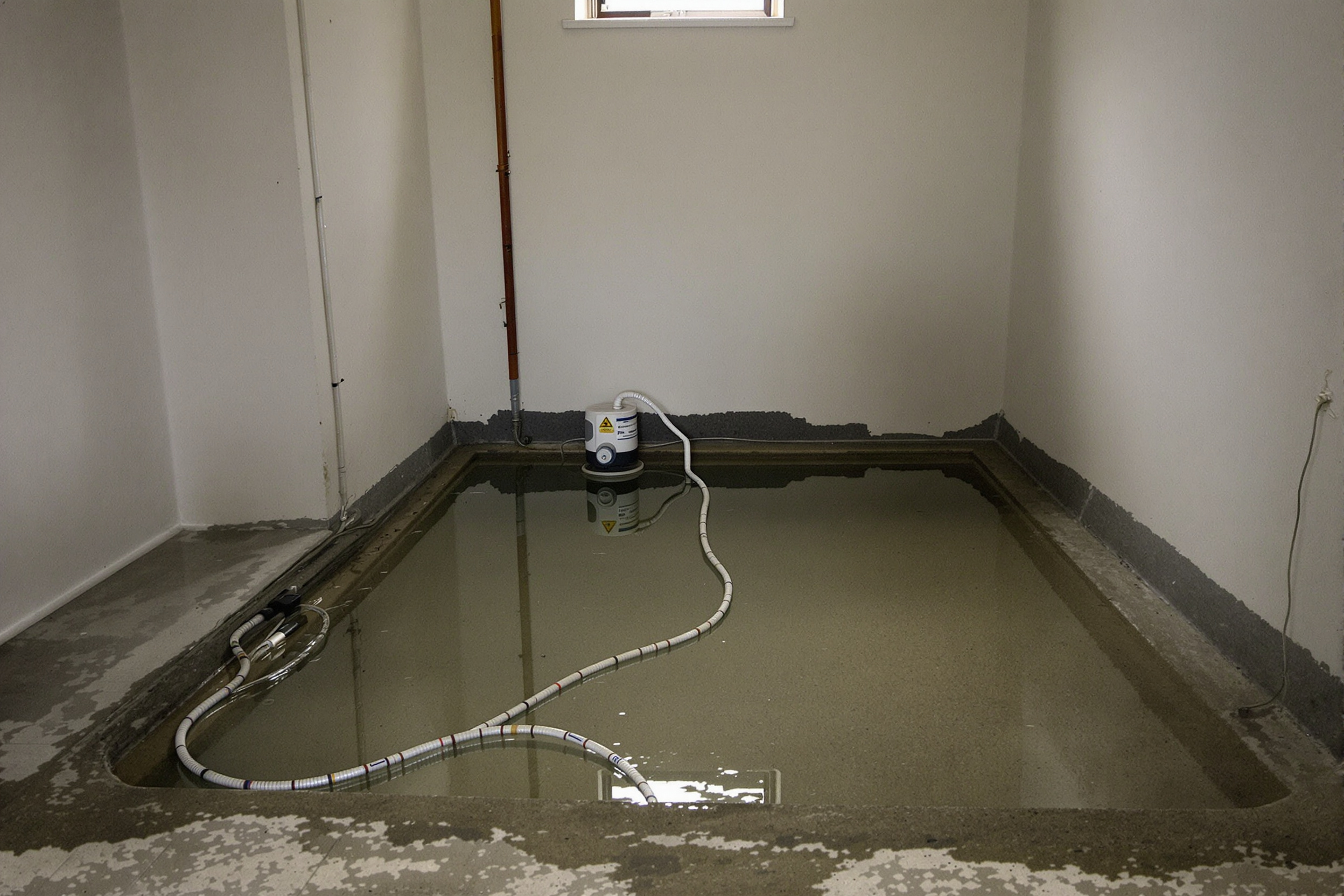
If your basement flooded after heavy rain, safety first: don’t enter standing water if
outlets, cords, or the panel are wet or submerged. If it’s safe, shut off power, stop the water
source, and photograph everything for insurance. Then extract and dry fast — call a certified
pro to dry it within 24–48 hours before mold sets in.
A wet basement is one of the most stressful things a homeowner in DuPage or Will County can walk
down the stairs to find. After a hard late-summer storm, water can come up through the floor drain,
seep along the foundation, or pour in when a sump pump quits at exactly the wrong moment. The good
news: the first hours are the ones you can control, and doing a handful of things right keeps a
manageable water loss from turning into a mold problem and a much bigger repair bill.
This guide walks you through the emergency steps in plain order, explains why basements across
Naperville, Lisle, and Downers Grove flood so reliably in heavy rain, covers cleanup and drying,
and tells you honestly when it is time to stop bailing and call a professional. ServiceMaster
Restoration Services has answered these calls across DuPage and Will County for 20+ years, and our
IICRC-aligned technicians are available 24/7 at (630) 241-1111.
What to do first (first 24–48 hours)
Work these in order. The first two are about not getting hurt; the rest are about limiting damage.
Do not skip the safety steps because the water “looks clean” — you often cannot tell what is
energized or contaminated just by looking.
-
Protect yourself from electricity. Water and electricity are the real danger in
a flooded basement. FEMA’s Ready.gov is blunt about it: “Be aware of the risk of electrocution.
Do not touch electrical equipment if it is wet or if you are standing in water,” and warns that
“underground or downed power lines can electrically charge the water.”
(Ready.gov, Floods)
If outlets, appliances, the furnace, or the electrical panel are wet or submerged — or you
would have to stand in water to reach the breaker — stay out and call an
electrician or your utility. Never wade into standing water to “just check something.” -
Cut the power to the basement — only if you can do it safely. Ready.gov
advises to “turn off the electricity to prevent electric shock if it is safe to do so.” If your
panel is dry and you can reach it from a dry spot, shut off the breakers feeding the basement. If
there is any doubt, do not risk it — get a professional to de-energize first. -
Stop the water at its source. If a burst supply line, water heater, or failed
appliance hose is feeding the flood, close the shutoff valve or your home’s main water valve. If
the water is coming in from outside (through the foundation, window wells, or a floor drain
backing up), you cannot “shut it off” — move to protecting your belongings and getting help. -
Assume the water may be contaminated. Rainwater that has traveled across the
ground, or anything coming up through a floor drain or sewer line, can carry bacteria and debris.
Ready.gov cautions homeowners to “avoid wading in floodwater, which can be contaminated and
contain dangerous debris.” Wear rubber boots and gloves, keep children and pets upstairs, and do
not let anyone touch the water with bare skin. -
Document everything before you move it. Take wide photos and video of the whole
basement, then close-ups of standing water lines on the walls, damaged flooring, drywall, and any
soaked furniture, electronics, or stored boxes. This is what your insurer will want. Do not throw
anything away yet — just photograph it. -
Start removing water and moving what you can save. Once power is off and the
area is safe, begin extracting water (a wet/dry vacuum or pump for shallow water) and carry
salvageable, dry-able items to a dry, ventilated area upstairs. Pull rugs and lift furniture off
wet carpet if you can do it without straining yourself. -
Get air moving and dry it fast. Open windows if the weather has cleared, run a
dehumidifier, and set up fans. Speed matters enormously here — which is the next step. -
Call a certified restoration company within the 24–48 hour window. The EPA
is specific: “If wet or damp materials or areas are dried 24-48 hours after a leak or spill
happens, in most cases mold will not grow.”
(EPA, A Brief Guide to Mold, Moisture and Your Home)
Household fans rarely dry structural materials (framing, subfloor, the inside of walls) quickly
enough. A pro brings commercial extraction, air movers, and dehumidifiers that hit that deadline.
Call us anytime at (630) 241-1111.
That eighth step is the whole game. Everything you do in the first two days is a race against mold,
and mold does not wait for the weekend to end.
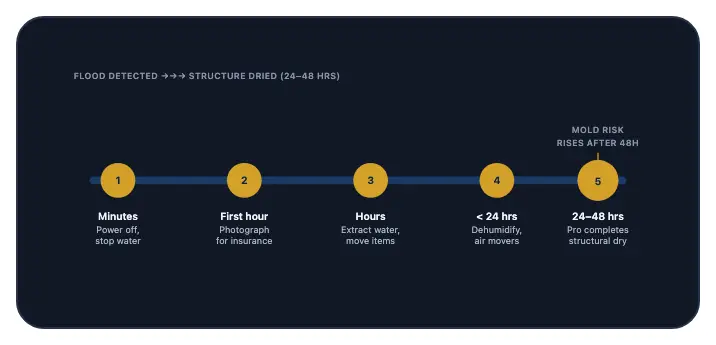
deadline that decides whether you have a water problem or a mold problem. Source: EPA, “A Brief
Guide to Mold, Moisture and Your Home.”
Why DuPage basements flood in heavy rain
If it feels like basements in our area flood more than they should, you are not imagining it. A few
local realities stack up during a heavy rain, and most of them have nothing to do with anything you
did wrong.
Heavy clay soil that does not drain
Much of DuPage and Will County sits on dense, clay-heavy soil. Clay holds water instead of letting
it percolate down, so during a downpour the ground around your foundation becomes saturated and
stays that way. That saturated soil presses water against the foundation walls (hydrostatic
pressure), and water finds its way in through hairline cracks, cove joints where the wall meets the
floor, and around utility penetrations. It is a slow, insistent seepage rather than a dramatic
gush, but on a fully finished basement it does plenty of damage.
Aging storm and combined sewers
Many older neighborhoods across the Chicago suburbs are served by aging storm sewers, and some
older areas still rely on combined sewers that carry both stormwater and sanitary waste in the same
pipe. When a late-summer thunderstorm dumps more rain than the system was designed to move, the
excess has to go somewhere — and sometimes that is backward, up through the lowest drain in
the neighborhood, which may be the one in your basement. When the water backing up is sewage rather
than rain, you are dealing with Category 3 “black water,” which is a different and more hazardous
cleanup entirely (more on that in our
sewage backup guide).
Sump-pump reliance — and sump-pump failure
Because of that clay soil and high water table, a huge share of homes here depend on a sump pump to
keep the basement dry. That is a good thing — until the storm that needs the pump most is the
same storm that knocks out the power that runs it. The classic DuPage basement flood is a
sump-pump failure during a storm: the power goes out, or the pump burns out from running nonstop, or
the float switch jams, and the pit overflows within an hour. Homes without a battery backup or
water-powered backup pump are especially exposed. If your flood traces back to the pit, our
basement water damage team sees this failure pattern every
storm season.
Late-summer storm season and surface water
Northern Illinois gets its most intense rainfall in the warm months, and late-summer thunderstorms
can drop a lot of water in a short window. Add downspouts that dump right next to the foundation,
grading that slopes toward the house, and window wells without proper drainage, and surface water
that should be running away from your home instead runs toward it and down into the basement. These
are the most fixable causes — extending downspouts and clearing window wells genuinely helps
— but during a big storm they all contribute at once.
The common thread across Naperville, Lisle, Downers Grove, Wheaton, Bolingbrook, and the rest of
the area: a lot of finished basements, a lot of clay, a lot of pumps, and storms that occasionally
overwhelm all of it at the same time. It is why “my basement flooded again” is such a familiar
phrase locally — and why fast, correct drying matters so much.
Cleanup and drying: doing it right, not just fast
Getting the visible water out is only the first third of the job. The damage that leads to mold,
warped floors, and ruined drywall is the moisture you cannot see — soaked into subfloor,
wicked up inside wall cavities, and trapped under baseboards. Here is what a proper dry-out involves.
Extraction
All standing water comes out first, because you cannot dry a structure that is still sitting in a
puddle. Professionals use truck-mounted or portable extractors that pull water out of carpet and
padding far more thoroughly than a shop vac. The faster and more completely the water is removed,
the less it has time to migrate into clean, dry materials.
Removing what cannot be saved
Some materials do not dry back to a safe, sanitary state and should come out: saturated carpet
padding, wet drywall that has wicked water up its face, soaked insulation, and particleboard
furniture that swells and crumbles. A good restorer removes the minimum necessary rather than
gutting the whole basement — if a company wants to tear out far more than the damage seems to
justify, it is fair to ask them to document the moisture readings that support it. (We cover how to
vet a company, and what fair scope looks like, in our guides on choosing a restoration contractor.)
Structural drying and monitoring
This is where professional equipment earns its keep. Air movers create high-velocity airflow across
wet surfaces while commercial dehumidifiers pull the resulting moisture out of the air, and the two
work together until framing, subfloor, and wall cavities reach a normal moisture content.
Technicians take moisture-meter readings at set points and track them daily — the readings,
not the calendar, tell you when it is actually dry. This approach follows the water-restoration
industry standard, IICRC S500, which restoration contractors and insurers use as a common framework
for drying and documentation.
(IICRC)
Cleaning and preventing mold
Once dry, affected surfaces are cleaned, and where water was contaminated, antimicrobial treatment
is applied. For small, clean-water spots, the EPA says most homeowners can handle it themselves:
“If the moldy area is less than about 10 square feet (less than roughly a 3 ft. by 3 ft. patch), in
most cases, you can handle the job yourself.”
(EPA, Mold Cleanup in Your Home)
Larger areas, anything involving contaminated water, or mold that keeps coming back is a job for a
professional. And remember the deadline: the entire reason to move quickly is that window before
mold takes hold.
When to call a pro (and a cost pointer)
Not every wet basement needs a restoration crew. A small, clean puddle from a spilled bucket or a
minor, clean-water leak that you catch immediately and dry within a day is often a DIY job. Call a
professional when any of these are true:
- The water is more than a couple of inches deep, or covers a large area.
- Water came up through a floor drain or sewer line, or is otherwise contaminated (Category 2 or 3).
- Drywall, insulation, or finished flooring got wet — these hide moisture and grow mold.
- The basement is finished, with carpet, walls, and stored belongings at risk.
- You cannot get it fully dry — structure included — within the 24–48 hour window.
- Electrical equipment, the furnace, or the water heater sat in water.
- You already smell a musty odor, or see mold starting.
On cost: water damage restoration is highly situation-specific, but for planning, national 2026
data from Angi and HomeGuide puts the average water-damage restoration project around
$3,867, with a typical range of roughly $1,384 to $6,387.
Mitigation — the extraction and drying part — commonly runs about
$3.75 to $7.50 per square foot, while rebuilding what had to be removed (drywall,
flooring, paint) tends to run $20 to $37 per square foot.
(Angi)
Contaminated (black) water costs more than clean water because of the extra containment, disposal,
and sanitizing involved. For a fuller local breakdown, see our
water damage restoration cost guide for DuPage County.
A word on insurance, because it is the question everyone asks: a sudden, accidental event like a
burst pipe is typically covered by homeowners insurance, but overland flooding from rain and
surface water is generally not — that requires separate flood coverage — and
a sewer or drain backup usually needs a specific backup endorsement on your policy. Coverage varies,
so check your own policy and your insurer. ServiceMaster works with all major insurance carriers and
can help document the loss for your claim.
Basement flooded right now?
ServiceMaster Restoration Services responds 24/7 across DuPage & Will County — Naperville,
Lisle, Downers Grove and beyond. IICRC-aligned certified technicians, residential and commercial,
and we work directly with your insurance. Call
(630) 241-1111 or
request help online. The sooner we start drying, the less it costs you.
For the bigger picture on repairing a water loss from start to finish, our
water damage restoration hub covers the full process,
equipment, and what to expect once our crew arrives.
Frequently Asked Questions
What should I do first when my basement floods?
Safety first: do not enter standing water if any outlets, cords, appliances, or the electrical
panel are wet or submerged, because of the risk of electrocution. If it is safe to do so, turn off
power to the basement, then stop the water source. Photograph everything for insurance, begin
removing water, and start drying. Then call a certified restoration company to dry the structure
within 24–48 hours before mold can grow.
Why does my basement flood every time it rains hard?
In DuPage and Will County it is usually a combination of dense clay soil that holds water against
the foundation, aging or overwhelmed storm and combined sewers, heavy reliance on sump pumps that
can fail during a storm, and surface water from downspouts, grading, or window wells running toward
the house. A repeat pattern often points to one fixable cause — a failing sump pump, a
cracked foundation, or drainage — worth having diagnosed.
Is a flooded basement an emergency?
Treat it as one. Beyond the immediate electrical and contamination hazards, the clock starts on
mold the moment materials get wet — the EPA notes that drying within 24–48 hours in
most cases prevents mold from growing. A few inches of water in a finished basement can also ruin
drywall, flooring, and belongings quickly, so fast action genuinely limits both the health risk
and the cost.
My sump pump failed and the basement flooded — what now?
Once power is safely off and it is safe to be in the space, extract the standing water, move
salvageable items to a dry area, and get air movers and a dehumidifier running. Then call a
restoration professional to dry the structure properly and check for hidden moisture. After the
cleanup, address the pump itself — a battery or water-powered backup pump helps prevent a
repeat during the next power outage. If the water was contaminated, do not attempt a DIY cleanup.
How fast does mold grow after a basement floods?
Fast. The EPA states that if wet or damp materials are dried within 24–48 hours after a leak
or spill, in most cases mold will not grow — which is exactly why that window is the target.
Household fans often are not enough to dry framing, subfloor, and the inside of walls in time,
which is why professional extraction and commercial drying equipment make the difference between a
water cleanup and a mold remediation.
This article is general information for DuPage & Will County homeowners, not professional
electrical, medical, or insurance advice. When electricity and water are involved, when in doubt,
stay out and call a professional. Coverage varies by policy — confirm details with your own
insurer. ServiceMaster Restoration Services · HQ 924 Ogden Ave, Lisle, IL ·
(630) 241-1111 · serving DuPage & Will County, 24/7.