
In Illinois, standard homeowners insurance usually covers sudden, accidental water damage, like a burst pipe or a failed washing-machine hose. It usually does not cover flooding, meaning rising or overland water, or slow, gradual leaks blamed on poor maintenance. Sewer and drain backups need a separate endorsement. Policies vary, so always read yours.
This guide is educational, not legal or insurance advice. Every policy is written differently, and coverage decisions rest with your insurer. Confirm your own terms with your agent or carrier, and contact the
Illinois Department of Insurance
(toll-free 866-445-5364) with questions or complaints about a claim.
If your ceiling is dripping or your basement in Naperville just took on water, you are probably feeling two things at once: dread about the damage, and confusion about who pays for it. That second worry is real. Homeowners across DuPage and Will County tell the same story online, feeling stuck between an insurance company that is slow to say yes and a restoration crew that needs to start drying today. This article clears up the part you can actually control: understanding what a typical Illinois homeowners policy covers, what it does not, and how to file so your claim has the best chance of going smoothly.
The short version: what Illinois homeowners policies usually cover
Insurance companies draw one big line through all water damage, and almost every coverage question comes back to it. Standard homeowners policies are built to pay for damage that is sudden and accidental. They are not designed to pay for the slow results of wear, age, or deferred maintenance, and they specifically exclude flooding. The Insurance Information Institute (Triple-I) puts it plainly: standard homeowners and renters insurance covers events like burst pipes, wind-driven rain, and damage from ice dams, while flood damage is excluded and sewer backups require a separate purchase.
The visual below sorts the most common Illinois scenarios into three buckets: usually covered, usually not covered, and covered only if you added an endorsement. Use it as a quick orientation, then read on for the reasoning, because the details are where claims are won or lost.
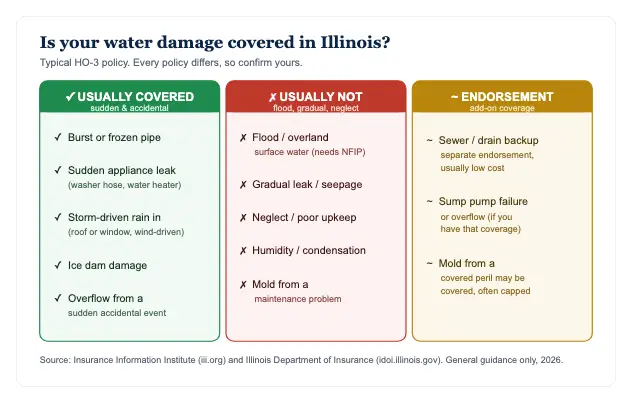
Insurance Information Institute
and the Illinois Department of Insurance.
“Sudden and accidental” vs “gradual”: the distinction that decides your claim
Almost every coverage dispute over water damage comes down to one question the adjuster is really asking: did this happen all at once, or did it build up over time? A standard policy is designed to pay for the first kind and to exclude the second. The Illinois Department of Insurance describes the excluded category directly, noting that standard homeowners policies do not cover water damage from maintenance problems such as continuous or repeated seepage or leakage, humidity or condensation, or landscaping and drainage problems.
What usually counts as sudden and accidental (covered)
These are the events a homeowner could not reasonably have seen coming and did not let fester:
- A burst or frozen pipe. A supply line that splits during a cold January snap in Wheaton and floods a bathroom is the textbook covered claim.
- A sudden appliance failure. A washing-machine hose that lets go, a water heater that ruptures, or a dishwasher that overflows without warning.
- Wind-driven rain that gets in. If a storm tears shingles off and rain pours through the opening, that resulting interior damage is generally covered. Triple-I lists wind-driven rain among the covered perils on a standard policy.
- Ice dams. When snow melts and refreezes at the roof edge and forces water back under the shingles, the damage inside is typically covered.
What usually counts as gradual or maintenance (excluded)
These are the losses insurers treat as the homeowner’s responsibility to prevent through upkeep:
- A slow leak you could have caught. A drip under the sink that quietly rots the cabinet and subfloor over months reads as maintenance, not an accident.
- Seepage and foundation moisture. Groundwater working through a basement wall or floor over time is generally excluded.
- Humidity and condensation. Ongoing moisture problems that lead to rot or mold.
- Neglect. If a known problem was left unrepaired and the damage grew, the insurer can deny the portion tied to the delay.
This is exactly why speed matters after any leak. The faster water is stopped, extracted, and dried, the cleaner the line between a covered sudden event and an excluded gradual one. Our team documents moisture readings and the scope of damage from day one, which gives your adjuster the clear record they need. You can read more about that role on our
insurance claim assistance page.
Why flooding is a separate policy (and what that means in DuPage & Will County)
Here is the single most misunderstood fact in home insurance: flood is not covered by homeowners insurance, period. Not by the standard policy, and not as an add-on to it. Triple-I is blunt that flood damage is excluded under standard homeowners and renters policies, and the Illinois Department of Insurance repeats the same warning for Illinois residents. To be protected against flooding you need a separate flood policy, most often through the National Flood Insurance Program (NFIP).
What insurers mean by “flood” is water that rises from the ground up or spreads across normally dry land: an overflowing creek, storm surge, or heavy rain that pools and runs overland into your home. That is different from rain that comes in from above through a storm-damaged roof, which a standard policy may cover. Triple-I frames the split simply, with top-down water like rainfall handled by the homeowners policy and bottom-up water like an overflowing river handled by flood insurance.
A few practical points for local homeowners:
- Flood coverage limits. An NFIP policy for homeowners can cover the structure up to $250,000 and contents up to $100,000, according to FloodSmart, the NFIP’s consumer site.
- The waiting period. New flood policies generally do not take effect for 30 days, the Illinois Department of Insurance notes, so you cannot buy it the week a storm is forecast and expect coverage.
- You do not need to be in a high-risk zone. Heavy summer and late-summer thunderstorms across Naperville, Bolingbrook, Plainfield, Aurora, and Romeoville regularly push water where maps say it should not go. Much of the flood damage NFIP pays for happens outside the highest-risk areas.
Sewer and drain backups: the endorsement most DuPage basements need
In a region full of finished basements and aging storm and combined sewers, this is the coverage gap that catches the most people. When a heavy rain overwhelms the system and sewage or drain water backs up through a floor drain or toilet, a standard homeowners policy does not cover it, and neither does flood insurance. Triple-I is explicit that sewer backups are not covered by a typical homeowners policy or by flood insurance, and that this protection must be bought as a separate endorsement, usually at a nominal cost.
Sump pump failure sits in the same category. The Illinois Department of Insurance points out that standard homeowners policies sometimes cover sewer backup or sump pump failure, but only if you have added that specific coverage. For a Lisle or Downers Grove home that relies on a sump pump through storm season, a backup-and-overflow endorsement is often the difference between a covered basement and a bill you pay yourself. It is worth a five-minute call to your agent to confirm you have it, and to ask about the dollar limit, which is frequently capped.
Backups also tend to involve Category 3 water, the contaminated “black water” class that requires trained, PPE-equipped cleanup rather than a mop and a shop vac. That is one more reason to document everything and bring in professionals early.
What about mold?
Mold coverage follows the same logic as everything above. On its own, mold is treated as a maintenance issue and is generally excluded. Triple-I notes that mold, like rot and insect infestation, is usually not covered because standard policies are not designed to pay for cleaning and upkeep. The important exception: if mold grows as the direct result of a covered peril, such as the burst pipe your policy already covers, the cost of removing that mold may be covered as well.
Two cautions for Illinois homeowners. First, mold coverage tied to a covered loss is often capped at a set dollar amount, so read your policy’s mold limit. Second, the covered-versus-excluded line again depends on how fast you acted. Mold can begin to develop within 24 to 48 hours of water exposure, so drying quickly protects both your home and your claim. Our
water damage restoration process is built around that window.
How to file a water damage claim in Illinois, step by step
A well-documented claim moves faster and is far less likely to be shorted. Both Triple-I and the Illinois Department of Insurance recommend the same core steps:
- Stop the source and stay safe. Shut off the water if you can, and stay clear of standing water near electrical panels or outlets.
- Contact your insurer right away. Report the claim promptly, even if you are unsure it is covered, the Illinois Department of Insurance advises. Have your policy number ready and ask about your deductible, deadlines, and what documentation they want.
- Prevent further damage, and keep the receipts. Triple-I stresses taking reasonable steps to protect the property from additional damage and saving receipts for those temporary repairs, which are typically reimbursable. This is where emergency water extraction and drying fit in.
- Document everything before cleanup changes the scene. Photograph and video the damage, and build an inventory of damaged belongings with a description, approximate purchase date, and replacement cost.
- Do not throw damaged items away until the adjuster has seen them, Triple-I cautions. Set ruined items aside rather than hauling them to the curb.
- Keep a paper trail. Save copies of everything you send and receive, and write down the name and number of everyone you speak with at the company.
One honest note about a common worry we hear: some homeowners feel caught between the insurer and the restoration company. A reputable restoration firm works with your carrier, not around it, by producing the moisture logs, photos, and line-item scope the adjuster relies on. We help document your claim and coordinate directly with your insurance company. We do not, and no honest company can, promise a particular payout, because that decision belongs to your insurer.
Don’t forget the deductible
Even on a fully covered water loss, you pay your deductible before your insurer pays anything. If your deductible is $1,000 and the covered damage totals $6,500, the carrier’s share is roughly $5,500. That math matters twice: it tells you whether a smaller loss is even worth filing, and it explains why a covered claim rarely means a $0 out-of-pocket day. Water and flood policies can also carry separate or percentage-based deductibles, so check which one applies to your loss. When we scope a job, we give you an honest, itemized estimate up front so you can see the full picture, deductible included, before any decision.
Will filing a claim raise my premium?
It might, and it is fair to weigh that before you file a small claim. Home insurance claims are recorded for up to seven years in an industry database called the Comprehensive Loss Underwriting Exchange (CLUE), which carriers check when setting rates. Water claims in particular can affect your future premium or renewal, so for damage only slightly above your deductible, it is worth doing the math. You are entitled to a free annual copy of your CLUE report to review and dispute errors. For anything substantial, though, the coverage is exactly what you pay premiums for. When you are weighing whether to file, our
guide to choosing a restoration company can help you find a partner who gives you a straight, documented estimate first.
Where ServiceMaster Restoration Services fits
For more than 20 years, ServiceMaster Restoration Services has helped homeowners and businesses across DuPage and Will County recover from water, fire, mold, and storm damage. Our IICRC-aligned, certified technicians respond 24/7, and we work directly with your insurance company, documenting the damage and the scope of work so your claim is supported by clear evidence. We serve Naperville, Lisle, Downers Grove, Wheaton, Bolingbrook, Woodridge, Hinsdale, Lombard, Glen Ellyn, Aurora, Plainfield, Romeoville, Lockport, and the surrounding communities.
Curious what restoration itself costs before insurance? See our local breakdown of
water damage restoration cost in DuPage County.
Water damage now? We answer 24/7.
Fast extraction and drying protects your home and strengthens your claim. Call for immediate help, and we will help document everything for your insurer.
Frequently Asked Questions
Is water damage covered by homeowners insurance?
Often, yes, when the damage is sudden and accidental. A standard Illinois homeowners policy typically covers events like a burst pipe, a ruptured water heater, or wind-driven rain that enters through storm damage. It typically excludes flooding and slow, gradual leaks tied to poor maintenance. Because policies differ, check yours or ask your agent.
What is the difference between sudden and gradual water damage?
Sudden damage happens all at once from an accident, like a pipe that bursts overnight, and is usually covered. Gradual damage builds up over weeks or months from something like a slow drip, seepage, or condensation, and is usually excluded as a maintenance issue. Adjusters look closely at which category your loss falls into, which is why fast, documented cleanup helps.
Is flooding covered by homeowners insurance?
No. Flood damage from rising or overland water is excluded from standard homeowners and renters policies, according to the Insurance Information Institute and the Illinois Department of Insurance. You need a separate flood policy, usually through the National Flood Insurance Program, which can cover a home’s structure up to $250,000 and contents up to $100,000. New flood policies generally have a 30-day waiting period.
How do I file a water damage insurance claim?
Stop the water source, then contact your insurer right away, even if you are unsure it is covered. Prevent further damage and keep receipts for temporary repairs, photograph and inventory everything, and do not discard damaged items until the adjuster has seen them. Keep copies of all paperwork and notes on who you spoke with. A restoration company can supply the moisture readings and scope your adjuster needs.
Does filing a water damage claim raise your premium?
It can. Claims are recorded for up to seven years in the industry’s CLUE database, and water claims in particular may affect your future premium or renewal. For damage only slightly above your deductible, it is worth weighing the cost of filing. For a significant loss, that is what your coverage is for. You can request a free annual CLUE report to review your history.
Disclaimer: This article is for general education only and is not legal, insurance, or financial advice. Coverage varies by policy and by carrier, and only your insurer can determine what your policy covers. Verify your specific terms with your agent or company, and contact the
Illinois Department of Insurance
(866-445-5364) with questions or complaints about a claim.
Sources
- Insurance Information Institute (Triple-I), “Water Damage: What’s Covered; What’s Not.”
- Insurance Information Institute (Triple-I), “Settling insurance claims after a disaster.”
- Insurance Information Institute (Triple-I), “Which disasters are covered by homeowners insurance?”
- Illinois Department of Insurance, “Flood Insurance” consumer page.
- FEMA / National Flood Insurance Program, FloodSmart, “What you need to know about buying flood insurance.”
- FEMA, “Flood Insurance.”