
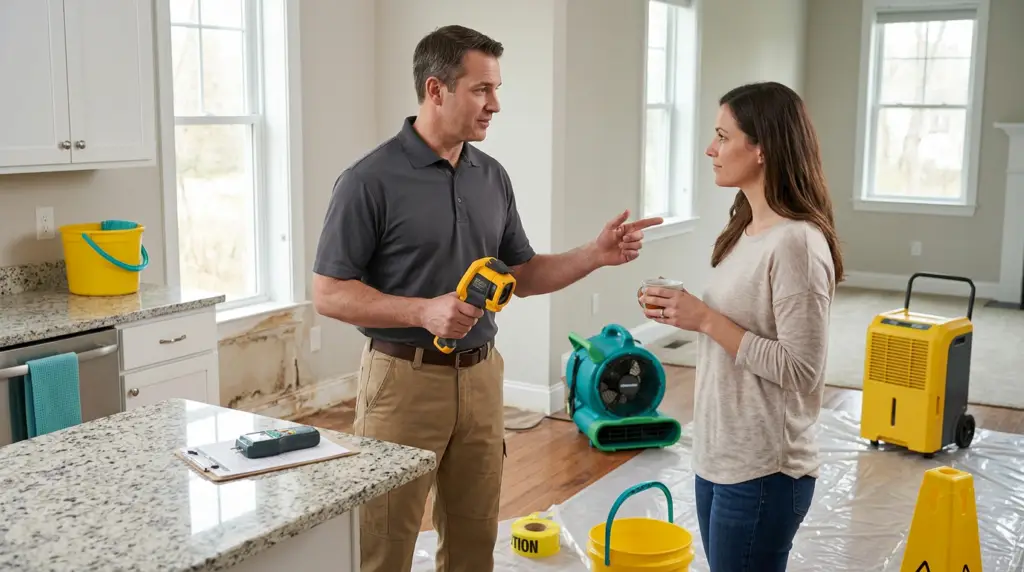

How does a property damage insurance claim work, step by step?
A property claim usually follows the same path: make the property safe and photograph the damage, take reasonable steps to prevent further loss, notify your insurer, meet the adjuster, review a line-item estimate of the repairs, track additional living expenses if you must move out, then settle. Policies vary, so read yours or ask the Illinois Department of Insurance.
The claim process from first call to settlement
This is the general sequence described by the Insurance Information Institute and the Illinois Department of Insurance. It is educational, not legal advice.
- Document. Photograph or video every affected area before anything is moved, as Triple-I advises in its guide to filing a homeowners claim.
- Mitigate. Take reasonable steps to protect the property, such as water extraction, board-up or tarping, and keep every receipt. The Illinois Department of Insurance calls mitigation the policyholder's responsibility.
- Notify your insurer. Report the loss promptly. Triple-I notes insurers must send claim forms within a time period set by law; return them quickly to avoid delays.
- Adjuster inspection. Show the adjuster structural damage and give a list of damaged items. Avoid discarding damaged items before the visit.
- Scope and estimate. Repairs are priced line by line. Compare your contractor's estimate with the adjuster's and resolve differences item by item.
- Additional living expenses. If the home is unlivable, save receipts for costs above your normal spending.
- Settlement and payment. Contents payments go to you; structure payments may be made out to you and your mortgage holder.

A room-by-room record speeds everything up
Photos of each room, a list of damaged items with approximate age and purchase price, and copies of receipts make the adjuster's visit shorter and the estimate more accurate. A home inventory made before a loss helps even more.
Who are the adjusters, and who do they work for?
The Illinois Department of Insurance describes three types of adjusters:
- Company adjuster: an employee of your insurer who represents the insurer and does not charge you.
- Independent adjuster: hired on contract by your insurer to represent its interest; also no charge to you.
- Public adjuster: works for you to prepare, present and settle the claim, for a fee, usually a percentage of the settlement. Illinois requires public adjusters to be licensed with the Department, and their fees are not covered by your policy.
IDOI also points out that you do not have to hire a public adjuster, that many of the same services are performed for free by insurer staff, and that public adjusters may not solicit you between 7 p.m. and 8 a.m. or while the fire department is still at your property.
What can a restoration company do on your claim, and what can't it do?
We work with your insurance. In practice that means documenting the damage with photos, moisture readings and drying logs, writing a line-item scope of the mitigation and repair work, meeting the adjuster on site to explain that scope, and answering questions about why each item is needed.
What a contractor should not do in Illinois is act as your adjuster. Interpreting what your policy covers and negotiating the settlement on your behalf is adjusting work, and in Illinois doing it for a policyholder requires a public adjuster license. In Power Dry of Chicago v. Bean (2022), an Illinois appellate court held that a contractor that applied the circumstances of a loss to the homeowner's policy language had acted as an unlicensed public adjuster, and its contract was void. Coverage decisions stay between you and your insurer, or a licensed public adjuster you hire.
If you disagree with the insurer's estimate, ask for it in writing, compare it with your contractor's line by line, and request a second inspection for items in dispute. The Insurance Information Institute notes that if you accept an early settlement and later find other damage, you can reopen the claim and file for an additional amount. If a dispute cannot be resolved, the Illinois Department of Insurance accepts consumer complaints.
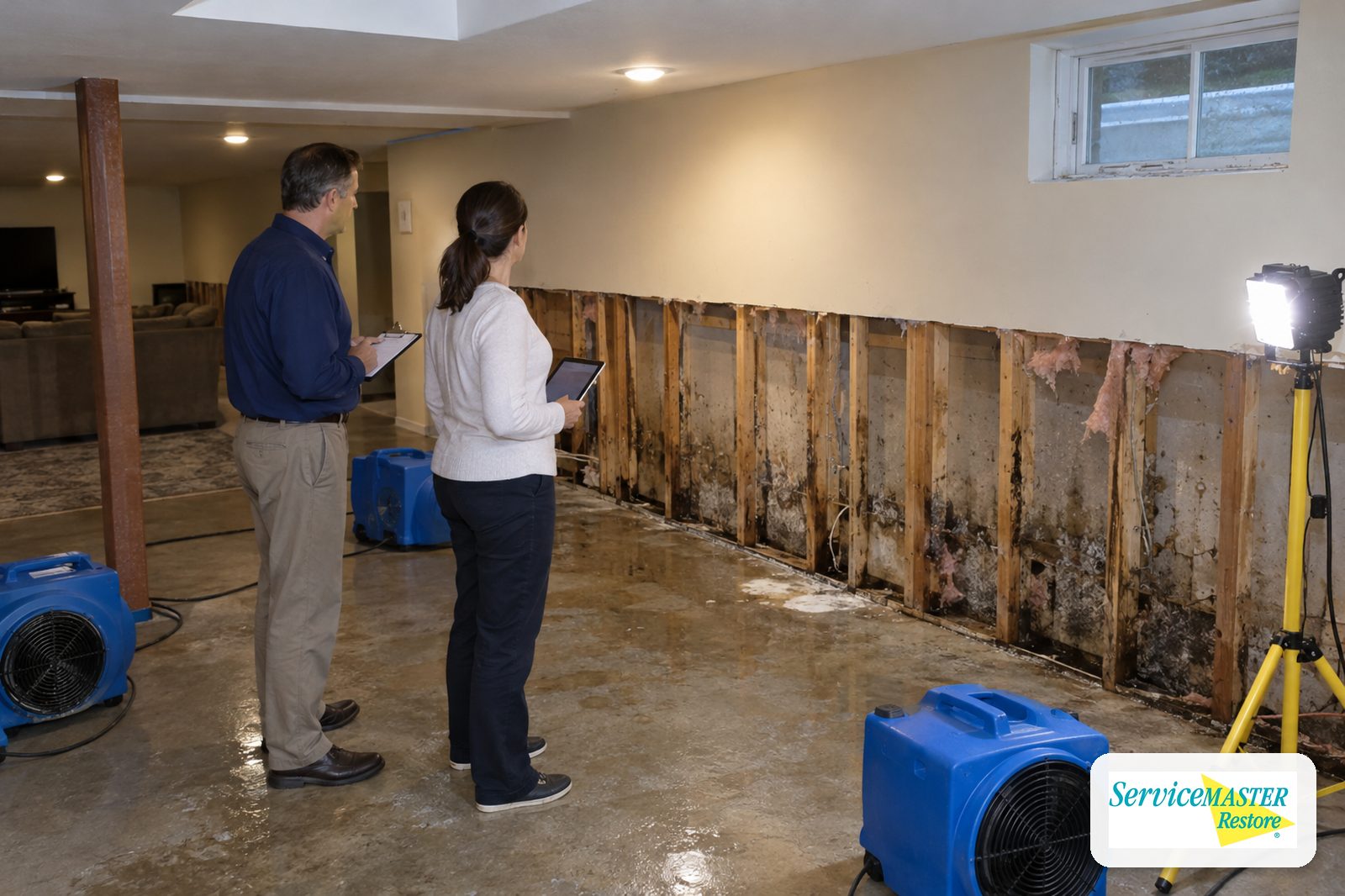
Meeting the adjuster with the scope in hand
When the restoration crew and the adjuster walk the property together, each line of the scope can be tied to something the adjuster can see or measure. That is documentation, not negotiation, and it keeps the claim moving.
Replacement cost, actual cash value and depreciation
How much you receive depends partly on the policy type. Replacement cost coverage pays to repair or replace with materials of like kind and quality; actual cash value subtracts depreciation for age and wear. Under Illinois Department of Insurance rules, 50 Ill. Adm. Code 919.80, actual cash value on residential fire and extended coverage is replacement cost at the time of loss less depreciation, and on request the insurer must provide the claim-file worksheets showing every depreciation deduction.
The type of loss also changes the size of a typical claim. Fire claims are rarer than water or wind claims, but far larger.
Average homeowners claim payment by cause of loss
Average claim severity in dollars, United States, 2019 to 2023
Source: Insurance Information Institute, Facts + Statistics: Homeowners and Renters Insurance (ISO/Verisk data, 2019-2023). Severity is the average amount paid per claim.

Additional living expenses, explained with numbers
IDOI gives this example: if you normally spend $1,500 a month on housing, utilities, food and transportation, and that rises to $2,000 because of the disaster, the insurer reimburses the $500 difference. Keep every receipt, and ask about limits on amount and time.
Claims help for DuPage and Will County property owners
From our Lisle office we help homeowners and businesses across both counties document losses after residential water damage, commercial fire damage and storms, including in Naperville, Lombard and Clarendon Hills. When the estimate is agreed, our repairs and reconstruction team can complete the rebuild.
For coverage questions on leaks, read does homeowners insurance cover water damage in Illinois? Emergencies start on our 24/7 emergency response page, and the full service picture is under water damage restoration and fire damage.
Please note: this page is general information, not legal or coverage advice. Policies differ, and only your insurer can make coverage decisions. For questions about your rights, contact the Illinois Department of Insurance.
Need help documenting a loss? Contact us or call (630) 241-1111.
Frequently asked questions
How much can a public adjuster charge in Illinois?
For claims arising from damage to a personal residence, the Illinois Department of Insurance explains in Company Bulletin 2024-16 that a public adjuster may not charge more than 10% of the insurance settlement paid on the claim. The contract must state that cap, and fees can be negotiated. Your policy does not pay public adjuster fees.
Can I cancel a public adjuster contract in Illinois?
Yes. According to the Illinois Department of Insurance, every public adjuster contract must state that the insured may cancel within 5 business days after a copy of the contract is received by the insurance company, and that cancellation can be sent by email as well as by registered or certified mail or personal service.
What is the difference between replacement cost and actual cash value?
Replacement cost coverage pays to repair or replace damaged property with items of similar kind and quality without subtracting depreciation. Actual cash value pays replacement cost minus depreciation for age and wear. Under Illinois rules, you can ask the insurer for the worksheets showing each depreciation deduction on an actual cash value settlement.
How long do I have to file a property insurance claim?
Check your policy, because deadlines differ. The Insurance Information Institute notes that most policies require claims to be filed within one year of the disaster, and some insurers require a signed proof of loss form detailing the damage and the amount claimed. Report the loss as soon as possible either way, since delays make damage harder to document.
How do I file a complaint about an insurance claim in Illinois?
Start by asking your insurer for its decision and estimate in writing and requesting a supervisor review. If that does not resolve it, the Illinois Department of Insurance runs a consumer complaint process and can be reached through its website or consumer phone lines. Keep copies of every letter, estimate and photo you send.
Sources
- Insurance Information Institute: How to File a Homeowners Claim
- Illinois Department of Insurance: Disasters: Temporary Repairs and Claim Tips
- Illinois Department of Insurance: Homeowners & Renters: Public Adjusters
- Illinois State Bar Association: Power Dry of Chicago, Inc. v. Bean, 2022 IL App (2d) 210043 (case summary)
- Illinois General Assembly, Joint Committee on Administrative Rules: 50 Ill. Adm. Code 919.80, Improper Claims Practice
- Insurance Information Institute: Facts + Statistics: Homeowners and Renters Insurance
- Illinois Department of Insurance: Company Bulletin 2024-16: Changes to the Regulation of Public Adjusters
- Insurance Information Institute: Settling Insurance Claims After a Disaster
- Illinois Department of Insurance: Understanding the Consumer Complaint Process