
To choose a water damage restoration company, verify IICRC certification and liability insurance, insist on a written, itemized scope before work begins, and confirm the crew documents moisture readings and bills your insurer directly. Walk away from anyone demanding large cash up front, refusing a written estimate, or pressuring you to sign on the spot.
When your basement in Naperville is filling with water or a burst pipe is soaking a ceiling in Wheaton, you make a fast decision under stress, and that is exactly when it is easiest to get overcharged. Homeowners across DuPage and Will County describe the same knot of worries afterward: was that 20 percent markup normal, did the crew tear out more than they needed to, and was I steered to the wrong company by a well-meaning plumber. This guide walks you through how to pick a restoration company you can trust, the green flags that mark a legitimate firm, the red flags that signal trouble, and how to tell whether a scope and estimate are fair.
The good news is that separating a solid company from a shaky one is not guesswork. There is a short list of things reputable firms do and questionable ones avoid, and most of it you can check in the first phone call and the first hour on site. Use the scorecard below as your quick reference, then read on for what each item means.
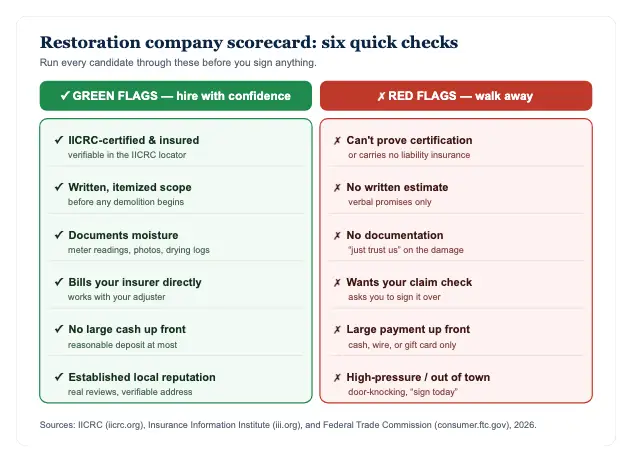
IICRC,
the Insurance Information Institute,
and the Federal Trade Commission.
Green flags: what a trustworthy restoration company looks like
Start with the things that are easy to confirm and hard to fake. The best restoration companies expect these questions and answer them without hesitation. If a firm bristles when you ask, that is information too.
IICRC certification you can actually verify
The Institute of Inspection, Cleaning and Restoration Certification (IICRC) is the nonprofit that writes the industry’s water restoration standard, the S500, and certifies the technicians and firms that follow it. Its structural-drying guidance is built around acting quickly, because materials that stay wet begin to grow mold within roughly 24 to 48 hours. So certification is not a decorative badge; it means the crew drying your home is trained to a recognized standard rather than improvising.
Here is the part most homeowners miss: you can check the claim yourself. The IICRC runs a public
Certified Firm locator
where you search by ZIP code or company name. To carry the Certified Firm designation, a company must employ at least one active IICRC-certified technician and maintain current general liability insurance. If a company says it is certified but does not appear in the directory, treat that gap as a red flag and ask for their technician certification numbers.
A written, itemized scope of work before demolition
A reputable company documents what is wet, what has to be removed, and what can be dried in place, then puts it in writing before anyone swings a hammer. This written scope is your best defense against the fear so many homeowners voice afterward, the sense that a crew “tore out a lot for not much damage.” When the scope is on paper and tied to moisture readings, over-demolition becomes obvious rather than invisible, and it gives your adjuster something concrete to approve.
Moisture documentation, not just a confident opinion
Water hides. It wicks up drywall and travels under flooring where you cannot see it, so professionals map it with moisture meters and thermal imaging, then log the readings as the structure dries. That documentation does two jobs: it proves the drying is working, and it becomes the evidence your insurer relies on. A company that cannot show you daily moisture logs is asking you to take both the damage and the bill on faith.
Direct insurance billing and adjuster coordination
Many established restoration firms bill your insurance company directly and coordinate with your adjuster, so you are not fronting the full cost and chasing reimbursement later. That is a genuine convenience and a good sign. There is an important line, though, between a company that bills your insurer and one that wants to run your entire claim or have you sign your insurance check over to them. The first is normal; the second is a warning we will come back to. For how coverage itself works in Illinois, see our guide to
whether homeowners insurance covers water damage.
An established local reputation
A company with a real address in or near DuPage and Will County, a track record you can find in reviews, and references it will share is far less likely to disappear mid-job or cut corners. The FTC’s advice for hiring after any emergency lands in the same place: research the company’s track record, search its name alongside words like “scam,” “review,” and “complaint,” and deal with reputable people in your community rather than whoever knocks first.
Red flags: the warning signs of overcharging and fraud
Disasters draw opportunists. The Federal Trade Commission warns that after storms and other emergencies, unlicensed operators and outright scammers move into recovery areas promising fast repairs. Watch for these patterns, any one of which is reason to pause.
- They demand a large payment up front. The Insurance Information Institute puts it plainly: “Beware of contractors who ask for a large amount of money up front.” A reasonable deposit can be normal, but a demand to pay most or all of the job before work begins is a classic setup for a crew that underdelivers or vanishes.
- They want you to sign over your insurance check. The FTC specifically flags contractors who “tell you to sign over your insurance check.” That hands your leverage to someone else. You should remain the one paying for satisfactory, completed work.
- They insist on cash, wire, gift cards, or crypto. The FTC advises paying “by credit card or check, never by wire transfer, gift card, payment app, cryptocurrency or in cash,” because those methods are hard to trace and nearly impossible to claw back.
- They pressure you to sign immediately. Unsolicited door-knocking, a “discount if you sign today,” or a blank contract are all high-pressure tactics the FTC associates with post-disaster scams. Legitimate work does not evaporate if you take an hour to read the paperwork.
- The bid is suspiciously low. The Insurance Information Institute cautions to “beware of contractors whose bids are very low,” because they may cut corners and leave you with unfinished or shoddy work, and a second bill to fix it.
- They cannot prove licensing, certification, or insurance. The FTC notes scammers often “claim they don’t need to be licensed.” Ask for proof of general liability and workers’ compensation insurance, and verify IICRC certification in the locator. If they hedge, move on.
- No written estimate and no documentation. If a company will not commit a scope to paper or show moisture readings, you have no way to judge whether the work, or the bill, is justified.
On the “is a markup normal?” worry specifically: restoration pricing includes overhead and, on insurance jobs, industry-standard estimating software most carriers recognize. What matters is not whether a line item exists but whether the whole estimate is itemized, tied to documented damage, and reviewed by your adjuster. A transparent, line-by-line estimate you can question is the antidote to that anxiety. A round number on a business card is not.
Should I use my insurer’s contractor or find my own?
This is one of the most common questions homeowners ask, and the honest answer is reassuring: the decision is yours. The Insurance Information Institute states it directly, that “the choice of repair firms is yours.” Your insurance company may hand you a list of preferred or “program” vendors, and you are free to use one, but you are not required to.
There are real trade-offs either way.
An insurer’s preferred contractor can be convenient. The billing relationship is already established, and the Insurance Information Institute notes that some insurers “even guarantee the work of firms they recommend,” though it adds that “such programs are not available everywhere.” The reasonable concern homeowners raise is divided loyalty: a vendor that depends on the insurer for a steady stream of referrals may feel some pull to keep the estimate lean. That is not a certainty, but it is fair to weigh.
A company you choose yourself works for you first. A good independent restorer documents the full extent of the damage and advocates for a complete, correct scope with your adjuster. The Insurance Information Institute’s recommended process fits this route well: get written bids from licensed contractors, show them to the adjuster, and “don’t get permanent repairs done until after the adjuster has approved the price.” That sequence keeps everyone aligned and protects you from paying for work the carrier later disputes.
A middle path resolves the tension for many people. You can hire an independent, IICRC-certified company you trust and have it bill your insurer directly and coordinate with your adjuster. You are not stuck choosing between “my company” and “insurance-friendly”; the right firm is both. If a plumber or a friend referred you to a restorer, that referral is a fine starting point, not an obligation, so run it through the same scorecard you would use for anyone else.
Questions to ask, and what a fair scope and estimate look like
Before you sign, a few pointed questions will tell you almost everything. Ask each candidate:
- Are you an IICRC Certified Firm, and can I verify it in the locator? Ask for the firm’s name as listed and the certification numbers of the technicians who will be on site.
- Are you licensed as required locally, and are you insured? Request proof of general liability and workers’ compensation coverage. This protects you if someone is hurt or something is damaged during the work.
- Will I get a written, itemized scope before demolition? The answer should be an immediate yes, with the moisture readings that justify each removal.
- Do you bill my insurance directly and work with my adjuster? Confirm they will document the claim, and confirm they will not ask you to sign your claim check over to them.
- What is the payment schedule? Listen for a reasonable structure tied to completed milestones, not a demand for most of the money up front.
- Can you share local references? Recent customers in nearby towns like Lisle, Downers Grove, or Bolingbrook are ideal.
What a fair scope and estimate actually contain
A fair estimate is not defined by being the cheapest. It is defined by being transparent and defensible. Look for these elements:
- A clear split between mitigation and repair. The emergency phase, extraction, drying, and antimicrobial treatment, is priced separately from any rebuild. Bundling them into one vague number makes overcharging easy to hide.
- Line items tied to measurements. Affected square footage, the number of air movers and dehumidifiers, and the days of drying should be spelled out, with moisture readings that support removing versus drying in place.
- Standard, adjuster-recognized pricing. Most carriers work from common estimating platforms, so an estimate your adjuster can read line by line moves faster and invites fewer disputes.
- Your deductible, stated honestly. Even a fully covered loss means you pay your deductible first, so a straight estimate shows the full picture, not a zero-dollar day.
- No guaranteed payout promises. No honest company can promise what your insurer will pay, because that decision belongs to the carrier. Be wary of anyone who guarantees “we’ll get it all covered.”
If you would like a sense of the underlying numbers before you compare bids, our breakdown of
water damage restoration cost in DuPage County
lays out typical mitigation and repair ranges so an estimate does not have to be a mystery. And for the mechanics of the water damage process itself, see our
water damage restoration overview.
How this applies in DuPage & Will County
Local context matters here. Illinois does not issue a single statewide general contractor or restoration license, so licensing is handled at the municipal level and varies from town to town. Roofing contractors are a notable exception, licensed by the state through the Illinois Department of Financial and Professional Regulation. The takeaway for a homeowner: because you usually cannot lean on a state license as your filter, the other checks carry more weight. IICRC certification, proof of insurance, a written scope, documented moisture readings, and a verifiable local reputation are how you tell a legitimate firm from a fly-by-night one.
Our region’s weather makes that diligence worth it. Heavy summer storms regularly overwhelm sump pumps and older sewers across Naperville, Bolingbrook, Plainfield, Aurora, Romeoville, and Lockport, and the finished basements common throughout Wheaton, Glen Ellyn, Hinsdale, Lombard, Woodridge, and Lisle mean a single storm can cause real losses. When many homes flood at once, out-of-town “storm chasers” appear, and choosing an established local company is your simplest protection against them.
Where ServiceMaster Restoration Services fits
For more than 20 years, ServiceMaster Restoration Services has helped homeowners and businesses across DuPage and Will County recover from water, fire, mold, and storm damage. Our IICRC-aligned, certified technicians respond 24/7, document moisture readings and the scope of work in writing, and work directly with your insurance company so your claim is supported by clear evidence. We provide itemized estimates up front and will never ask you to sign your insurance check over to us, because the control should stay with you. You can learn more
about our team or reach us any time through our
contact page. We serve Naperville, Lisle, Downers Grove, Wheaton, Bolingbrook, Woodridge, Hinsdale, Lombard, Glen Ellyn, Aurora, Plainfield, Romeoville, Lockport, and the surrounding communities.
Water damage now? We answer 24/7.
Get a straight, itemized scope and documented moisture readings from a local IICRC-aligned team that bills your insurer directly. Call for immediate help across DuPage & Will County.
Frequently Asked Questions
How do I choose a water damage restoration company?
Verify the firm is IICRC certified and carries liability insurance, insist on a written and itemized scope of work before any demolition, and confirm the crew documents moisture readings and bills your insurer directly. Ask for local references, check reviews, and avoid any company that demands large payment up front or pressures you to sign immediately. The choice of firm is yours, not your insurer’s.
What does IICRC certified mean?
IICRC stands for the Institute of Inspection, Cleaning and Restoration Certification, the nonprofit that writes the industry’s water restoration standard and certifies technicians and firms. An IICRC Certified Firm must employ at least one active IICRC-certified technician and carry current general liability insurance. You can verify any firm’s status yourself using the free IICRC locator by searching your ZIP code or the company name.
Should I use my insurance company’s preferred restoration contractor or my own?
Either is allowed, and the choice is yours. A preferred vendor can be convenient and is sometimes work-guaranteed by the insurer, but some homeowners worry about divided loyalty. An independent company you hire works for you first and documents the full damage. A strong middle path is to hire an IICRC-certified company you trust and have it bill your insurer directly and coordinate with your adjuster.
What are the red flags of a bad restoration company?
Watch for demands for large payment up front, requests to sign over your insurance check, insistence on cash or wire or gift cards, high-pressure “sign today” tactics, unsolicited door-knocking, suspiciously low bids, and any inability to prove certification, licensing, or insurance. A refusal to provide a written estimate or moisture documentation is also a warning sign, according to guidance from the FTC and the Insurance Information Institute.
Do water damage restoration companies bill insurance directly?
Many established firms do bill your insurance company directly and coordinate with your adjuster, so you are not fronting the entire cost. That is normal and convenient. Be careful, though, to distinguish direct billing from a company that wants to run your whole claim or have you sign your claim check over to it. You should stay the decision-maker, and you still pay your deductible on a covered loss.
Disclaimer: This article is for general education only and is not legal or insurance advice. Licensing rules, coverage, and claim decisions vary by municipality, policy, and carrier. Verify a company’s certification and insurance directly, and confirm your own coverage with your agent or insurer.
Sources
- IICRC, “IICRC Certified Firms” (certification requirements) and the IICRC Global Locator (verify a firm).
- Insurance Information Institute (Triple-I), “Settling insurance claims after a disaster” (choosing a contractor, bids, and the choice of repair firm).
- Federal Trade Commission, “How To Avoid Scams After Weather Emergencies and Natural Disasters.”
- Illinois Department of Financial and Professional Regulation, Roofing Contractor licensing (state-licensed trade; general contractors licensed locally).