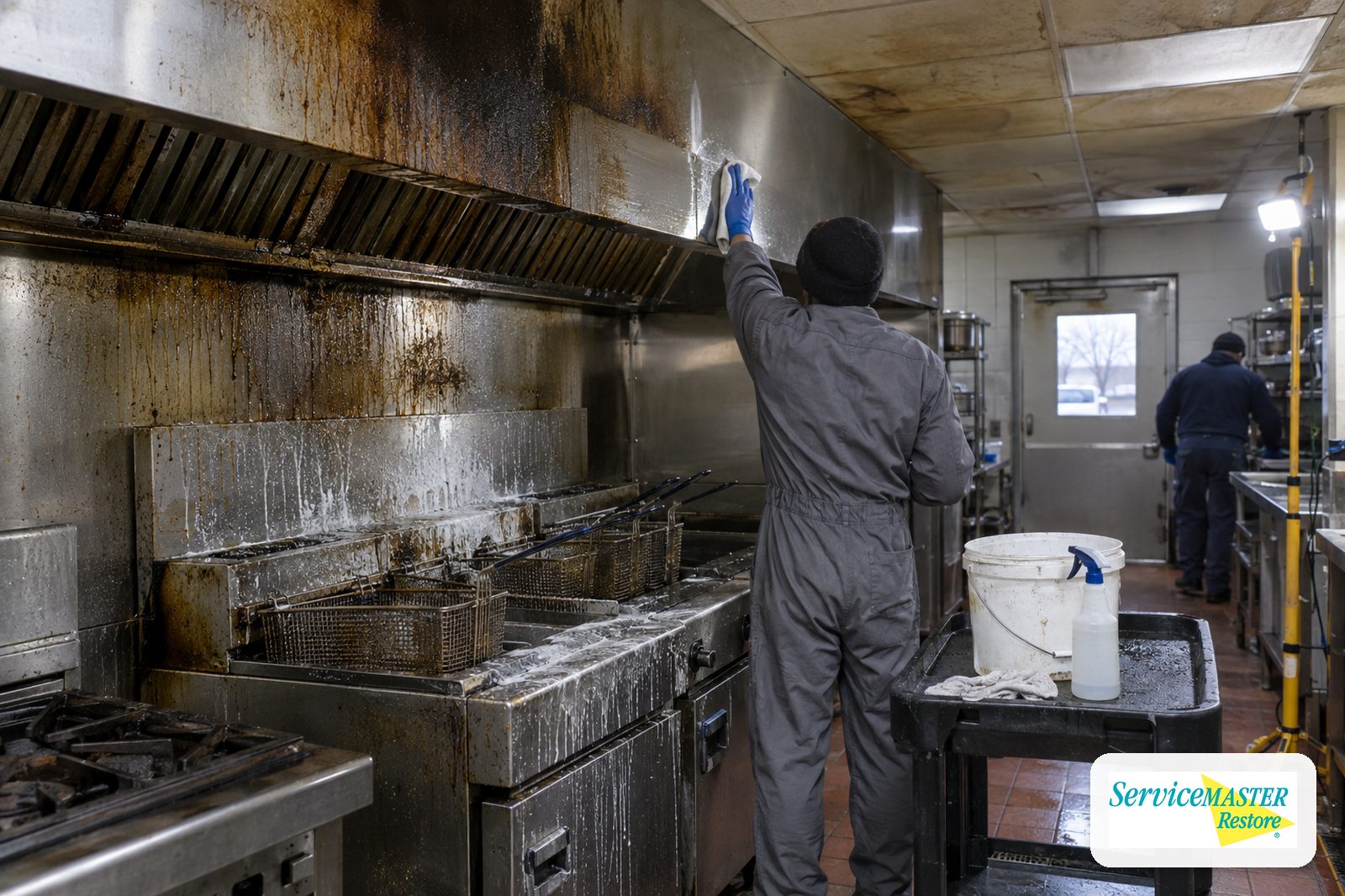
Restaurant fire damage restoration means removing greasy soot and odor from the kitchen, hood, ducts, and dining room, throwing out exposed food, cleaning and sanitizing every food-contact surface, and getting the suppression system serviced. Before you reopen, the fire code official and your county health department will usually need to sign off.
Restaurant fires are common and usually small. Small doesn’t mean harmless. A fryer flare-up that never leaves the cook line can still coat the kitchen in sticky residue, discharge the hood system, and leave a smell customers notice. This guide is for owners in Naperville, Downers Grove, Lisle, Lockport, Bolingbrook, and the rest of DuPage and Will County. It covers why kitchen fires start, what the codes say about hoods and ducts, and how to get back to a passed inspection. We have handled commercial fire losses here for over 20 years, and the sources below are the same codes your inspectors use.
How often restaurant fires happen, and why
The U.S. Fire Administration estimates that about 5,600 restaurant fires were reported to U.S. fire departments each year from 2011 to 2013, causing roughly $116 million in property damage a year. Cooking was “by far the leading cause,” at 64% of restaurant fires. Heating and electrical malfunction came in at 7% each (USFA, Restaurant Fires data snapshot).
The National Fire Protection Association’s fact sheet Structure Fires in Eating and Drinking Establishments (Richard Campbell, 2010–2014 data) estimates 7,410 such fires a year. Cooking equipment caused 61%. Deep fryers were involved in 21% and ranges or cooktops in 14%. And failure to clean was a factor in 22% of these fires (NFPA fire statistical reports).
Most of these fires stay small: USFA found 67.9% never spread beyond the object where they started, such as one fryer. That is why owners are often surprised by how much cleanup a “small” fire leaves. For ignition sources in offices, warehouses, and retail, see our guide to causes of commercial fires.
Leading causes of U.S. restaurant fires, 2011–2013
Share of an estimated 5,600 restaurant fires per year
Cooking 64%
Heating 7%
Electrical malfunction 7%
Unintentional, careless actions 4%
Appliances 4%
Other heat 3%
Bars are scaled to the largest value. Remaining causes were each under 3% and total about 23%. Source: U.S. Fire Administration, Restaurant Fires (2011–2013) data snapshot.
Grease, hoods, and ducts: what NFPA 96 expects
Commercial cooking under a hood is governed by NFPA 96, the Standard for Ventilation Control and Fire Protection of Commercial Cooking Operations. Local fire officials enforce it through the codes their communities adopt, so editions and amendments can differ from one town to the next.
Inspection frequency depends on how you cook
NFPA 96 requires the entire exhaust system to be inspected for grease buildup by a “properly trained, qualified, and certified” person on a schedule tied to cooking type and volume. The table below is reproduced from NFPA’s own code-development record (NFPA 1 / NFPA 96 extract).
| Type or volume of cooking | Inspection frequency |
|---|---|
| Solid fuel cooking (wood, charcoal) | Monthly |
| High volume: 24-hour cooking, charbroiling, wok cooking | Quarterly |
| Moderate volume | Semiannually |
| Low volume: churches, day camps, seasonal businesses, senior centers | Annually |
This is an inspection schedule. When an inspection finds grease contamination, those parts must be cleaned; a measured depth of 0.078 inch (2,000 microns) triggers cleaning. Each inspection or cleaning leaves a certificate on site with the company, technician, and date, plus a written report of areas not cleaned. Keep those records. After a fire, your adjuster and fire marshal may ask for them.
Wet chemical systems and Class K extinguishers
NFPA 96 treats the automatic system over your cooking line as primary protection and portable extinguishers as backup, and requires the system to be maintained by a certified person at least every six months. Most of these systems use a wet chemical agent that forms a soapy foam on hot oil, smothering and cooling it (saponification). Grinnell Mutual’s loss-control bulletin notes dry chemical extinguishers “are not sufficient” for vegetable-oil fires because the oil can re-flash. The same bulletin says NFPA 10 requires extinguishers protecting these appliances to be listed for Class K fires, within 30 feet of travel from the cooking equipment (Grinnell Mutual, Class K extinguishers). NFPA 96 also calls for a placard near each Class K extinguisher stating that the fixed system should be activated before the extinguisher is used (NFPA 96 First Draft Report).
After a discharge, a qualified suppression contractor must service and recharge the system before you cook again. A restoration crew cleans the residue; it does not certify your fire system.
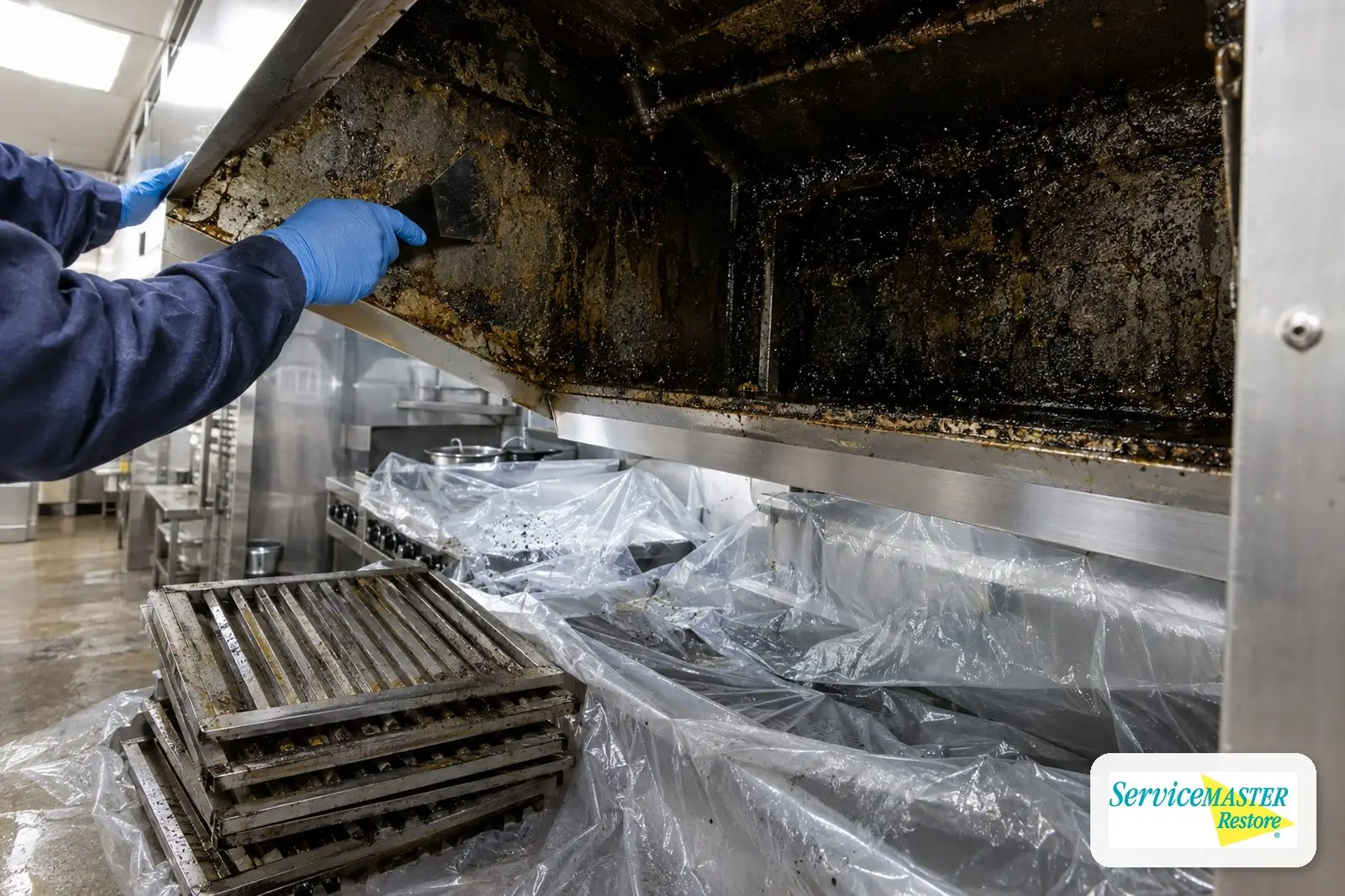
What to do after a restaurant kitchen fire
This order draws on USFA recovery guidance and the FDA Food Code. Our step-by-step guide for business owners after a fire goes deeper on the first 48 hours.
- Stay out until the fire department clears the building. USFA warns a damaged building may not be as safe as it looks; don’t restore utilities firefighters shut off (USFA, After the Fire).
- Stop serving and call the health department. The FDA Food Code, a model many health agencies follow, says to discontinue operations and notify the regulatory authority when a fire may create an imminent health hazard, and to get approval before resuming (FDA Food Code 2022, sections 8-404.11 and 8-404.12). In DuPage County that means the DuPage County Health Department, which regulates more than 4,000 food service facilities. In Will County, call the Will County Health Department. Confirm which agency holds your permit.
- Call your insurer and document everything. Photograph the line, hood, walk-in, storage, and dining room before anything moves. We can help you work through the insurance claim.
- Secure the space and stop secondary damage. Board up openings and remove firefighting water. Our damage mitigation for businesses and water cleanup after firefighting services handle this phase.
- Schedule the suppression contractor and hood cleaner. The fire system needs service and the hood needs NFPA 96 cleaning before the fire official lets you cook.
- Clean, sanitize, and book re-inspections. Once soot, odor, and food-contact surfaces are done, call the health department and fire official.
Greasy protein soot: why kitchen residue is different
A grease fire doesn’t leave the dry, powdery soot of a paper or wood fire. Burning fat and food leave an oily film on stainless steel, ceiling tiles, fixtures, and the hood plenum. Restorers often describe burned protein (meat, poultry, fish) residue as faint and yellowish but heavy on odor. We break down these residue types in our post on types of smoke damage.
Oily residue smears under a dry cloth or the wrong cleaner, pushing it into porous surfaces. Professional smoke and soot cleanup identifies the residue first, then works top-down with degreasers matched to each surface. Lingering odor gets its own treatment through odor removal and air quality treatment. The IICRC published its first fire and smoke standard, ANSI/IICRC S700, in 2025. It covers assessing fire residues and odors in buildings, systems, and contents, plus cleaning and odor management (IICRC S700).
Check the places nobody looks: above the drop ceiling, the HVAC return, the makeup air unit, and the dining room. Skip them and the odor tends to return on the first warm day.
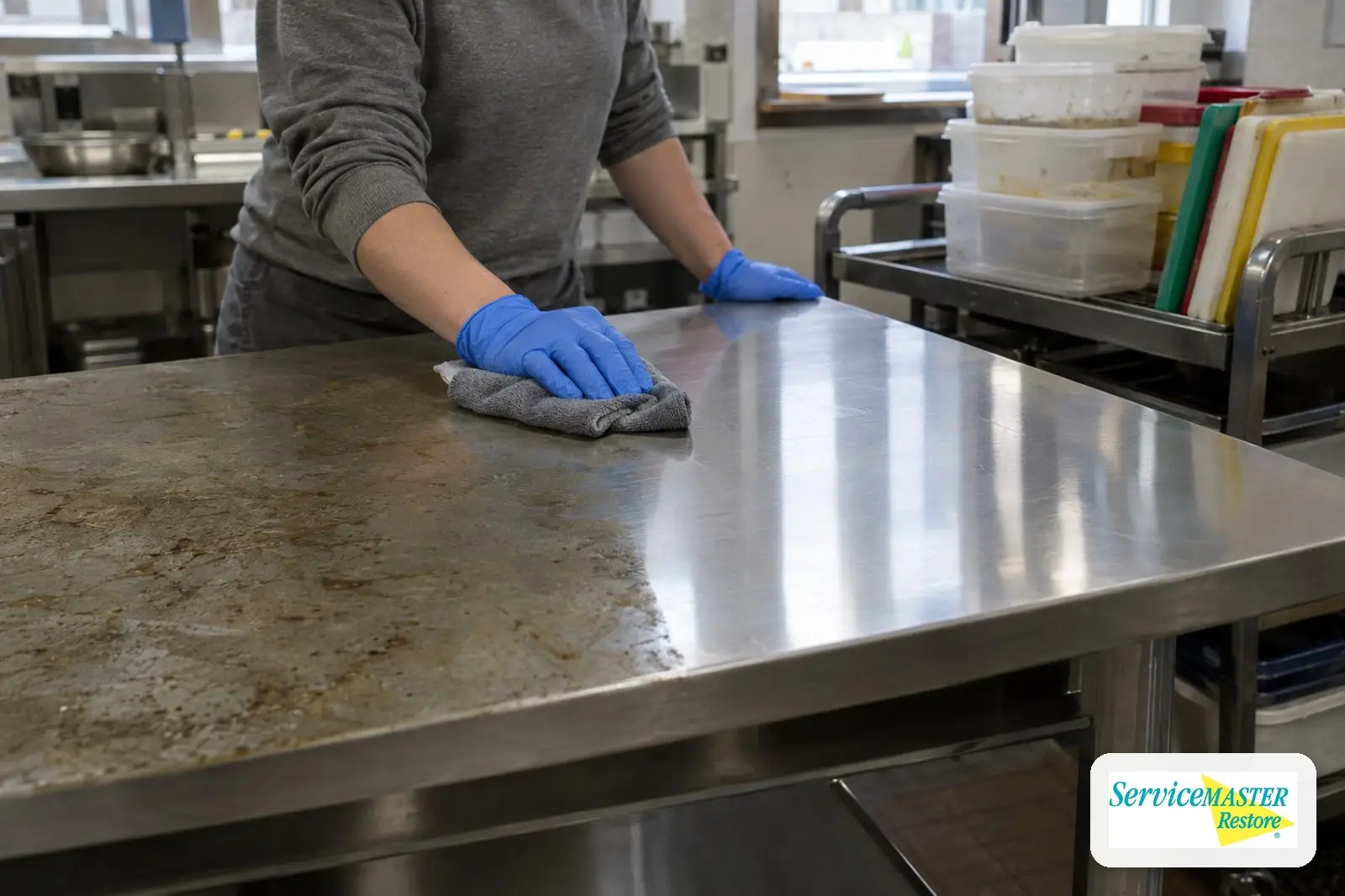
Food and food-contact surfaces: discard, clean, sanitize
USDA’s Food Safety and Inspection Service says food near a fire can be ruined by heat, smoke fumes, or firefighting chemicals. Discard food in permeable packaging such as cardboard or plastic wrap; refrigerators aren’t airtight, so smoke can reach chilled food too. Food touched by firefighting chemicals goes, since washing won’t remove them. Exposed cookware can be washed in strong detergent, then soaked 15 minutes in 1 tablespoon of unscented chlorine bleach per gallon of water (USDA FSIS, Fires and Food Safety).
For a restaurant, that usually means:
- Discard permeable dry goods, produce, and anything smelling of smoke, after documenting it for your adjuster.
- Inspect cans for bulging, rust, or heat damage, and discard any that were close to the fire.
- Clean prep tables, cutting boards, slicers, and smallwares, then sanitize. The FDA Food Code requires food-contact surfaces to be sanitized after cleaning and before use.
- Have the walk-in and ice machine checked; both trap soot and odor.
Your health inspector makes the final call. When in doubt, throw it out.
How to keep downtime as short as possible
Nobody can honestly promise a reopening date before seeing the damage, but these habits save time:
- Run trades in parallel. Restoration, hood cleaning, suppression service, and electrical repairs can often overlap with one coordinator.
- Contain the work. If the dining room was barely touched, ask whether it can be sealed off and whether limited operations are allowed. Rules vary, so ask first.
- Have your paperwork ready. Hood certificates, suppression tags, and your permit number speed re-inspection.
- Book inspections early. Call inspectors once you have a realistic finish date, not after the last wipe-down.
Our post on business continuity during commercial restoration covers phased reopenings. For the full cleanup sequence, see the fire and smoke restoration process.
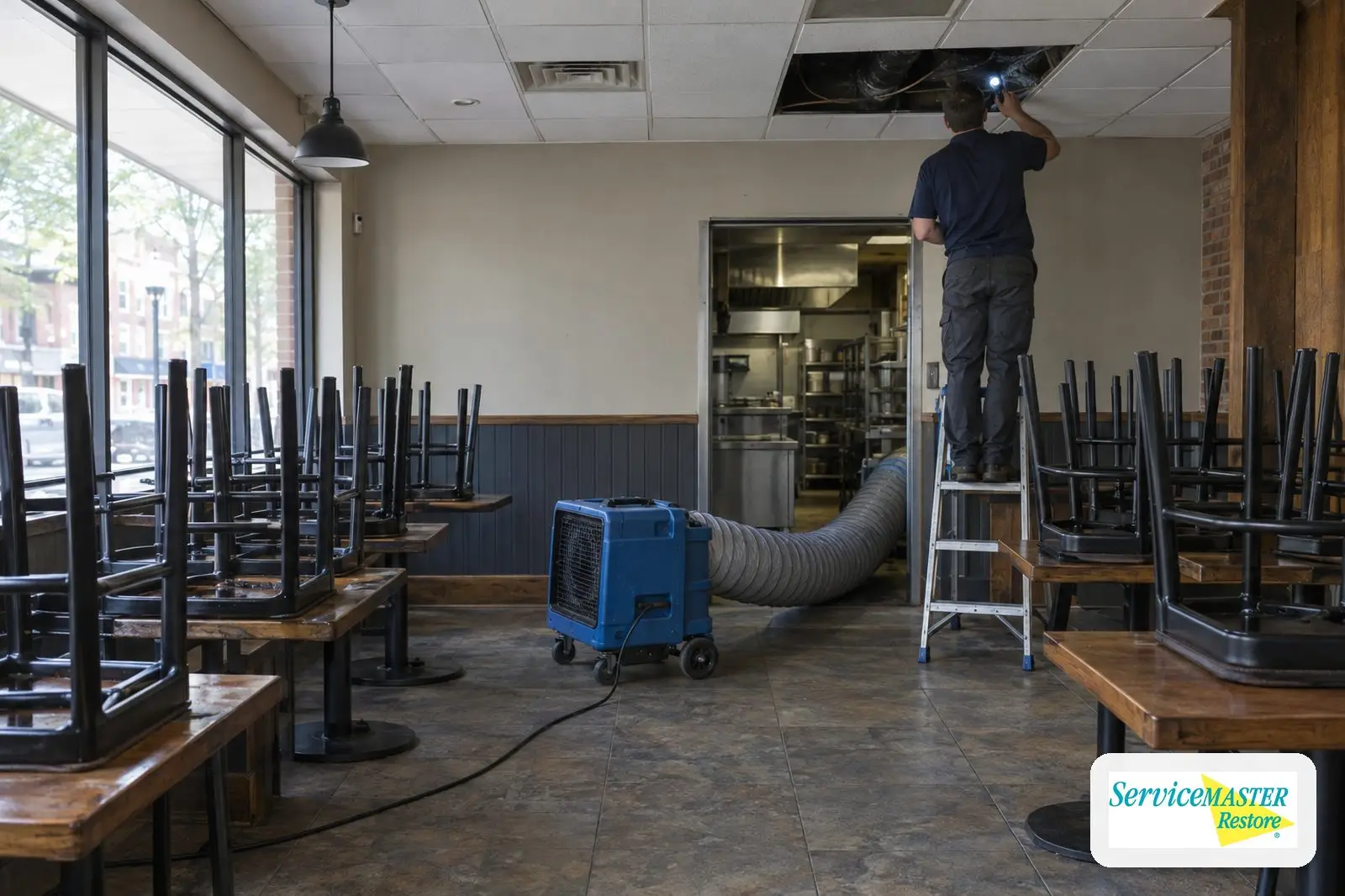
Insurance and business interruption
Property coverage typically pays for physical damage; lost revenue is a separate piece. The Insurance Information Institute describes business interruption (business income) insurance as coverage that replaces lost revenues when a business shuts down due to fire or other covered losses, often as part of a business owners policy (Triple-I, Understanding business owners policies).
Policies vary on waiting periods, coverage length, and whether spoiled food and extra expenses are included. Ask your agent or adjuster, and keep daily sales records from before and after the fire. This section is general education, not legal or insurance advice. Check your own policy.
Local pages cover fire damage restoration in Naperville, fire damage restoration in Lockport, and fire damage restoration in Glen Ellyn. For everything else, start with our commercial fire restoration page.
Frequently Asked Questions
How long does it take to reopen a restaurant after a kitchen fire?
It depends on how far smoke and grease spread, whether the hood system discharged, and how quickly inspections can be scheduled. A fire confined to one appliance may need only cleaning, suppression service, and re-inspection. Structural or electrical damage takes much longer. Running restoration, hood cleaning, and suppression service in parallel, then booking health and fire inspections early, is the most reliable way to shorten the timeline.
Do I need a health inspection before reopening after a fire?
Usually, yes. The FDA Food Code, which many health agencies use as a model, says operations should stop after a fire that may create an imminent health hazard and resume only with regulatory approval. In DuPage County, contact the DuPage County Health Department. In Will County, contact the Will County Health Department. Your local fire official will typically need to approve the cooking line and suppression system too.
How often should a restaurant hood and duct system be cleaned?
NFPA 96 sets inspection frequency by cooking type: monthly for solid fuel, quarterly for high-volume cooking such as 24-hour kitchens, charbroiling, or woks, semiannually for moderate volume, and annually for low-volume operations. Cleaning is required whenever an inspection finds grease contamination. Your local fire code may set stricter rules, so confirm with your fire official.
Can food be saved after a restaurant fire?
Some can, but much of it can’t. USDA guidance says to discard food in permeable packaging, food exposed to firefighting chemicals, and anything heat may have affected, including cans that were close to the fire. Refrigerators aren’t airtight, so smoke can reach chilled food. Your health inspector has the final word. If you aren’t sure about an item, throw it out.
Does business insurance cover lost income after a kitchen fire?
It can, if your policy includes business interruption (business income) coverage. The Insurance Information Institute says this coverage replaces lost revenue when a covered loss like fire forces you to close, and it is often part of a business owners policy. Waiting periods, limits, and covered expenses vary widely, so review your policy with your agent or adjuster.
Related guides and services
- Commercial fire damage restoration services
- Smoke and soot cleanup
- Damage mitigation for businesses
- Odor removal and air quality treatment
- Help with your fire insurance claim
- What to do after a fire at your business
- Causes of commercial fires and how to prevent them
- Types of soot and smoke damage
- All restoration guides
Kitchen fire at your restaurant? Our certified technicians serve restaurants and commercial kitchens across DuPage and Will County from our Lisle office, and we work with your insurance company. Call (630) 241-1111, 24/7, or contact us online.
Sources
- U.S. Fire Administration (FEMA): Restaurant Fires (2011–2013), data snapshot
- National Fire Protection Association: Structure Fires in Eating and Drinking Establishments fact sheet (R. Campbell, 2010–2014 data), via NFPA fire statistical reports
- NFPA: NFPA 1 code-development record extracting NFPA 96 inspection, maintenance, and cleaning requirements
- NFPA 96 First Draft Report (fire-extinguishing equipment and Class K placard)
- U.S. Fire Administration: After the Fire, Returning to Normal
- U.S. Food and Drug Administration: Food Code 2022
- USDA Food Safety and Inspection Service: Fires and Food Safety
- DuPage County Health Department: Environmental Health and Food Safety
- Will County Health Department: Food Safety
- IICRC: ANSI/IICRC S700 Standard for Professional Fire and Smoke Damage Restoration
- Grinnell Mutual: Class K Fire Extinguishers loss-control bulletin
- Insurance Information Institute: Understanding business owners policies