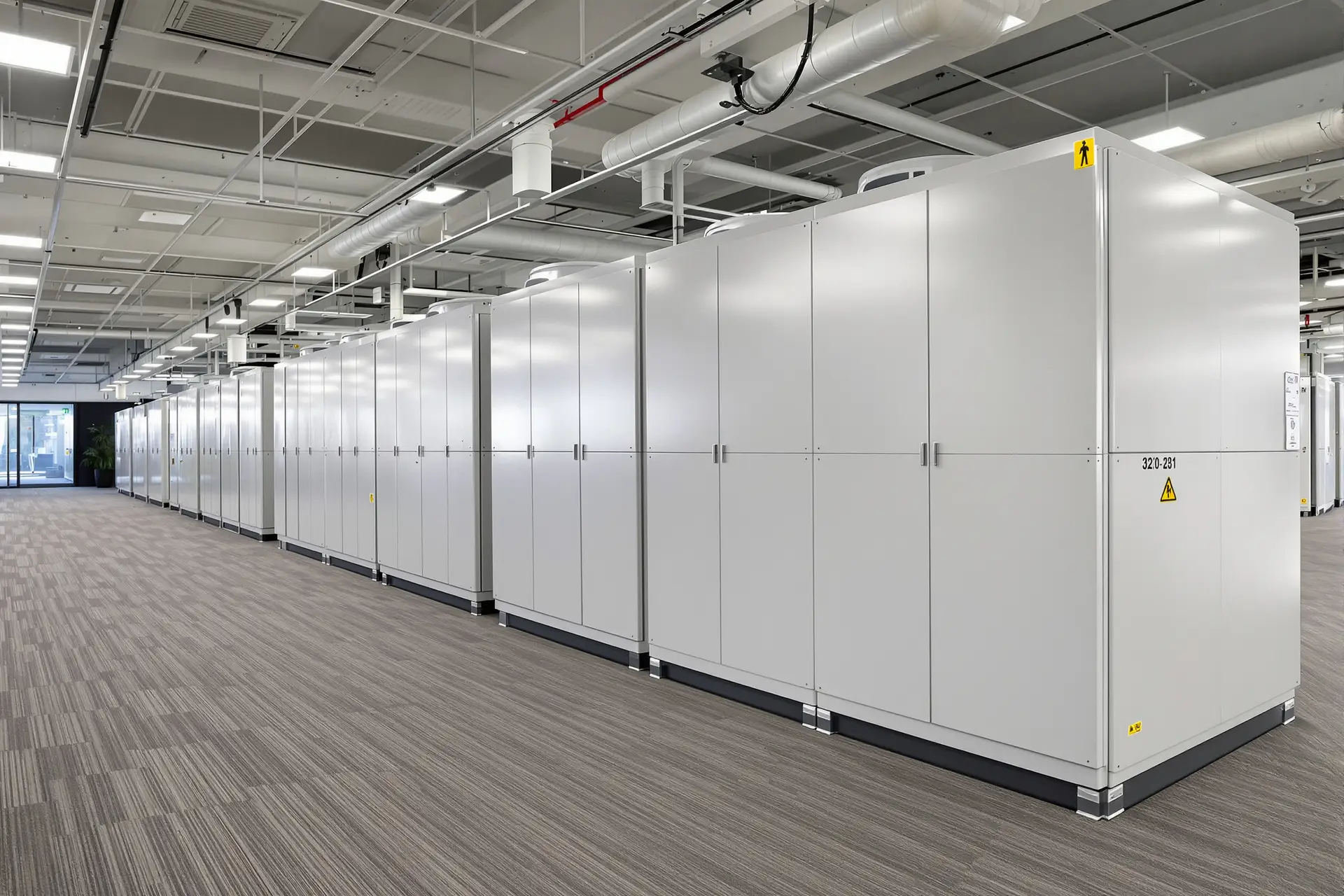
Commercial restoration is the emergency mitigation and repair of water, fire, or storm damage
to a business property — offices, retail, and warehouses — engineered around keeping you
open. For DuPage and Will County companies, it means 24/7 large-loss response, rapid structural drying,
and claim-ready documentation that shortens downtime and protects revenue.
When a supply line lets go above a suspended ceiling on a Friday night, or a rooftop unit fails and
soaks two floors of office over a long weekend, the damage to the building is only half the problem.
The other half is every hour the doors stay closed: payroll that runs whether or not anyone can work,
customers who go somewhere else, tenants asking when they can get back in, and a landlord or lender
who wants a plan. For a business, restoration is not really about drying drywall. It is about getting
back to operating — and doing it in a way that stands up to an insurance adjuster.
That is a different discipline from residential work, and it is where most local restoration
companies are thin. ServiceMaster Restoration Services has handled commercial and residential losses
across DuPage and Will County for 20+ years, with IICRC-aligned certified technicians on call 24/7 at
(630) 241-1111. This guide explains how commercial restoration
differs, how the right response protects business continuity, what the process actually looks like
step by step, and how it intersects with your commercial property and business-interruption coverage.
Why commercial restoration is different
Homeowners and business owners both want the same outcome — a clean, dry, safe building —
but the path to it is genuinely different at commercial scale. Four things change the job: scale,
speed, occupancy, and documentation.
Scale and complexity
A commercial loss is rarely a single room. A burst pipe in a multi-story office in Naperville can send
water through ceiling tiles, into wall cavities, down stairwells, and across open floor plates before
anyone arrives. Warehouses in Bolingbrook and Romeoville hold thousands of square feet of open space,
racked inventory, and concrete slabs that hold moisture. Retail spaces in Downers Grove and Wheaton mix
sales floors, stockrooms, and mechanical areas. Drying that much square footage on a tight timeline
takes commercial-grade air movers and desiccant or refrigerant dehumidifiers in quantity — not
the handful of units that would dry a basement. It also takes crew size and logistics that a
residential-first outfit often cannot muster after hours.
Speed, because downtime is the real cost
In a home, the clock that matters most is the 24–48 hour window before mold begins to grow. That
clock runs in a commercial building too — the EPA is specific that “if wet or damp materials or
areas are dried 24-48 hours after a leak or spill happens, in most cases mold will not grow”
(EPA)
— but a business is also bleeding money the whole time it is closed. Every hour the storefront is
dark or the production line is down is lost revenue that no amount of later repair recovers. That is why
commercial mitigation is measured in a fast, staged response: stabilize and stop the damage first, then
dry aggressively, then rebuild — often in ways that let part of the operation reopen while work
continues elsewhere.
Occupancy and safety while you operate
Businesses frequently cannot — and do not want to — fully shut down. A dental practice needs
its front two operatories; a distribution center needs its shipping dock; an office needs a floor its
people can safely use. Commercial restoration is planned around occupancy: containment barriers that
seal the work zone from the working zone, negative-air machines to keep dust and odor contained,
walk-off paths, night and weekend scheduling, and clear coordination with facility managers and
building engineers. Doing this safely around employees and customers means OSHA-aware work practices,
proper signage, and control of slip, air-quality, and electrical hazards throughout.
Documentation for the claim — and for everyone who asks
A commercial claim has more stakeholders than a homeowner’s: the property carrier, possibly a separate
business-interruption adjuster, a property manager, tenants, and sometimes a lender or corporate risk
department. All of them want proof. Professional restorers document moisture readings, affected areas,
equipment placement, drying logs, and photos to a standard adjusters recognize. The water-restoration
industry standard, IICRC S500, exists precisely so contractors and insurers share a common framework
for drying and documentation.
(IICRC)
Good documentation is not busywork — it is what gets the claim paid and the restoration period
justified.
Business continuity & minimizing downtime
The businesses that come through a loss best are the ones that treated recovery as a plan, not a scramble.
FEMA’s Ready.gov puts it plainly: “Being prepared in advance is a critical step to responding to an
emergency and keeping your business and employees safe.”
(Ready.gov, Business)
The agency recommends that companies “organize a business continuity team and compile a business
continuity plan to manage a business disruption,” and that the plan “encompass as much as possible of
what a business might need during an emergency,” including communications, IT support and recovery, and
continuity of operations.
(Ready.gov, Business Continuity Planning)
Restoration is one piece of that continuity plan — the piece that turns a damaged building back
into a working one. The relationship between how fast mitigation begins and how much downtime you absorb
is the whole argument for a 24/7 responder. Water and smoke do not pause overnight; they migrate,
saturate, corrode, and set in. Getting extraction and drying started in hours rather than days keeps a
recoverable loss from cascading into gutted walls, ruined inventory, and a weeks-long closure.
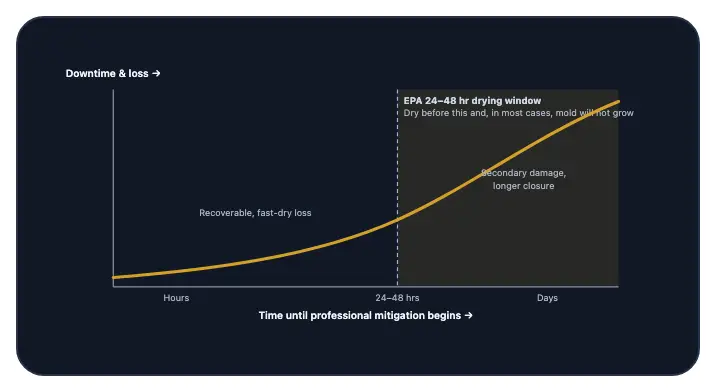
the EPA’s 24–48 hour drying window — dry wet materials within it and, in most cases, mold
will not grow. Source: EPA, “A Brief Guide to Mold, Moisture and Your Home.”
A few practical moves keep a commercial disruption from spiraling, and a good restoration partner
supports every one of them:
- Have the number before you need it. Program a 24/7 emergency restoration line into
your facility contacts now. The middle of a 2 a.m. flood is the wrong time to be comparing
quotes. - Stabilize first. Emergency board-up, roof tarping, and water shutoff stop the loss
from growing while a full plan comes together. - Reopen in phases. Containment lets an unaffected wing, floor, or sales area keep
running while drying and rebuild proceed behind barriers. - Protect the record. Photograph and inventory damage immediately; it feeds both the
restoration scope and the insurance claim. - Keep people informed. Employees, customers, and tenants all need to know the plan
— Ready.gov flags communications as a core part of continuity.
For an operations-first look at stopping a loss from getting worse, see our overview of
damage mitigation for businesses.
The commercial restoration process, step by step
Whether the trigger is water, fire, or storm, the sequence a professional crew follows is consistent.
Understanding it helps you know what to expect — and what a thorough job looks like.
1. Emergency response and assessment
It starts with a live answer and a fast dispatch. On arrival, the crew makes the site safe —
de-energizing wet electrical, addressing standing water and slip hazards — then performs a full
assessment: mapping the source, the extent of migration with moisture meters and thermal imaging, and
the affected materials and contents. This is also when emergency stabilization happens: stopping the
water, tarping a roof, or boarding up openings after a fire so the building is secure and weather-tight.
The assessment becomes the scope of work and the first entry in the documentation trail.
2. Mitigation: extraction, source control, and content protection
Mitigation is everything that limits further damage. Truck-mounted and portable extractors pull
standing water out fast; salvageable contents, inventory, documents, and equipment are moved, protected,
or set out for specialized cleaning. For fire and smoke losses, this stage includes removing debris and
soot-laden materials and beginning odor control. The goal is simple: get the affected area from
“actively getting worse” to “stable and ready to dry” as quickly as possible.
3. Large-scale structural drying
This is where commercial capability shows. Crews deploy air movers and dehumidifiers — often
high-capacity desiccant units for big open volumes like warehouses — sized to the space and the
water class. Then they monitor. Technicians take moisture readings at fixed points and log them daily,
because the readings, not the calendar, decide when framing, subfloor, slab, and wall cavities are
genuinely dry. This staged, measured approach is the core of IICRC S500 and is what keeps a
hidden-moisture problem from becoming next month’s mold remediation.
4. Cleaning, sanitizing, and deodorizing
Once materials are dry, surfaces are cleaned; where water was contaminated (Category 2 or 3) or fire
left soot and residue, antimicrobial and deodorization treatments are applied. Smoke odor in particular
takes dedicated work — it embeds in porous materials and HVAC systems — and is a common
reason a space “looks fine but doesn’t smell right” after a rushed cleanup.
5. Rebuild (reconstruction)
Whatever had to be removed gets put back: drywall, flooring, ceilings, paint, fixtures, and finishes,
returning the space to pre-loss condition. Handling mitigation and reconstruction under one roof keeps
the timeline tight and avoids the gap where a business sits dried-out but not usable, waiting on a
separate contractor.
6. Reopening and final walkthrough
The last step is verifying the space is safe, dry, clean, and ready, then walking it with the owner or
facility manager and closing out the documentation package for the insurer. For phased projects, areas
are handed back as they finish so the business can return to normal in stages rather than all at once.
For the full commercial water workflow, see our
commercial water damage restoration hub; for
fire and smoke, see commercial fire damage restoration.
Water or fire loss at your business right now?
ServiceMaster Restoration Services responds 24/7 across DuPage & Will County — Naperville,
Lisle, Downers Grove, Bolingbrook, Aurora and beyond. IICRC-aligned certified technicians, large-loss
capacity for offices, retail, and warehouses, and we work directly with your insurance carrier. Call
(630) 241-1111 or
request emergency service. The sooner mitigation starts, the sooner you reopen.
Insurance & business-interruption coverage
Two different policies usually come into play after a commercial loss, and it helps to know which does
what. Your commercial property coverage handles the physical damage — the
building and its contents. Your business-interruption (business income) coverage
handles the money you lose while you cannot operate. They work together, and both hinge on how well the
loss is documented and how quickly the property is restored.
According to the Insurance Information Institute, business income coverage can help pay for “lost net
income (based on financial records),” plus “mortgage, rent and lease payments,” “loan payments,”
“taxes,” and “employee payroll” while you are shut down.
(Insurance Information Institute)
An “extra expense” extension can cover costs like “renting a temporary place of business while the
original place of business is being restored” and replacing hardware, technology, and furniture.
A crucial detail: this coverage is tied to a restoration period. The III notes that
“typically, there’s a 48 to 72-hour waiting period before the period of restoration kicks in,” and that
“the standard property policy limits the business income restoration period to 30 days,” extendable “to
360 days by endorsement.” In other words, the meter on your lost income runs against the time it takes
to restore the property — which is one more reason fast, well-documented mitigation is not just a
building decision but a financial one.
Know the gaps, too. The III is clear that business interruption does not cover “flood or
earthquake damage, which are covered by a separate policy,” nor “pandemics, viruses, or communicable
diseases.” And like homeowners policies, commercial property coverage generally responds to sudden and
accidental events rather than gradual leaks or deferred maintenance, and flood is a separate policy
entirely. Every policy is different, so confirm your specific terms, limits, deductibles, and
endorsements with your agent or carrier rather than assuming.
ServiceMaster works with all major insurance carriers and documents commercial losses to the standard
adjusters expect — moisture logs, photos, and a clear scope — which helps your claim move
and supports the restoration period your business-interruption coverage is measured against. For help
navigating the paperwork, see our insurance claim assistance
page. We do not provide legal or coverage advice; we make sure the loss is captured accurately so your
professionals can do their part.
Frequently Asked Questions
What is commercial restoration?
Commercial restoration is the emergency mitigation and repair of a business property after water,
fire, smoke, or storm damage — offices, retail, warehouses, and industrial spaces. Beyond
cleanup and structural drying, it is planned around keeping the business operating: phased reopening,
containment so unaffected areas stay usable, and documentation built for a commercial insurance
claim. It is a larger-scale, faster, more coordinated version of residential restoration.
How fast can a business reopen after water or fire damage?
It depends on the size and class of the loss, but speed of response is the biggest lever you control.
Because the EPA notes that drying wet materials within 24–48 hours in most cases prevents mold,
mitigation that starts within hours keeps damage recoverable and shortens the closure. Many businesses
reopen in phases — an unaffected floor or sales area returns first behind containment —
rather than waiting for the entire project to finish.
What is large-loss drying, and why does it need special equipment?
Large-loss drying is structural drying at commercial scale — think multiple floors of office or
thousands of square feet of warehouse. It requires commercial-grade air movers and high-capacity
dehumidifiers (often desiccant units for big open volumes), deployed in quantity and monitored with
moisture meters against the IICRC S500 standard. Household or small-shop equipment cannot move enough
air or remove enough moisture to dry that much space within the window that prevents mold.
Who do I call for after-hours commercial restoration in DuPage or Will County?
Call a restoration company that answers live, 24/7, and can dispatch a crew immediately —
because water and smoke keep spreading overnight. ServiceMaster Restoration Services provides 24/7
emergency response across DuPage and Will County, including Naperville, Lisle, Downers Grove, Wheaton,
Bolingbrook, Aurora, Plainfield, and Lockport, at (630) 241-1111.
Programming that number into your facility contacts in advance saves critical time.
Does business-interruption insurance cover lost income while we’re closed?
Often, yes. The Insurance Information Institute explains that business income coverage can help pay
lost net income and continuing expenses — rent or mortgage, loan payments, taxes, and payroll
— during the restoration period, typically after a 48 to 72-hour waiting period. It does not
cover flood, earthquake, or communicable-disease losses, and terms vary by policy. Confirm your
specific coverage, limits, and endorsements with your carrier or agent.
Commercial losses are stressful and expensive, but they are survivable when the response is fast,
coordinated, and documented. If your business has taken on water or fire damage anywhere across DuPage
or Will County, our crews are ready around the clock.
This article is general information for DuPage & Will County businesses, not legal, insurance, or
coverage advice. Insurance policies vary — confirm your specific commercial property and
business-interruption terms, limits, and endorsements with your own carrier or agent. ServiceMaster
Restoration Services · HQ 924 Ogden Ave, Lisle, IL ·
(630) 241-1111 · serving DuPage & Will County, 24/7,
residential and commercial.