
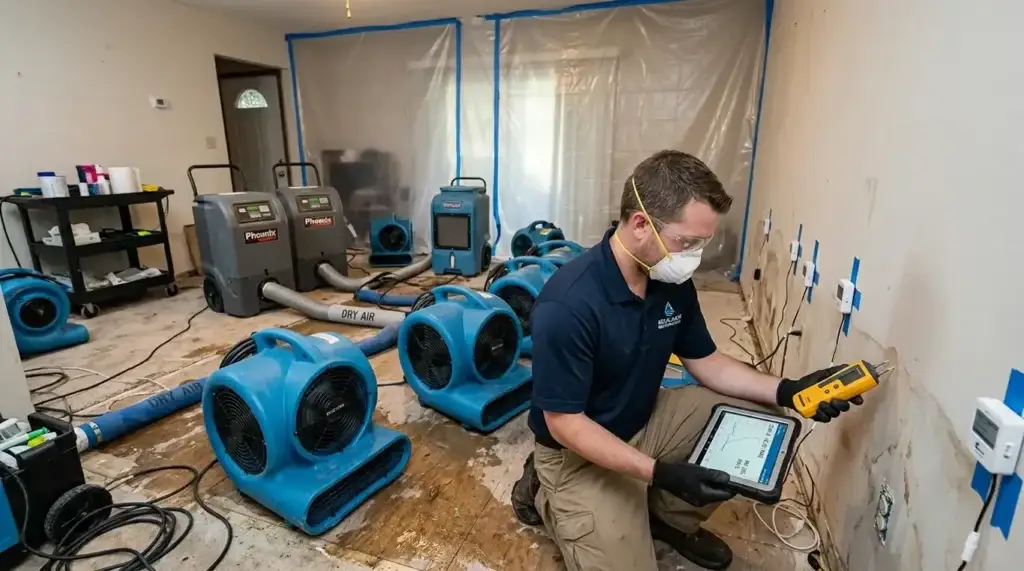


What is water damage, and how is it handled in DuPage County?
Water damage is harm caused when water soaks materials that should stay dry, such as drywall, framing, flooring, insulation and contents. Under the ANSI/IICRC S500 standard, restorers rate it by contamination (Category 1, 2 or 3) and by drying load (Class 1 to 4). The EPA advises drying wet materials within 24 to 48 hours to prevent mold.
This page is the starting point for every kind of water problem, from a slow drip under a sink to a flooded lower level. Below we explain where water damage comes from in Chicago-suburb buildings, how professionals classify it, what to do before help arrives and which of our water services fits your property.
What causes most water damage in Chicago-suburb homes and businesses?
The climate in DuPage and Will County works against buildings from two directions. Freeze-thaw winters split exposed pipes and build ice dams on roofs, and heavy summer thunderstorms push water toward basements faster than gutters, sump pumps and storm sewers can carry it away. Add the area's many finished basements and some older housing stock, and the usual causes look like this:
- Plumbing and appliances. Supply lines, water heaters, washing machine and dishwasher hoses, and refrigerator ice makers. The Insurance Information Institute recommends checking those hoses every year.
- Frozen and burst pipes. A split line can run for hours if nobody is home. Our burst and leaking pipe service covers locating and containing the leak.
- Storm water and seepage. Saturated soil, full window wells and failed sump pumps put water on the floor. See basement water damage for that scenario.
- Roof leaks and ice dams. When meltwater cannot drain through the gutters, it can seep into the house and drip from ceilings and walls.
- Sewer and drain backups. These are contaminated losses. Our guide to sewage backup cleanup and Category 3 water explains why they are handled differently.
- Commercial building systems. Fire sprinkler lines, rooftop equipment and shared plumbing stacks in offices and multi-unit buildings.
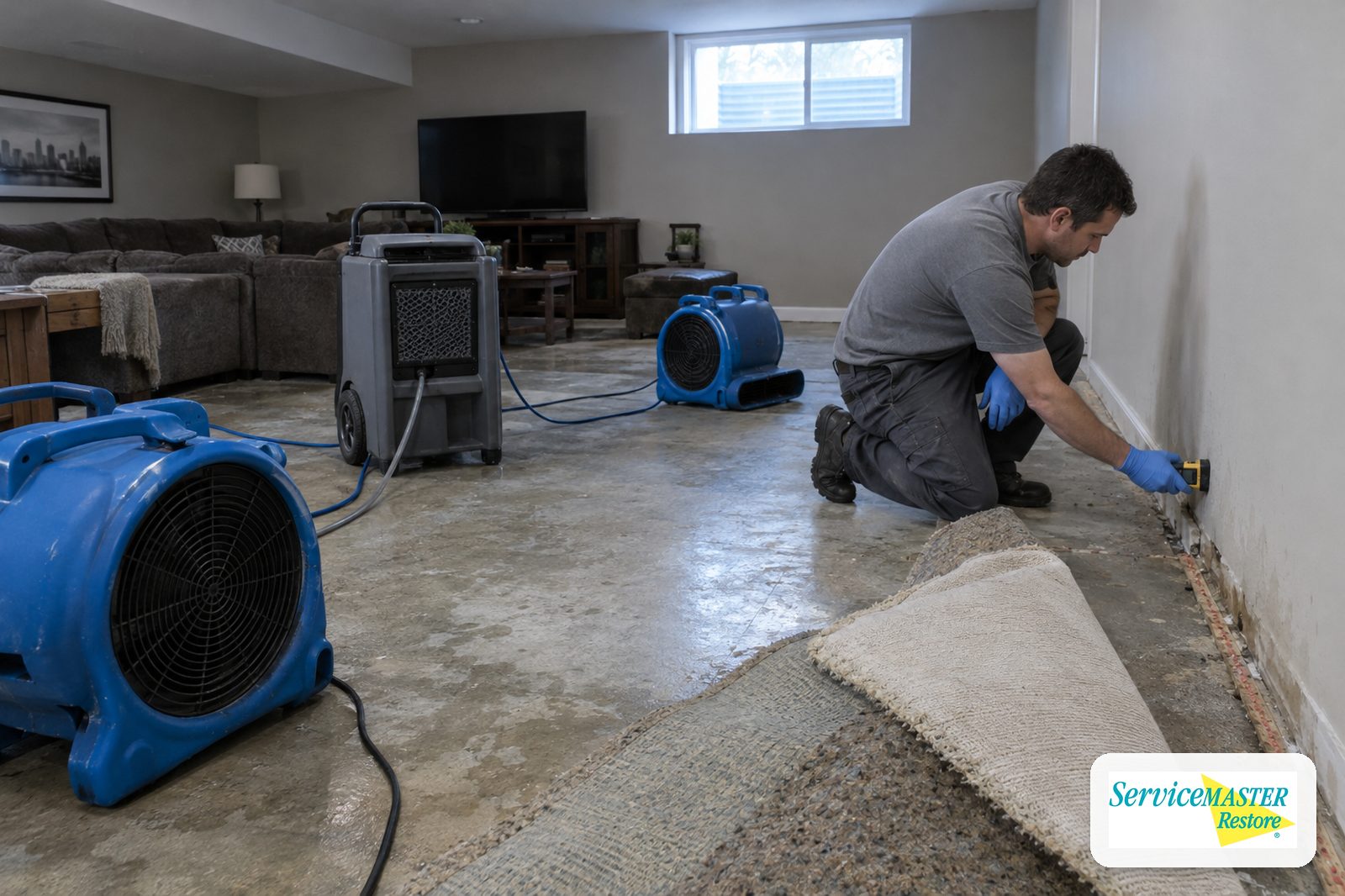
Finished basements raise the stakes
Carpet, pad, drywall and wood framing sit exactly where water collects first. A few inches of water in an unfinished basement is mostly a pumping and drying job. The same water in a finished family room soaks materials that wick it upward and hide it behind baseboards. That is why lower-level losses in Naperville and Lisle homes often need moisture readings above the visible waterline before anyone can say how far the damage goes.
What do Category 1, 2 and 3 water and Class 1 to 4 mean?
The IICRC S500 Standard for Professional Water Damage Restoration, currently the fifth edition published in 2021, uses two separate scales. Category describes how contaminated the water is, which decides whether workers need containment and protective equipment. Class describes how much wet material has to dry, which decides how much dehumidification and air movement the job needs.
| Rating | What it means | Typical examples |
|---|---|---|
| Category 1 | Water from a clean, sanitary source | A broken supply line or a sink overflowing with clean tap water |
| Category 2 | Water with some level of contamination | Discharge from a washing machine, tub or sink drain |
| Category 3 | Grossly contaminated water that can contain harmful agents | Sewage, waste-line backflow from beyond a trap, rising water from rivers or streams |
| Class 1 to 3 | Drying load, estimated from the share of a space's floor, wall and ceiling area that is wet, from lowest (Class 1) to highest (Class 3) | A wet corner of one room compared with a ceiling leak that soaks walls, insulation and carpet |
| Class 4 | Specialty drying of dense, low-porosity materials that hold water deeply | Hardwood, plaster, brick and concrete |
Source: IICRC S500 Consensus Body, Category of Water Damage and Weather-related Events (2026); class summary from R&R Magazine, Six Main Changes in the ANSI/IICRC S500 Fourth Edition.
Two details matter for property owners. First, category is not fixed: the standard notes that time and temperature affect how contaminants multiply, which can change the category of a loss that sits untreated. Second, in a March 2026 position statement the S500 consensus body clarified that wind-driven rain and other weather-related water are not automatically Category 3. The restorer has to inspect and decide based on whether the water is actually grossly contaminated.
What should you do in the first hour after a leak or flood?
- Stop the source. Close the main water shut-off valve. The Insurance Information Institute also explains which water losses standard policies cover, so it helps to know the source.
- Keep people and pets clear. Keep everyone out of areas touched by sewage or floodwater and away from wet electrical equipment.
- Document before you move anything. Take wide photos and video of each room, then close-ups of damaged materials and belongings.
- Move what you safely can. Carry rugs, papers and electronics to a dry area and lift furniture off wet floors.
- Notify your insurer. Ask how to report the loss and whether they need anything before work starts. Our insurance claim assistance page explains how documentation supports a claim.
- Get drying started. The EPA's guide to mold and moisture says that if wet materials are dried 24 to 48 hours after a leak, in most cases mold will not grow. Professional emergency water removal clears standing water so drying can begin.
For a version written for plumbing failures, read what to do in the first hour after a burst pipe.
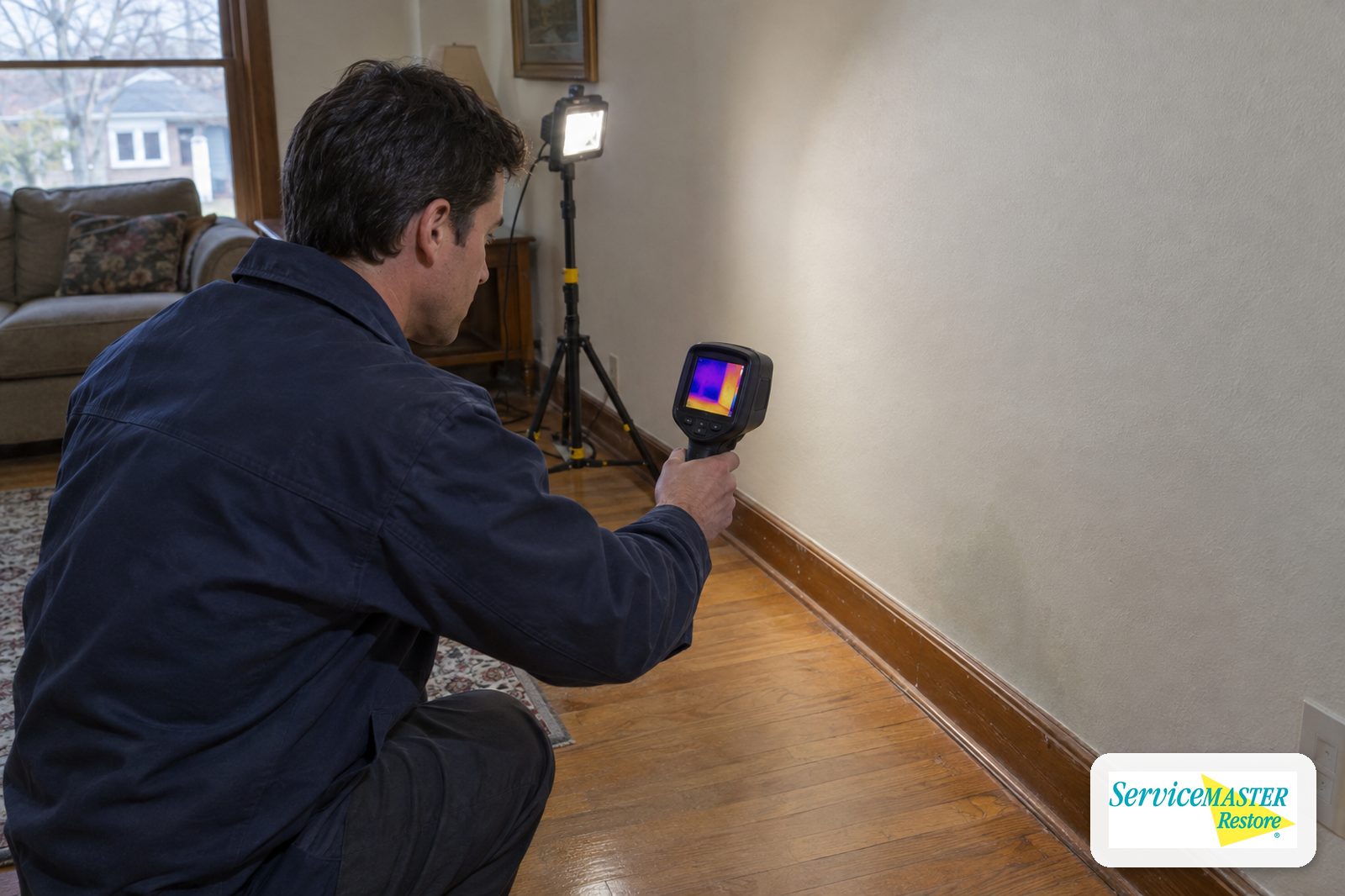
The water you cannot see does the most damage
Water travels under baseboards, into wall cavities and beneath flooring, so a floor that feels dry can sit over a wet subfloor. Restorers use moisture meters and thermal imaging to find where water went, then size structural drying and dehumidification to the actual wet area rather than the visible stain. Skipping that step is how musty odors and mold show up weeks after a job looked finished.
Residential or commercial: which water damage service fits your property?
The drying science is the same in a ranch house and an office building, but the priorities are different.
- Homes, condos and townhomes. Residential water damage restoration focuses on finished basements, appliance leaks, protecting belongings and whether your family can stay home during drying.
- Offices, retail, restaurants and multi-unit buildings. Commercial water damage restoration centers on downtime, tenant communication, larger drying systems and claim documentation.
- Want the full process? Our water damage restoration process page walks through inspection, extraction, drying, monitoring and repair, with typical timelines and cost ranges.
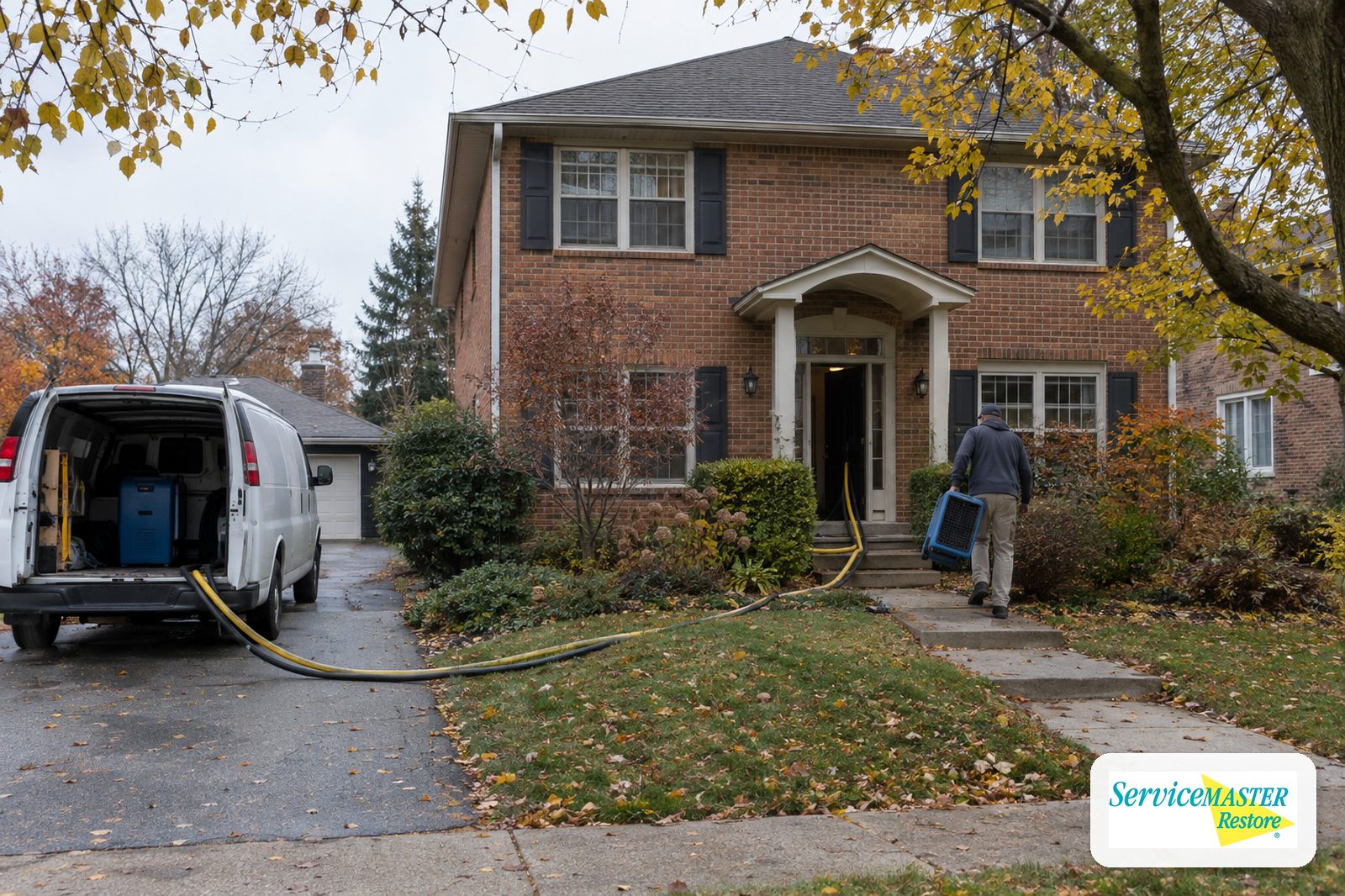
Local help across DuPage and Will County
Our certified technicians work out of our Lisle headquarters on Ogden Avenue and handle residential and commercial water losses throughout both counties, including Hinsdale, Glen Ellyn, Lockport and Woodridge. With more than 20 years in the business, we have seen how quickly a small leak becomes a large repair when drying waits. If you have questions about a specific property, contact our team.
Water on the floor right now? Call (630) 241-1111 any time, day or night, and we will help you take the next step.
Frequently asked questions
What is the difference between a water damage category and a water damage class?
Category describes contamination: Category 1 is clean water, Category 2 has some contamination and Category 3 is grossly contaminated, such as sewage. Class describes the drying load, based on how much of a space's floor, wall and ceiling area is wet, with Class 4 reserved for dense materials like hardwood, plaster and concrete. The IICRC S500 standard uses both to plan containment and drying equipment.
Is rainwater that leaks into a house automatically Category 3?
No. In a March 2026 position statement, the IICRC S500 consensus body said top-down water ingress, wind-driven rain and water from weather-related events are not automatically Category 3. The restorer inspects and gathers information, then decides whether the water is grossly contaminated. Sewage and rising water from rivers or streams, by contrast, are listed as Category 3 examples in the standard.
How quickly can mold start growing after water damage?
Quickly enough that drying should start right away. The EPA says that if wet or damp materials are dried within 24 to 48 hours after a leak or spill, in most cases mold will not grow. Beyond that window the risk climbs, which is why extraction and dehumidification are treated as emergency work rather than something to schedule for next week.
Does homeowners insurance cover flooding from heavy rain?
Generally no. Ready.gov states that homeowners insurance policies do not cover flooding. Flood coverage is sold separately through FEMA's National Flood Insurance Program and some private insurers, and Ready.gov notes it typically takes up to 30 days for a policy to take effect, so buy it well before a storm. Sudden plumbing failures are treated differently. Policies vary, so check yours.
Can I dry minor water damage myself?
Small clean-water spills caught right away, such as an overflowing sink on a tile floor, can usually be handled with towels, a wet-dry vacuum and fans. Call a professional if water reached carpet pad, walls or ceilings, came from a sewer, or sat for more than a day. The EPA also says mold growth larger than about 10 square feet calls for its larger-cleanup guidance.
Sources
- IICRC: Category of Water Damage and Weather-related Events (ANSI/IICRC S500 Consensus Body position statement, 2026)
- IICRC: S500 Standard for Professional Water Damage Restoration
- Restoration & Remediation (R&R) Magazine: Six Main Changes in the Newly-Released ANSI/IICRC S500 Fourth Edition
- Restoration & Remediation (R&R) Magazine: The IICRC S500 Approach to Determining Initial Equipment Usage
- US EPA: A Brief Guide to Mold, Moisture and Your Home
- Ready.gov (FEMA): Floods
- Insurance Information Institute (Triple-I): Which disasters are covered by homeowners insurance?
- Insurance Information Institute (Triple-I): How to protect your home from water damage
- Insurance Information Institute (Triple-I): Protect your home from winter weather
- Fixr: How Much Does Water Damage Restoration Cost? (updated January 31, 2025)
