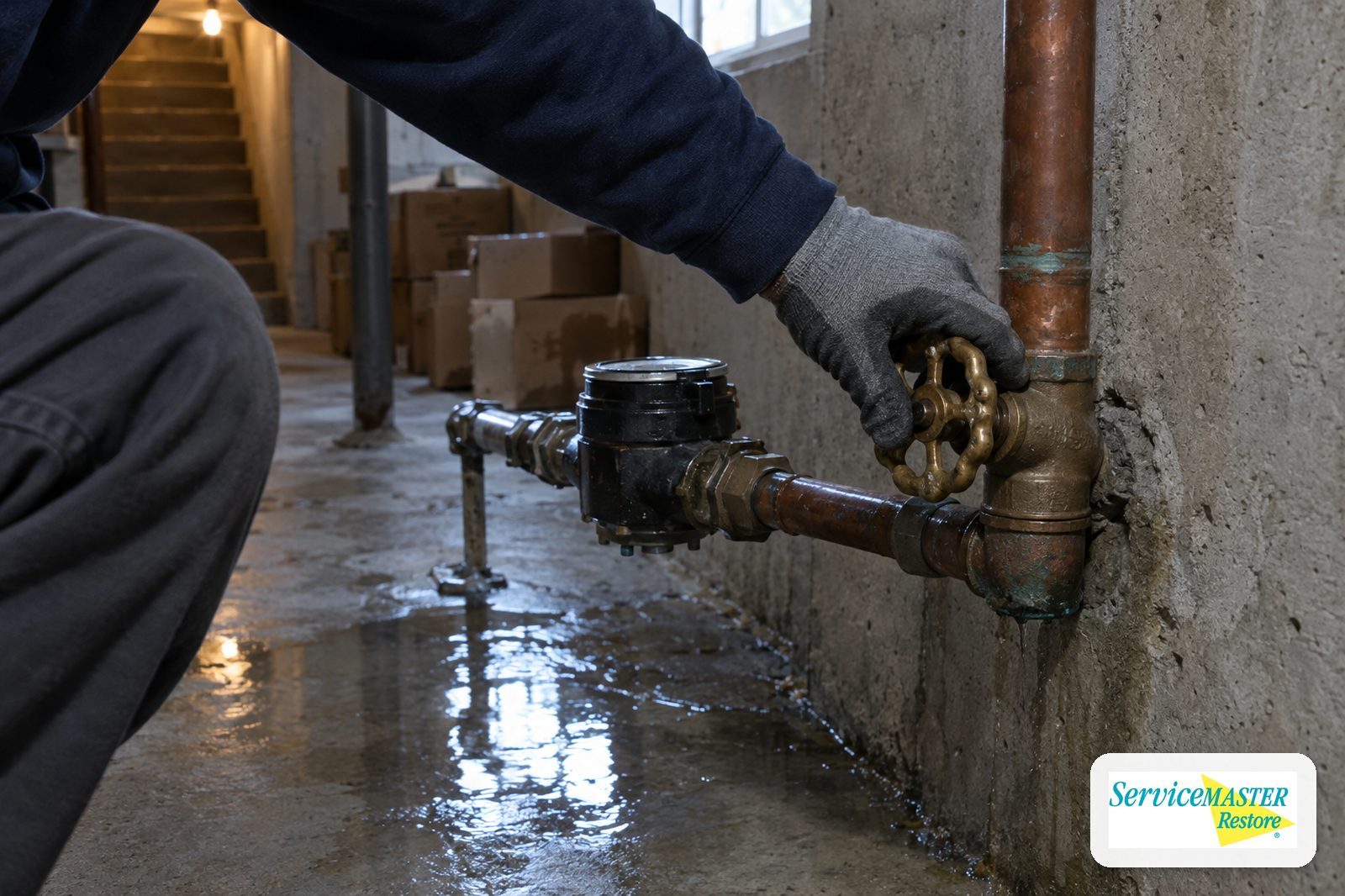
If a pipe bursts, shut off your home’s main water valve first, then cut power to any wet area only if you can reach the breaker from a dry spot. Open faucets to drain the lines, photograph the damage, and start removing water right away. Wet materials need to be dry within 24–48 hours to prevent mold.
A burst pipe is the hiss behind a basement ceiling in Glen Ellyn on a January morning, or water seeping from under a kitchen sink in Lockport while you are at work. What you do in the next sixty minutes decides whether you are drying a floor or gutting a room. For prevention, see our fall checklist for preventing winter water damage; storm water is covered in basement flooding after heavy rain.
The first hour after a pipe bursts, step by step
Work in this order. The first two steps keep you safe; the rest limit damage and protect your claim.
Step 1: Shut off the main water valve
Go straight to the main shutoff and close it. A round wheel handle turns clockwise until it stops. A lever handle turns a quarter turn so it sits across the pipe.
After the 2021 arctic outbreak in Texas and Louisiana, the Insurance Institute for Business & Home Safety (IBHS) found damage was worse because many homeowners did not know how to turn the main water supply off once a pipe had burst.
Step 2: Make the area electrically safe
Ready.gov is direct: “Do not touch electrical equipment if it is wet or if you are standing in water,” and turn off the electricity “if it is safe to do so.” If your panel is dry and you can reach it without stepping into water, switch off breakers for the wet rooms. If water is near the panel or dripping through a light fixture, stay out and call an electrician or your utility.
Step 3: Open faucets to drain the lines and relieve pressure
With the main closed, water is still sitting in the pipes. Open a cold tap on the lowest level and one on the top floor so it drains through the faucets instead of the break. In freezing weather this also helps any line that is still frozen: IBHS notes an open, dripping faucet relieves pressure buildup between the ice blockage and the faucet.
Step 4: Document before you clean up
Photograph and video the broken pipe, wet ceilings and walls, standing water and damaged belongings. The Insurance Information Institute (Triple-I) recommends photographing or videotaping the damage, keeping receipts, and not discarding damaged items until the adjuster has seen them.
Step 5: Remove water and protect belongings
Once power is handled, mop and towel up what you can. Use a wet/dry vacuum only if it is rated for water and plugged into a dry outlet away from the wet area. Lift furniture onto blocks and move papers and electronics to a dry room. Triple-I calls this taking reasonable steps to protect your property from further damage. Water that soaked into drywall or carpet pad will not come out with a shop vac; that is where professional emergency water removal matters.
Step 6: Call the right people
A burst pipe usually needs two trades. A licensed plumber repairs the pipe. A water damage restoration company handles everything the water touched: extraction, moisture checks and drying. Call your insurer or agent the same day to open a claim. For the pipe side, see burst and leaking pipes.
Burst pipe response timeline
What to do, and when, from the moment you find the leak.
Minute 0 to 5
Close the main water valve. Stay clear of water near outlets, cords or the panel.
Minute 5 to 15
Shut off breakers to wet rooms, only from a dry spot. Open the lowest and highest faucets to drain the lines.
Hour 1
Photograph everything. Remove standing water, lift furniture, move valuables. Call a plumber, a restoration company and your insurer.
Day 1 to 3
Professional extraction and drying, with moisture readings in walls, floors and ceilings. EPA advises drying water-damaged areas within 24 to 48 hours to prevent mold growth.
Sources: U.S. EPA (24 to 48 hour drying window); Ready.gov (electrical safety); Triple-I (documentation).
How to find and label your main water shutoff
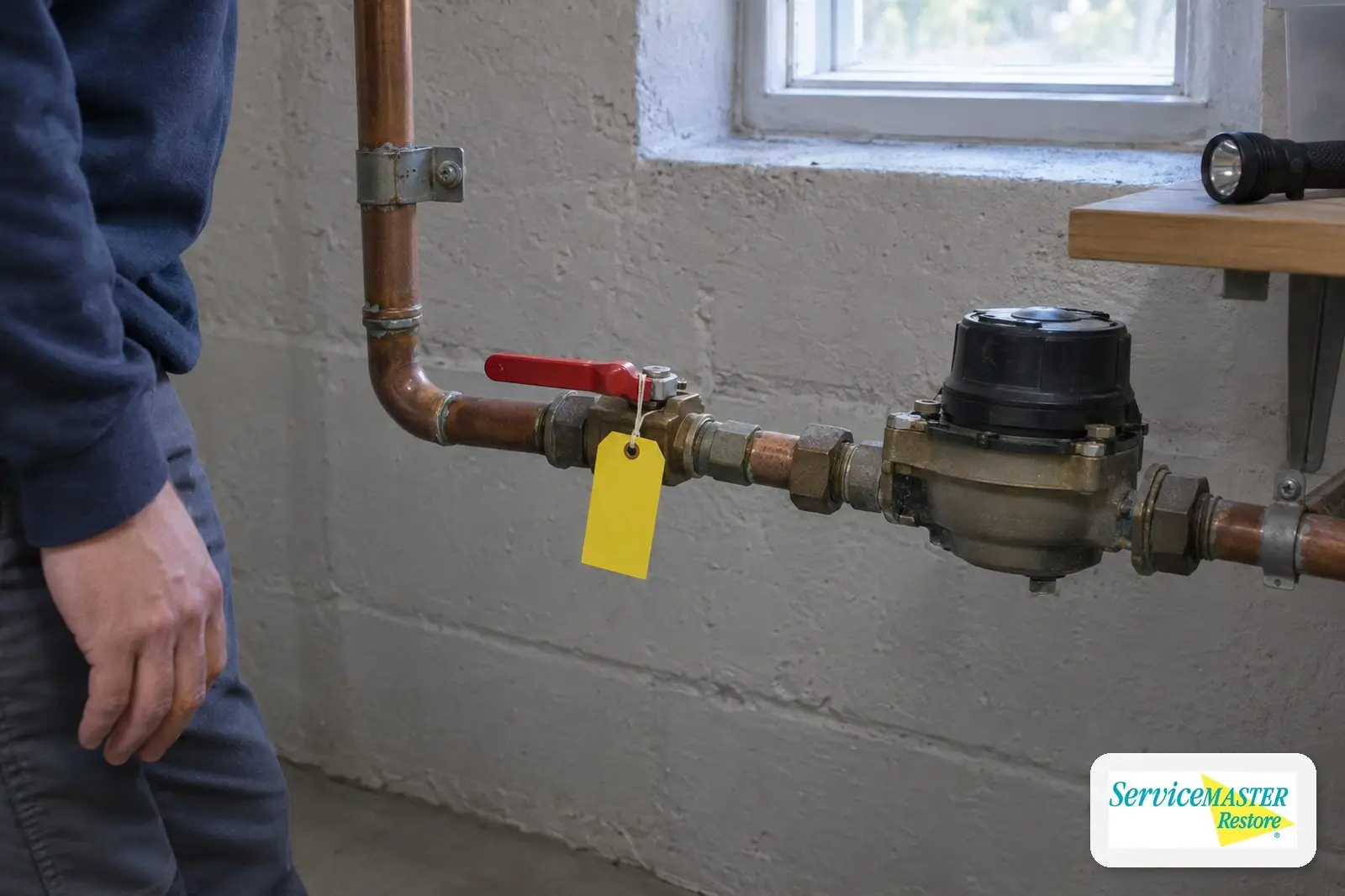
Do this on a calm afternoon, not mid-emergency. In many DuPage and Will County homes with a basement, the main valve is where the water service comes through the foundation, often on the street-facing wall near the water meter. In slab homes it may be in a utility room, near the water heater, or in the garage.
- Identify the type. A round wheel (gate valve) closes clockwise, often over several turns. A straight lever (ball valve) closes with a quarter turn.
- Test it gently. If an old valve will not turn by hand, do not force it with a wrench; have a plumber service or replace it.
- Label it. Hang a bright tag on the handle and note the location inside the electrical panel door.
- Know the backup. If the house valve fails, your village water department can usually shut service off at the curb.
Triple-I puts it simply: being able to locate and shut off the main water supply quickly saves stress, money and time.
Why pipes burst in Chicago-area winters
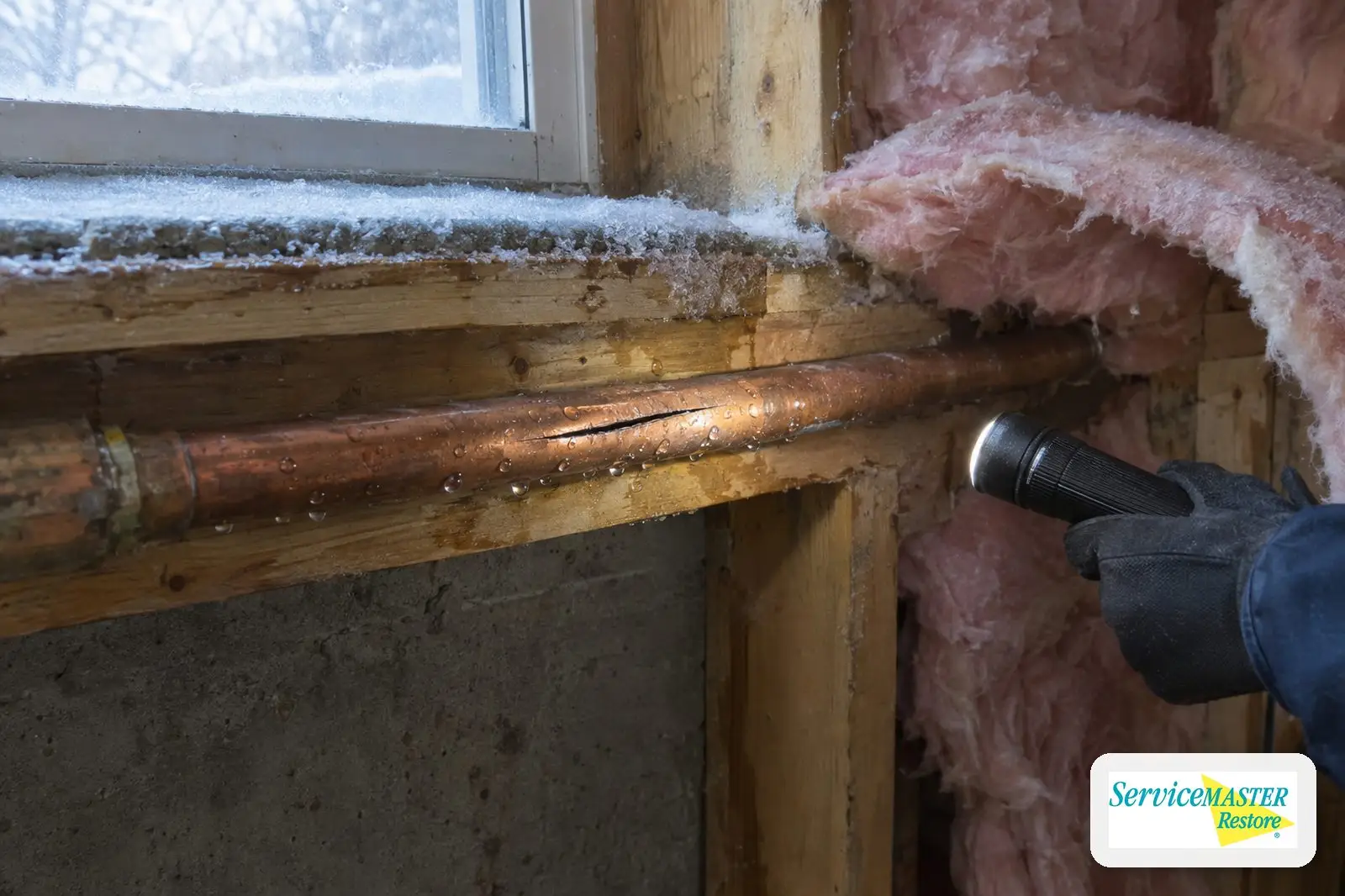
The Red Cross explains that water expands as it freezes, putting tremendous pressure on metal and plastic pipes. The surprise is where the pipe splits. Growing ice pushes water toward a closed faucet, and that trapped water builds pressure between the ice blockage and the faucet. The break often appears a few feet from the frozen spot, not at it.
According to the Red Cross, the pipes that freeze most often are those exposed to severe cold (hose bibs, sprinkler lines), supply lines in unheated basements, crawl spaces, attics, garages and kitchen cabinets, and pipes along poorly insulated exterior walls. That describes plenty of homes in Naperville, Downers Grove and Bolingbrook, especially where plumbing runs along an outside wall or through a garage.
IBHS research adds that uninsulated copper is the most problematic pipe material and that bursts become common when power fails for more than 24 hours in sub-freezing weather. Its winter guidance calls burst pipes the leading cause of property damage resulting from winter weather.
Not every burst is about cold. A cracked washer hose or failed water heater connection can let go in July. Triple-I suggests replacing appliance hoses every five to seven years.
If a pipe is frozen but has not burst yet
If only a trickle comes from a faucet, suspect a frozen pipe. The Red Cross advises keeping that faucet open and applying gentle heat with an electric heating pad, a hair dryer, a space heater kept away from flammables, or towels soaked in hot water. Never use a blowtorch, kerosene or propane heater, or any open flame. If you cannot find or reach the frozen section, call a licensed plumber.
Drying within 24 to 48 hours: why the clock matters
The EPA’s guidance is short: dry water-damaged areas and items within 24 to 48 hours to prevent mold growth.
Restorers classify water under the ANSI/IICRC S500 Standard for Professional Water Damage Restoration. A broken supply line is the classic example of Category 1, water from a sanitary source. It does not stay that way. An IICRC presentation to NADCA explains that Category 1 water can deteriorate to Category 2 or 3 depending on how long materials stay wet and the temperature, and that odors can signal the change.
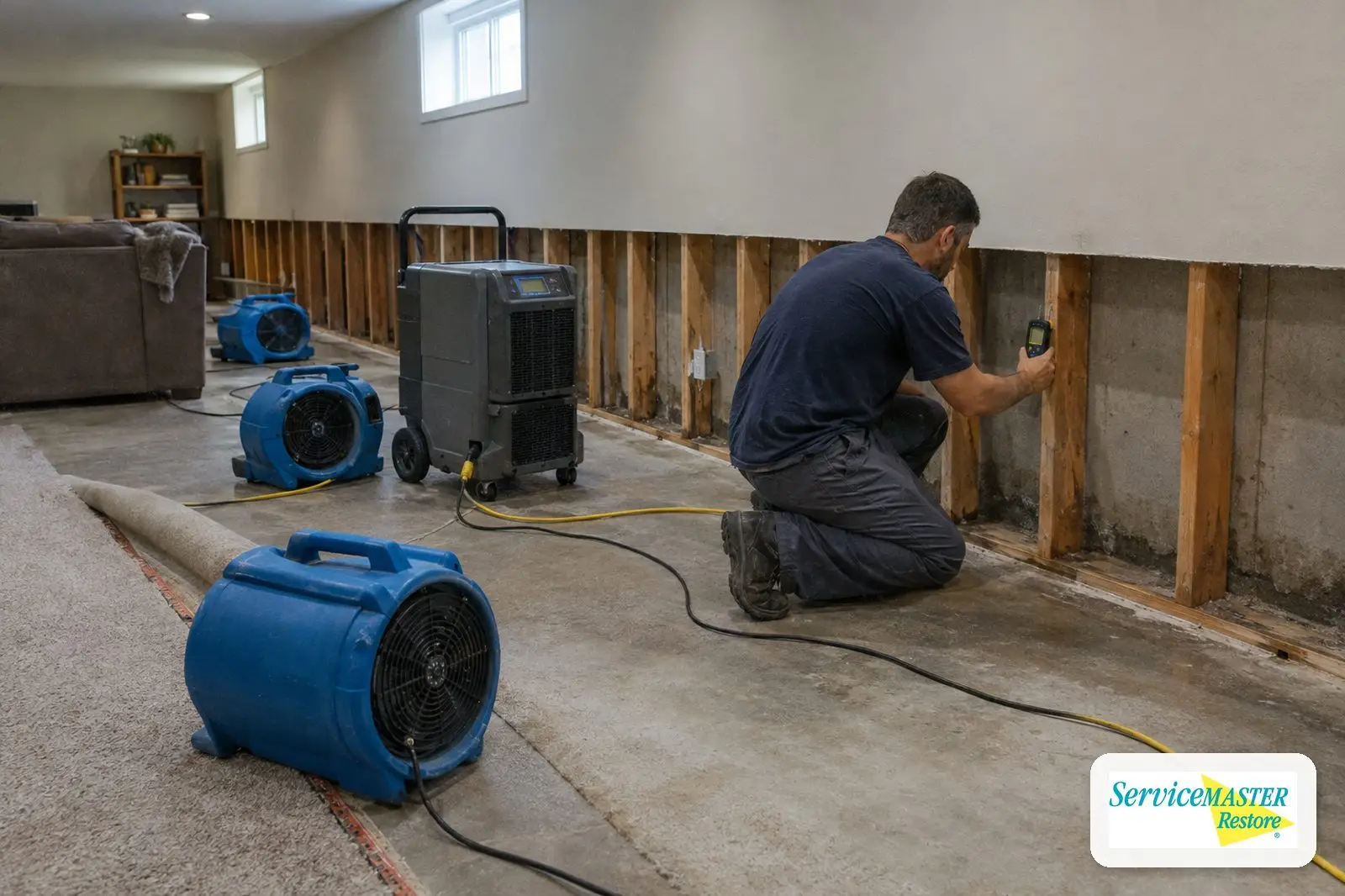
The bigger risk is water you cannot see. It pools under hardwood and wicks up drywall into insulation. Surfaces can feel dry while a wall cavity stays wet for weeks. Professional structural drying and dehumidification typically relies on moisture meters to find that water, then dehumidifiers and air movers to remove it, with readings repeated until materials are back to normal.
If mold has started, the EPA says growth under about 10 square feet is usually a homeowner job; larger areas call for a professional. Ready.gov adds that people with asthma, lung conditions or immune suppression should not enter buildings with indoor leaks or visible mold. Larger growth is a job for professional mold remediation.
Insurance basics: sudden and accidental vs. gradual
Water damage is a common claim. Triple-I, using ISO data, reports that about one in 60 insured homes has a water damage or freezing claim each year, with an average claim of about $15,400 from 2019 to 2023.
Coverage turns on how the water got there. Asked about a pipe that bursts and floods the floors, Triple-I answers yes, the standard HO-3 policy covers accidental discharge of water from a plumbing system, and freezing of plumbing is a listed peril in its coverage breakdown. Policies do not cover damage from lack of maintenance, and slow seepage is treated as a maintenance issue.
So a pipe that splits overnight in a cold snap is the sudden, accidental event policies are written for, while a slow drip that rotted a cabinet over months usually gets declined. Report the loss promptly, keep receipts, and, as Triple-I warns, avoid extensive permanent repairs before the adjuster assesses the damage.
For exclusions and deductibles, read does homeowners insurance cover water damage in Illinois. We work with your insurance company and offer insurance claim assistance if you want help.
This is general information, not insurance or legal advice. Policies vary, so check your policy and ask your agent or adjuster.
When to call a professional
A small leak caught early on a tile floor is often a towel-and-fan job. Call a restoration company when:
- Water came through a ceiling or ran inside a wall.
- Carpet, pad, hardwood or laminate got wet, or water reached a finished basement.
- You notice a musty or sour odor.
- Materials still feel damp after a day.
ServiceMaster Restoration Services has handled water losses across DuPage and Will County for over 20 years, with certified technicians available 24/7 for homes and businesses. We provide water damage restoration throughout the area, including water damage restoration in Glen Ellyn, water damage cleanup in Lockport and water damage restoration in Lemont. See also how to choose a water damage restoration company and water damage restoration cost in DuPage County.
Frequently Asked Questions
What is the first thing to do when a pipe bursts?
Shut off the main water valve. That stops new water from entering the house while you handle everything else. Next, make the area electrically safe by switching off breakers to wet rooms, but only if you can reach the panel without standing in water. Then open faucets to drain the lines, photograph the damage, and start removing water.
How do I know if a pipe burst inside a wall?
Watch for the sound of running water when nothing is on, a sudden drop in water pressure, damp or bulging drywall, peeling paint, spreading ceiling stains, or a musty smell. You can also turn off every faucet and water-using appliance and watch your water meter. If it keeps moving, water is going somewhere. Shut the main and call a plumber.
How long does it take for mold to grow after a pipe bursts?
The EPA advises drying water-damaged areas and items within 24 to 48 hours to prevent mold growth. Timing depends on temperature, humidity and the material, so start drying the same day. Hidden moisture in wall cavities and under flooring is where mold most often gets a head start.
Does homeowners insurance cover a burst pipe?
Usually, if the damage was sudden and accidental. Triple-I says a standard HO-3 policy covers accidental discharge of water from a plumbing system, and freezing of plumbing is a listed peril. Damage from a long-term leak or lack of maintenance is typically excluded. Policies vary, so confirm the details with your agent or adjuster before assuming you are covered.
Should I call a plumber or a restoration company for a burst pipe?
Often both. A plumber fixes the pipe and restores water service. A restoration company removes the water, measures moisture in walls and floors, and dries the structure to prevent mold and further damage. If water spread beyond a small area or soaked into drywall, flooring or a finished basement, call both the same day.
Related guides and services
- Burst and leaking pipe water damage
- Emergency water removal and extraction
- Structural drying and dehumidification
- Water damage restoration services
- Insurance claim assistance
- Fall maintenance to prevent winter water damage
- Basement flooding after heavy rain in DuPage
- Homeowners insurance and water damage in Illinois
- All restoration guides
Water coming through the ceiling right now? Shut off the main, then call ServiceMaster Restoration Services at (630) 241-1111, 24/7, anywhere in DuPage and Will County, or reach us through our contact page.
Sources
- American Red Cross: Frozen Pipes
- Insurance Institute for Business & Home Safety: Protect Your Business From Winter Weather
- Insurance Institute for Business & Home Safety: State of the Risk, Interior Water Damage
- U.S. EPA: A Brief Guide to Mold, Moisture and Your Home
- U.S. EPA: Mold Cleanup in Your Home
- Ready.gov (FEMA): Floods
- IICRC: ANSI/IICRC S500 Standard for Professional Water Damage Restoration
- IICRC presentation to NADCA: Cleaning Related to Fire and Water Restoration Projects
- Insurance Information Institute: Am I Covered?
- Insurance Information Institute: Which Disasters Are Covered by Homeowners Insurance?
- Insurance Information Institute: How to Protect Your Home From Water Damage
- Insurance Information Institute: Settling Insurance Claims After a Disaster
- Insurance Information Institute: Facts + Statistics, Homeowners and Renters Insurance