
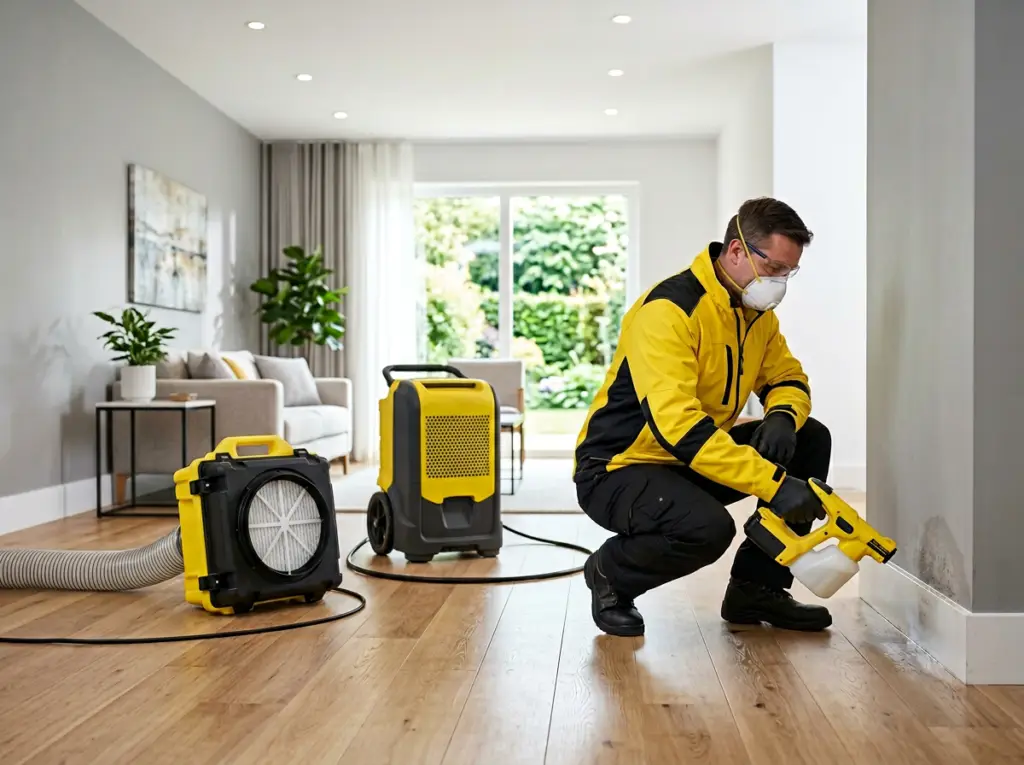

What is structural drying, and why isn't a box fan enough?
Structural drying removes the water soaked into drywall, framing, subfloors and insulation after the standing water is gone. It balances fast airflow, dehumidified air and warmth so moisture leaves the materials instead of the room's air. A box fan moves air but never removes the water vapor, so humidity climbs and drying stalls.
After a leak in a home, most of the water you can't see is inside materials. A wet wall cavity or a subfloor under laminate can hold moisture for weeks if the air around it is already damp. This page explains the science that decides how fast a house dries, the readings technicians rely on, and the drying goal the industry standard calls for.
How does evaporation actually dry a house?
Drying is a chain. Water moves from the inside of a material to its surface, evaporates into the air, and then has to be removed from that air. Break any link and the process slows down.
Three levers control the chain. Airflow across a wet surface carries away the thin layer of saturated air sitting on it. Dry air has room to accept more vapor. Warmth gives water molecules the energy to evaporate. Professional drying manages all three at once, which is why the equipment is set up as a system rather than a few fans pointed at a stain.
Air movers do the evaporating
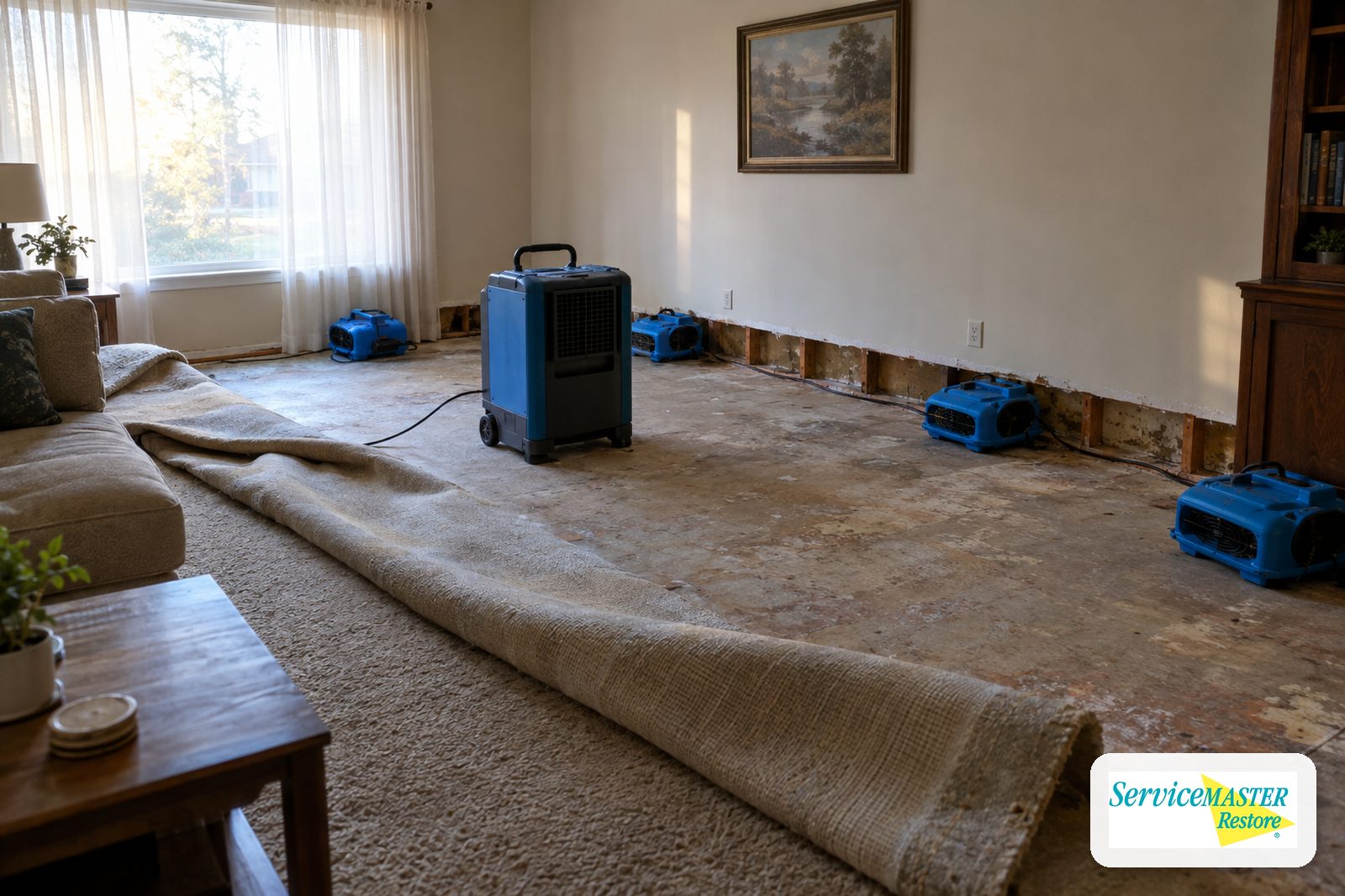
Restoration air movers push a fast, low sheet of air along walls and floors. They are aimed to keep air moving across every wet surface, including closets and toe-kicks that a household fan never reaches.
Faster evaporation puts more water vapor into the room. Without dehumidification, that vapor raises the humidity until it slows drying or condenses on cooler surfaces, which is how secondary damage starts.
What do temperature, humidity and grains per pound tell a technician?
This is psychrometry, the science of moist air, and it is one of the topics the ANSI/IICRC S500 water damage standard covers. Relative humidity on its own can mislead because it depends on temperature. The National Weather Service gives a clear example: 30°F air with a 30°F dew point is at 100% relative humidity, while 80°F air with a 60°F dew point is only at 50%, yet the warmer air holds far more water.
That is why drying technicians convert their readings into grains per pound, an absolute measure that does not shift with temperature.
| Reading | What it measures | Why it matters on a drying job |
|---|---|---|
| Temperature | Air and surface heat, °F | Warmer air speeds evaporation and is needed to interpret humidity correctly. |
| Relative humidity (RH) | Water vapor as a percent of what air can hold at that temperature | EPA advises keeping indoor RH below 60%, ideally 30–50%, to discourage mold. |
| Dew point | Temperature at which the air would reach 100% RH | Surfaces colder than the dew point collect condensation. |
| Grains per pound (GPP) | Weight of water vapor per pound of dry air; 7,000 grains equal 1 pound | Comparing GPP in the wet room, outdoors and at the dehumidifier outlet shows whether water is actually being removed. |
| Material moisture content | Moisture in wood, drywall or subfloor, read with a meter | Compared with the same material in an unaffected room to set the drying goal. |
Sources: NWS La Crosse, Dew Point vs. Humidity; EPA, A Brief Guide to Mold, Moisture and Your Home; NIST SP 811, Appendix B.9 conversion factors; IICRC S500.
Which equipment does residential drying use?
Most home losses are dried with air movers and low-grain refrigerant (LGR) dehumidifiers. An LGR works like a conventional dehumidifier, cooling air below its dew point so vapor condenses, but it is built to keep pulling water out when the air is already fairly dry. That keeps the drying chain moving late in the job.
Some materials hold water stubbornly. Hardwood flooring, plaster walls and concrete may need specialty methods such as desiccant dehumidifiers or carefully controlled heat, which we cover on our large-scale structural drying page and our advanced restoration equipment page.
Meters prove what the eye can't
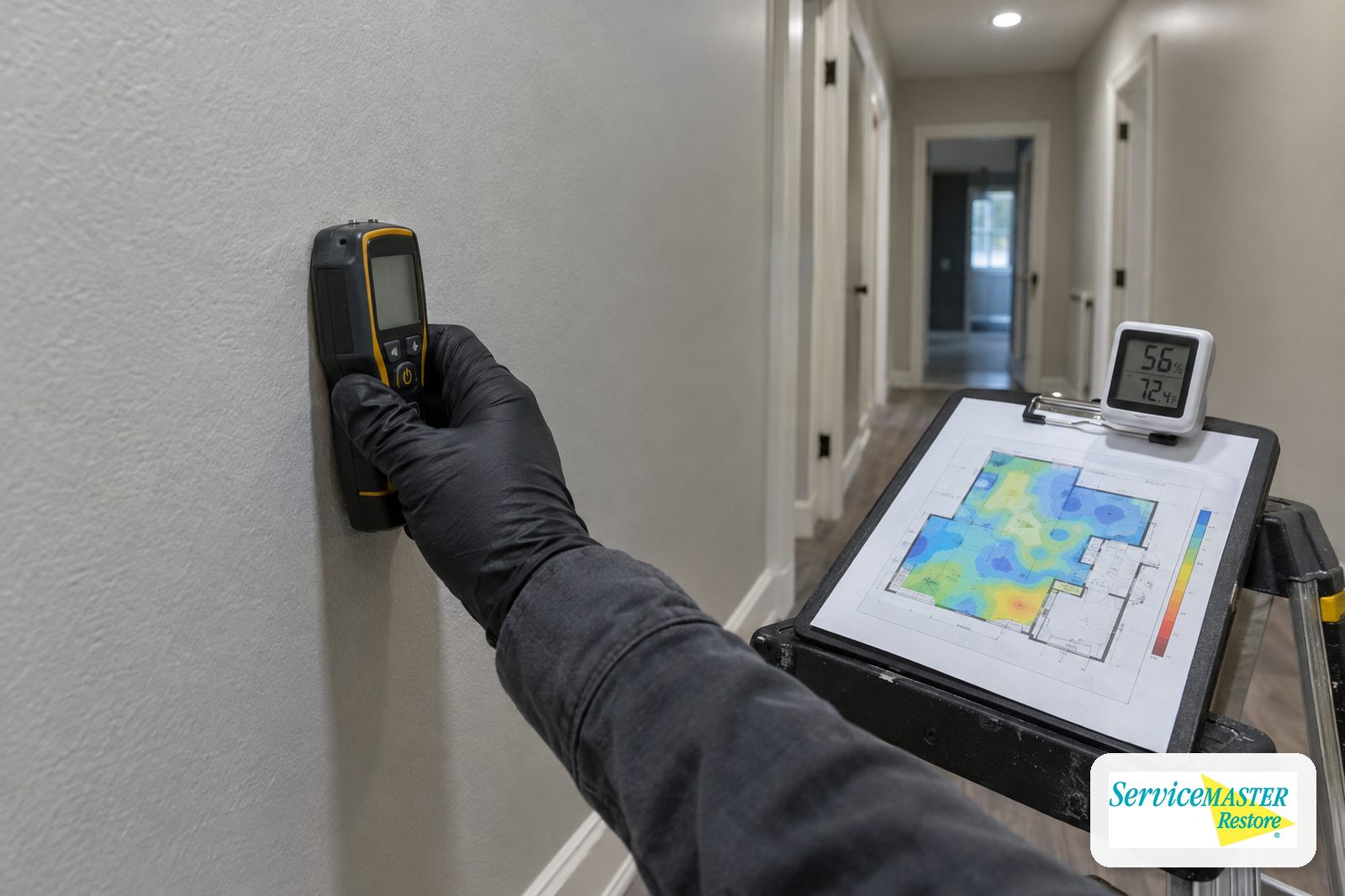
Pin meters read moisture deep in wood and drywall; pinless meters scan large areas without holes; thermo-hygrometers log temperature and humidity; infrared cameras show cooler, evaporating areas that are then confirmed with a meter. Readings go on a moisture map so everyone, including your adjuster, can see progress.
The same mapping decides what must be removed. The EPA says wet wallboard may be dried in place if it shows no obvious swelling and the seams are intact; otherwise it should be removed and replaced.
What drying goal does the IICRC standard call for?
The S500 asks the restorer to establish a dry standard and drying goals during the initial response, according to the S500 consensus body's 2026 position statement, which quotes that section. The dry standard comes from readings of the same materials in an unaffected part of the house. The goal is to bring wet materials back to that level, or acceptably close to it.
That definition matters. "It feels dry" is not a goal. A subfloor that reads dry on the surface can still hold enough water to cup new flooring or feed mold behind new drywall.
How long does drying a home take?
It depends on what got wet, how much of it, and conditions in the house. A kitchen leak caught the same day on drywall and vinyl can dry quickly; a weekend-long supply-line leak into hardwood and a finished basement takes longer. The EPA's 24-to-48-hour guidance for preventing mold is the reason to start immediately, not a promise of when drying ends.
Weather matters too. Humid Chicago-area summers often mean outdoor air carries more moisture than the air inside, so restorers usually keep windows closed and let dehumidifiers do the work. Older plaster homes in places like Hinsdale may need more time than newer drywall construction in Plainfield.
- Inspect and map. Find every wet material and record readings, including the dry standard from unaffected rooms.
- Extract first. Pulling liquid water with emergency water removal equipment is far faster than evaporating it.
- Open the structure where needed. Wet pad, insulation and swollen trim come out; paneling can be pried away so the wall can breathe.
- Set up a closed drying system. Air movers on wet surfaces, dehumidifiers sized to the space, doors and windows managed to hold conditions.
- Monitor and adjust. Readings are logged and equipment is moved or added when materials stop improving.
- Verify the goal. Equipment comes out only when materials reach the drying goal.
From drying to rebuild
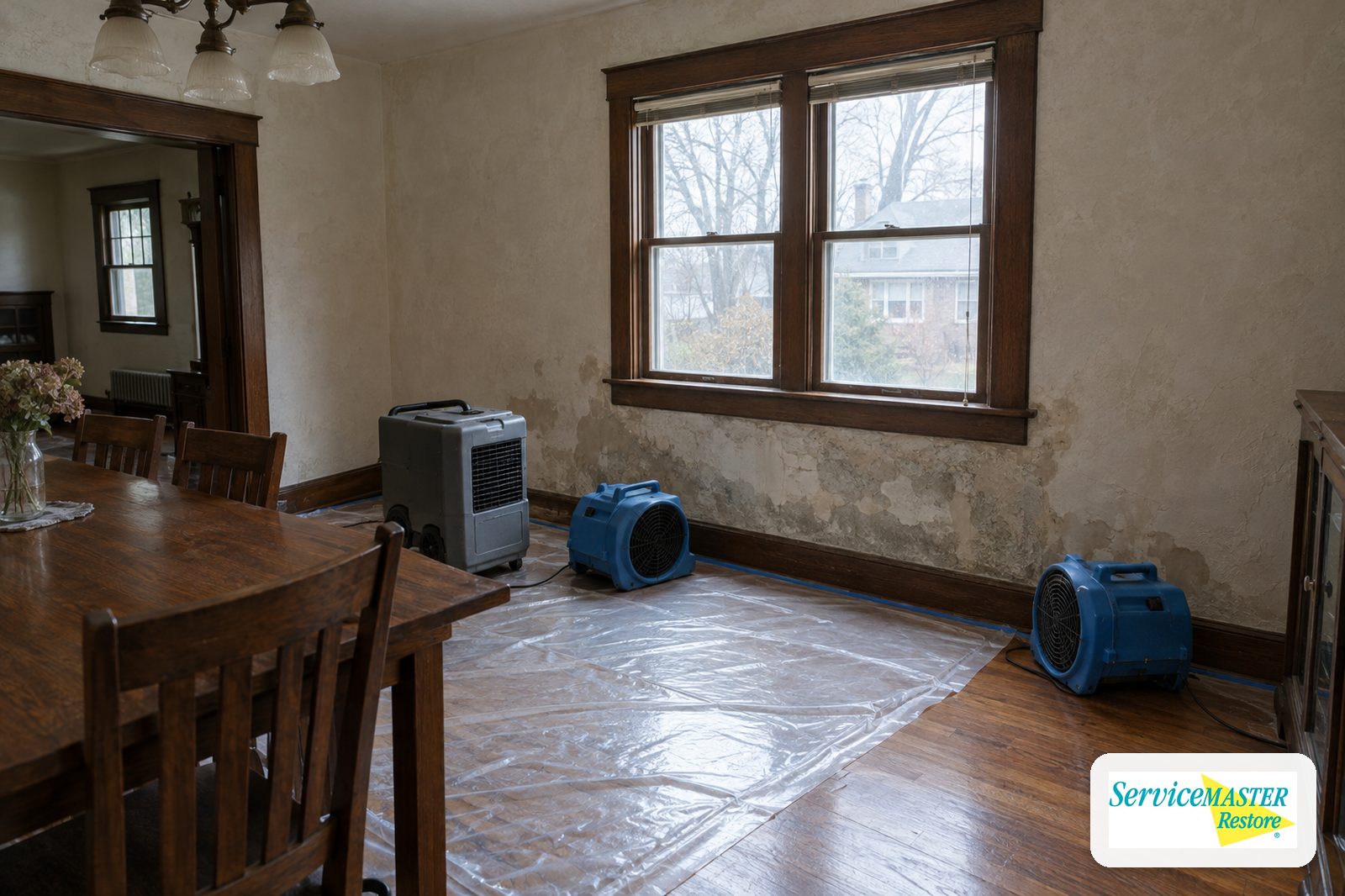
Drying is one phase of residential water damage restoration. It usually follows a burst or leaking pipe and comes before repairs, which is why rushed drying leads to repeat damage.
Our certified technicians handle drying for homes across DuPage and Will County from our Lisle office, including Woodridge. For what drives the bill, read water damage restoration cost in DuPage County, and see how to choose a restoration company.
Want to talk through readings from your home? Reach our team or call 24/7 at (630) 241-1111. Drying is part of our full water damage restoration service.
Frequently asked questions
Should I open the windows to help my house dry?
Only when the outdoor air is drier than the indoor air, which in a Chicago-area summer often is not the case. The National Weather Service notes that dew points of 65°F or higher mean lots of moisture in the air. Opening windows on those days pushes more water vapor in. Restorers compare indoor and outdoor grains per pound and usually keep the house closed while dehumidifiers run.
Can I rent a dehumidifier and dry the house myself?
For a small clean-water spill caught right away, often yes. Larger losses are harder: water inside walls, under flooring or in a finished basement needs measurement to find. The EPA notes that, depending on the size of the area and resources available, professional assistance may be needed to dry an area quickly and thoroughly. If mold growth covers more than about 10 square feet, the EPA points to professional remediation guidance.
What is a dry standard?
It is the moisture reading of an undamaged material of the same type in an unaffected part of the building, such as a dry wall in another room. Under the IICRC S500, the restorer establishes dry standards and drying goals at the start of the job, then dries wet materials until they reach that goal. It turns 'looks dry' into a number that can be checked.
Can hardwood floors be saved after water damage?
Sometimes. EPA guidance for wood surfaces is to remove moisture immediately and dry with dehumidifiers, gentle heat and fans, using caution with heat on hardwood floors. Restoration trade sources note that dense materials such as hardwood benefit from very dry air, which is where desiccant dehumidifiers come in. Cupping that does not flatten after drying, or water trapped under the floor too long, may mean replacement.
What humidity should my house be at after drying is finished?
The EPA recommends keeping indoor relative humidity below 60 percent, ideally between 30 and 50 percent, to discourage mold growth. An inexpensive humidity meter from a hardware store lets you check. If a basement stays above that range after drying, a properly sized household dehumidifier and fixing the source of moisture are the usual next steps.
Sources
- IICRC: ANSI/IICRC S500 Standard for Professional Water Damage Restoration
- IICRC: Category of Water Damage and Weather-related Events (S500 Consensus Body Position Statement, 2026)
- National Weather Service La Crosse: Dew Point vs. Humidity
- U.S. EPA: A Brief Guide to Mold, Moisture and Your Home
- NIST: NIST Guide to the SI, Appendix B.9: Factors for units listed by kind of quantity
- U.S. EPA: Mold Remediation in Schools and Commercial Buildings, Table 1
- Restoration & Remediation magazine: What You Need to Know About Desiccant Drying
- Restoration & Remediation magazine: The IICRC S500 Approach to Determining Initial Equipment Usage