
What to do after a fire at your business: wait for the fire department to say the building is safe, account for every employee, secure the property against weather and theft, call your insurer, and photograph everything before cleanup. Then start drying and soot removal quickly, keep every receipt, and track lost income for a business-interruption claim.
A fire at a business does not end when the engines leave. The owner of a Naperville storefront or a warehouse near Lockport is left in front of a dark building with urgent questions. Can I go in? Who boards up the windows? What does my insurer need today? When can we reopen? This guide answers them in the order they usually come up, using guidance from the U.S. Fire Administration, the Insurance Information Institute, OSHA, and the IICRC.
Step 1: Wait for the all-clear and account for your people
The first rule comes from the U.S. Fire Administration’s recovery guide: do not enter a damaged building unless the fire department says it is safe. USFA warns that floors and walls “may not be as safe as they look,” and that firefighters will shut off or disconnect water, electricity, and gas if those utilities are unsafe. Do not turn them back on yourself (USFA, After the Fire).
Before the building, think about your staff. OSHA’s emergency action plan rule lists “procedures to account for all employees after evacuation” as a minimum element of a workplace plan (OSHA 29 CFR 1910.38). Confirm everyone is out, tell the officer in charge right away if anyone is missing, and send people home once they are released.
Expect a cause-and-origin investigation
Under the Illinois Fire Investigation Act, the local fire chief investigates the cause, origin, and circumstances of fires, and the Office of the State Fire Marshal can supervise that work (425 ILCS 25/6). The scene may stay off-limits for a while, so do not move debris until investigators release it. Before you leave, write down the incident report number and the name of the fire marshal or investigator. USFA’s checklist has blanks for both, and your insurer will ask.
Step 2: Secure the building so the loss stops growing
Firefighting is rough on a structure by design. USFA explains that crews may break windows and cut holes in the roof to slow the fire and clear smoke, and open walls to make sure no fire is hiding inside. That leaves the building open to rain, snow, and trespassers. USFA advises telling the police the site will be vacant and boarding up windows and doors where needed.
This step protects your claim, too. The Insurance Information Institute (Triple-I) tells owners to take “reasonable steps to protect your property from further damage” when the area is safe, and notes that payments for temporary repairs are part of the total settlement (Triple-I, Filing a business insurance claim). Emergency board-up and site securing closes openings, tarps damaged roof sections, and fences off hazards. For the wider set of containment steps, see damage mitigation for businesses.

Step 3: Call your insurer and start the paper trail
USFA’s advice is short: contact your insurance company right away and ask what to do first. Triple-I’s business claim checklist fills in the rest:
- Notify your agent and carrier quickly. For severe damage, an adjuster may inspect in person.
- Read your policy. It lists your duties after a loss.
- Photograph and video the damage before anything is cleaned or thrown out.
- Inventory damaged items, with receipts where you have them.
- Save damaged parts from equipment you repair right away, in case the adjuster wants them.
- File the proof of loss on time. Triple-I says this sworn statement is due within 60 days of the insurer’s request.
- Get at least two repair bids and keep every receipt in one place.
Log every call with the date, name, and what was said. If a claim stalls, the Illinois Department of Insurance accepts written complaints, though it asks you to raise the problem with your insurer or agent first. Our insurance claim assistance page explains how we document a loss so your adjuster has what they need.
How business-interruption coverage works
Property coverage repairs the building and contents. Business income (business-interruption) coverage keeps the company going while the doors are closed. Triple-I says it can help pay lost net income based on your financial records, plus rent or mortgage, loan payments, taxes, and payroll (Triple-I, Business interruption insurance). Details that matter:
- Waiting period: typically 48 to 72 hours before the period of restoration begins.
- Time limit: the standard policy limits the restoration period to 30 days, extendable to 360 days by endorsement.
- Extra expense: can cover costs such as temporary space or leased equipment that keep you running.
- Civil authority: if a government order blocks access because of damage nearby, coverage typically does not exceed two consecutive weeks.
Lost income is measured against your books, and undocumented income is not covered. Pull last year’s financials, sales reports, and payroll records early.
Policies vary. This is general information, not insurance or legal advice. Confirm your coverage, limits, and deadlines with your agent or adjuster.
Smoke, soot, and firefighting water: the damage that keeps going
USFA puts it plainly: things the flames never touched may still be ruined by smoke and “soggy with water used to put out the fire,” and anything you want to save will need careful cleaning. USFA also cautions that soot and dirty water “may contain things that could make you sick,” so limit how much you and your staff handle damaged items.
The water is its own emergency. Sprinklers and hose lines can soak drywall, ceiling tile, carpet, and stock in minutes, and the EPA says water-damaged areas and items should be dried within 24 to 48 hours to prevent mold growth (EPA). That clock starts at the fire, not when the claim is approved, which is why water damage cleanup after firefighting should begin as soon as the building is released.
Smoke also moves through ductwork and above drop ceilings into rooms far from the fire. The industry standard ANSI/IICRC S700 includes building systems such as HVAC in its scope for assessing fire residues and odors (IICRC S700). Have the HVAC system assessed before running it, so it does not spread residue into clean areas.
USFA’s national data shows why business fires hit so hard financially: nonresidential buildings see a small share of fires but an outsized share of the money lost.
Nonresidential building fires as a share of all U.S. fires, 2017–2019
Percent of national totals for fires, deaths, injuries, and dollar loss
Dollar loss · 20%
Fires · 8%
Injuries · 7%
Deaths · 3%
Source: U.S. Fire Administration, Nonresidential Building Fires (2017–2019). USFA estimates an annual average of 108,500 nonresidential building fires in that period, causing about $2.8 billion in property loss per year, and notes these fires “may lead to lost jobs and closed businesses.”
USFA’s more recent estimates put 2023 at 110,000 nonresidential building fires and roughly $3.16 billion in dollar loss (USFA national estimates). The 2017–2019 report also found that 58% of the larger, nonconfined fires spread beyond the room where they started.
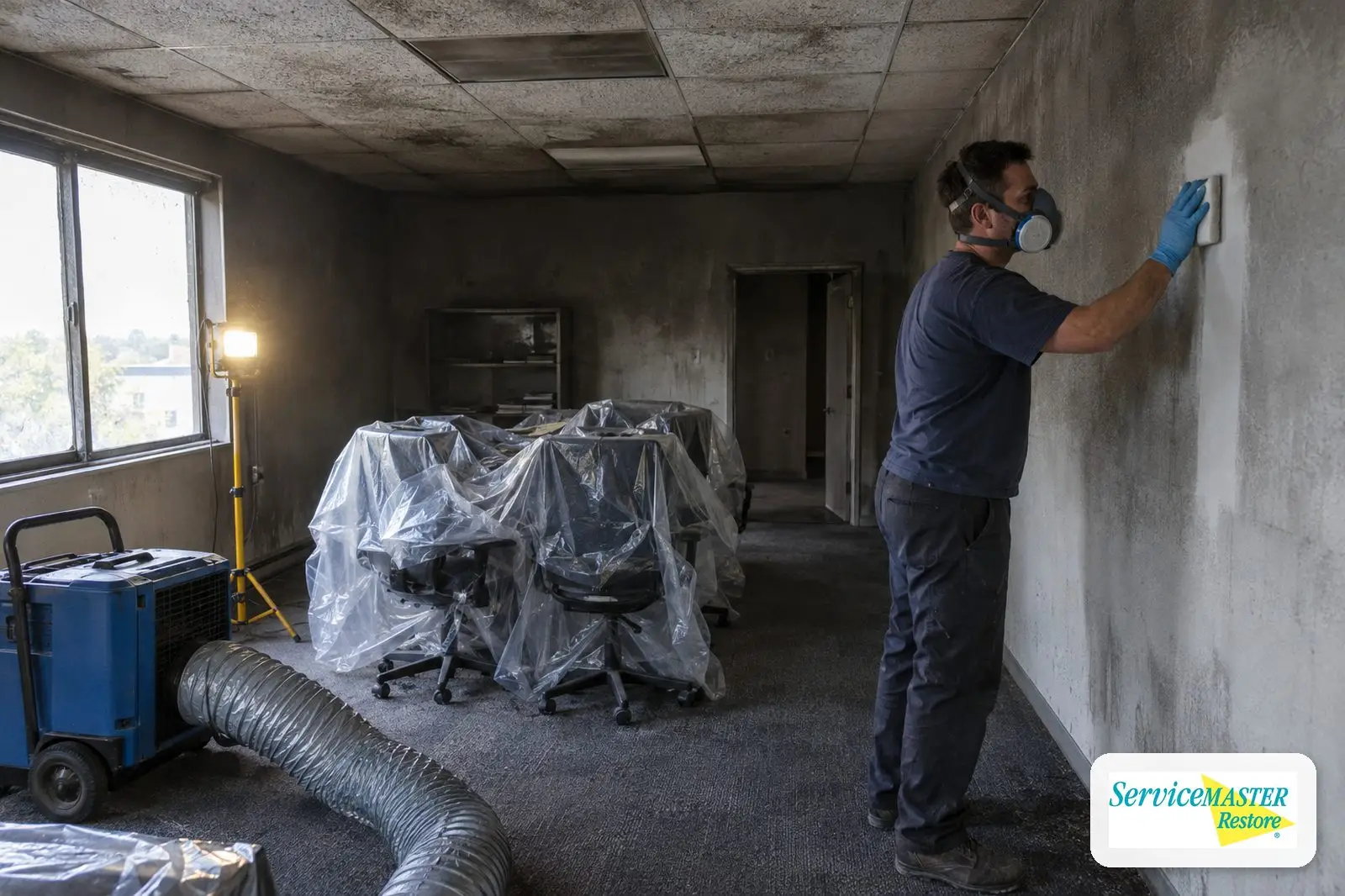
What professional commercial fire restoration involves
Restoration is a sequence, and each stage depends on the one before it. ANSI/IICRC S700, first published in 2025, covers assessing fire residues and odors, writing a Restoration Work Plan, documenting the project, and following the authorities having jurisdiction. On a commercial job, that typically looks like this.
Step 1 · Safety check and assessment
After fire officials release the site, technicians identify hazards, map smoke and water migration, and sort what can be cleaned from what must go.
Step 2 · Stabilize the structure
Board-up, roof tarping, and water removal stop the loss from spreading.
Step 3 · Dry out and remove debris
Wet materials are dried inside the EPA’s 24 to 48-hour window, and unsalvageable materials are removed and documented.
Step 4 · Clean soot from structure, contents, and systems
Walls, ceilings, inventory, and ductwork are cleaned with methods matched to each surface.
Step 5 · Odor management
Source removal comes first, then deodorization, so the space does not look clean but still smell of smoke.
Step 6 · Repairs and final evaluation
Drywall, ceilings, and finishes go back in, and the space is checked before it is handed back.
Sequence based on the scope of ANSI/IICRC S700 and EPA drying guidance.
Commercial losses add pressures a home does not have: inventory, records, tenants, and customers who will go elsewhere if you stay closed. Our commercial fire damage restoration services bring certified technicians and 24/7 emergency service to businesses across DuPage and Will County, and we work with your insurance company throughout. For more on the cleaning stages and what drives a fire job’s scope, read our guide to the fire and smoke damage restoration process.
Getting back open
Many businesses reopen in phases: a front office or one side of a warehouse returns while work continues behind containment. Before staff or customers come back, ask your village or city building department and fire prevention bureau which inspections they require. Rules differ between towns, so ask early.
Keep customers informed. Update your Google Business Profile hours, post a short notice online, and tell key clients when you expect to be back. If you work from a temporary location, keep those receipts, since extra expense coverage may apply.
Then use what you learned. Ready.gov recommends that companies “organize a business continuity team and compile a business continuity plan,” including identifying risks, developing strategies, defining teams, and testing the plan (Ready.gov). Larger organizations can look to NFPA 1660, which now incorporates the widely used NFPA 1600 continuity standard. Revisit your OSHA emergency action plan as well. Our article on commercial restoration and business continuity covers the planning side in depth.
We respond to business fires throughout the area, including fire damage restoration in Naperville, fire damage restoration in Glen Ellyn, and fire damage restoration in Lockport, plus Lisle, Downers Grove, Bolingbrook, and the rest of DuPage and Will County.

Frequently Asked Questions
What should a business owner do immediately after a fire?
Make sure every employee is accounted for, then stay out until the fire department says the building is safe. Get the incident report number and investigator’s name, notify your insurer, and arrange board-up so weather and trespassers cannot add to the damage. Photograph everything before cleanup, and keep receipts for every fire-related expense.
How long after a fire can you go back into your business?
Only when fire officials say it is safe, which can take longer while investigators determine cause and origin. USFA warns that floors and walls may not be as safe as they look, and utilities may be shut off for safety. Do not reconnect water, gas, or power yourself. Ask the officer in charge when and how you may enter.
Does business insurance cover lost income after a fire?
Often, if you carry business income coverage. The Insurance Information Institute says it can help pay lost net income, rent, loan payments, taxes, and payroll during the restoration period, typically after a 48 to 72-hour waiting period. Standard policies limit that period to 30 days unless extended by endorsement. Policies vary, so confirm your terms with your agent.
Should I clean up before the insurance adjuster comes?
Protect the property, but do not throw anything away first. Triple-I advises reasonable temporary repairs to prevent further damage when the area is safe. Photograph the damage, inventory damaged items, and save damaged equipment parts for the adjuster. Board-up and drying help your claim; discarding contents before they are documented can complicate it.
How long does commercial fire damage restoration take?
It depends on how far smoke and water spread, the building’s size, and how much needs rebuilding. A small, contained fire may be handled quickly, while one that spread beyond the room of origin takes much longer. Starting drying within the EPA’s 24 to 48-hour window and reopening in phases both help shorten downtime.
Related guides and services
- Commercial fire damage restoration for DuPage and Will County businesses
- Emergency board-up and site securing after a fire
- Damage mitigation for businesses
- Help documenting your fire insurance claim
- Water damage cleanup after firefighting
- Smoke and soot cleanup
- Common causes of commercial fires and how to prevent them
- Restaurant kitchen fire damage restoration
- All restoration guides
Fire at your business in DuPage or Will County? Call (630) 241-1111, 24/7, to reach ServiceMaster Restoration Services in Lisle, or send us a message. With over 20 years serving the area, our certified technicians handle commercial fire, smoke, and water damage and work with your insurance company.
Sources
- U.S. Fire Administration (FEMA), After the Fire: Returning to Normal (FA-46)
- U.S. Fire Administration, Nonresidential Building Fires (2017–2019), Topical Fire Report Series
- U.S. Fire Administration, Nonresidential Building Fire Statistics, National Estimates
- Insurance Information Institute, Filing a Business Insurance Claim
- Insurance Information Institute, Do I Need Business Interruption Insurance?
- OSHA, 29 CFR 1910.38 Emergency Action Plans
- IICRC, ANSI/IICRC S700 Standard for Fire and Smoke Damage Restoration
- U.S. EPA, A Brief Guide to Mold, Moisture and Your Home
- Ready.gov (FEMA), Business Continuity Planning
- NFPA, NFPA 1660 Standard for Emergency, Continuity, and Crisis Management
- Illinois General Assembly, Fire Investigation Act, 425 ILCS 25/6
- Illinois Department of Insurance, Understanding the Complaint Process