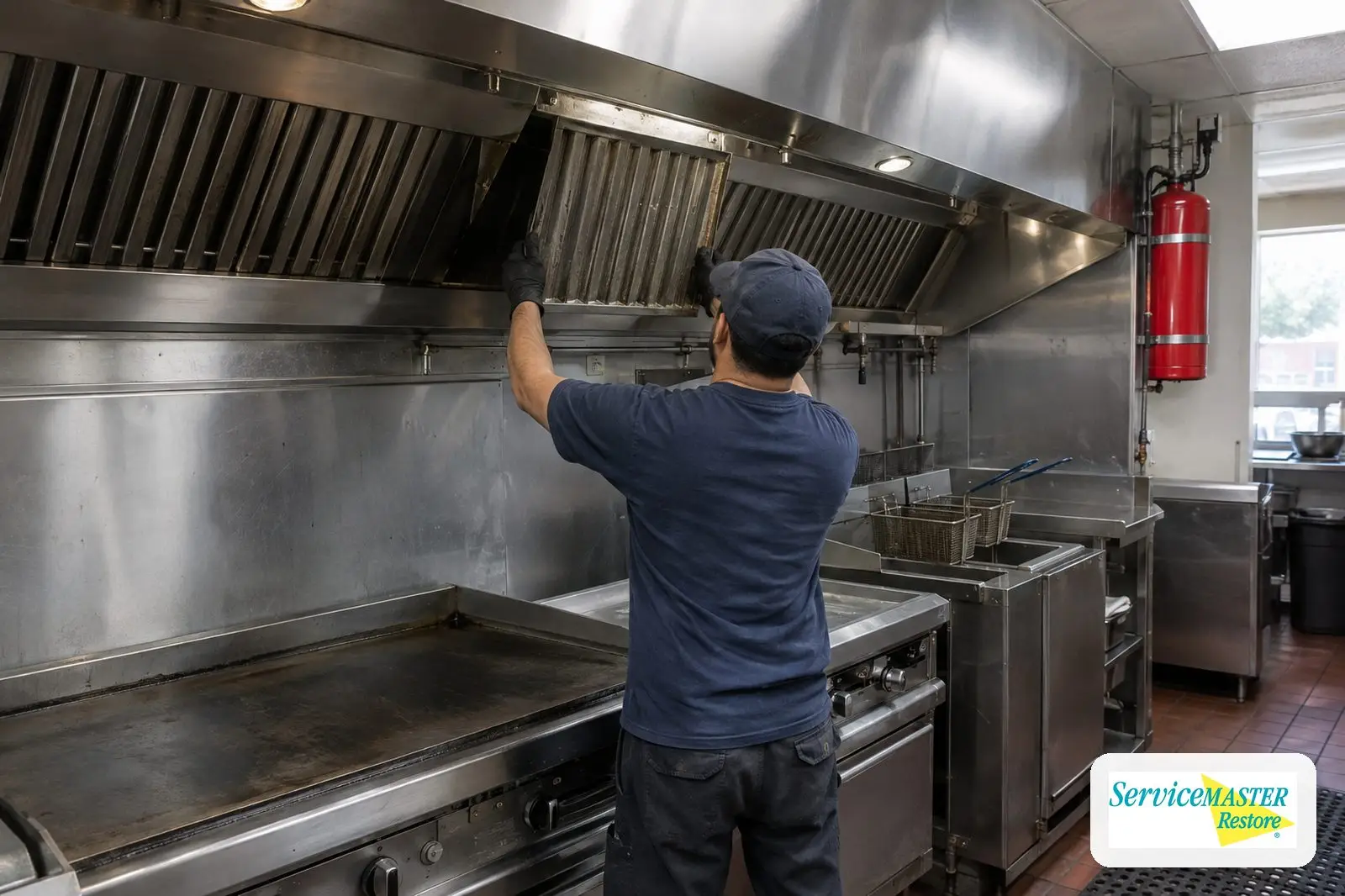
The leading causes of commercial fires are cooking, careless actions such as heat sources left near combustibles, intentional fire-setting, electrical malfunctions, and heating equipment. In U.S. Fire Administration data for 2017 to 2019, cooking alone caused 30% of nonresidential building fires. Warehouses differ: NFPA finds industrial equipment and electrical systems lead there.
Commercial fires are less common than house fires, but costlier. The U.S. Fire Administration (USFA) estimates that fire departments responded to 110,000 nonresidential building fires in 2023, with 130 deaths, 1,200 injuries, and about $3.16 billion in direct losses (USFA, Nonresidential Building Fire Statistics). In its 2017 to 2019 analysis, USFA found that nonresidential buildings made up only 8% of all fires but 20% of total fire dollar loss (USFA, Nonresidential Building Fires 2017-2019).
Locally, the risk spans office parks in Naperville and Oak Brook, restaurants on every main street, and distribution buildings along I-55 in Bolingbrook and Romeoville. We have cleaned up after commercial fires here for over 20 years. Below is what the data says starts these fires, followed by a prevention checklist.
The leading causes of commercial fires
Most published numbers come from the National Fire Incident Reporting System (NFIRS), which USFA runs with reports from local fire departments. USFA sorts each fire into one cause group, while NFPA’s property-type reports often track the equipment involved, so the two should not be added together. USFA’s latest nonresidential report covers 2017 to 2019, an average of 108,500 fires a year.
Leading causes of nonresidential building fires, U.S., 2017 to 2019
Percent of fires where a cause was determined
1. Cooking
Cooking leads by a wide margin, and not only in restaurants. It was the top cause in eating and drinking places (64%), stores and offices (33%), schools, and assembly buildings. Most (95%) were small, confined fires, and USFA’s annual estimates still show cooking as the largest cause in 2023, at 33,300 fires (USFA, Nonresidential Building Fire Causes).
Offices show how cooking turns up in buildings that are not restaurants. NFPA’s office study found cooking equipment involved in 29% of fires, and 22% started in a kitchen or cooking area (NFPA, U.S. Structure Fires in Office Properties). That data covers 2007 to 2011, so read it as a pattern, not a current count.
2. Careless actions
This USFA group covers misused or discarded materials and heat sources placed too close to combustibles. It ranks second overall. Among the larger fires that spread beyond the room where they started, careless actions were the leading cause at 25%. They also led in storage buildings, at 26% of fires.
3. Intentional fires
Intentional fires accounted for about one in ten nonresidential fires in 2017 to 2019. USFA’s annual estimates rose from 8,800 in 2014 to a peak of 18,900 in 2022, then 14,300 in 2023. In offices, NFPA found intentionally set fires were 10% of incidents but caused 20% of direct property damage, the largest share of any cause.
4. Electrical malfunctions
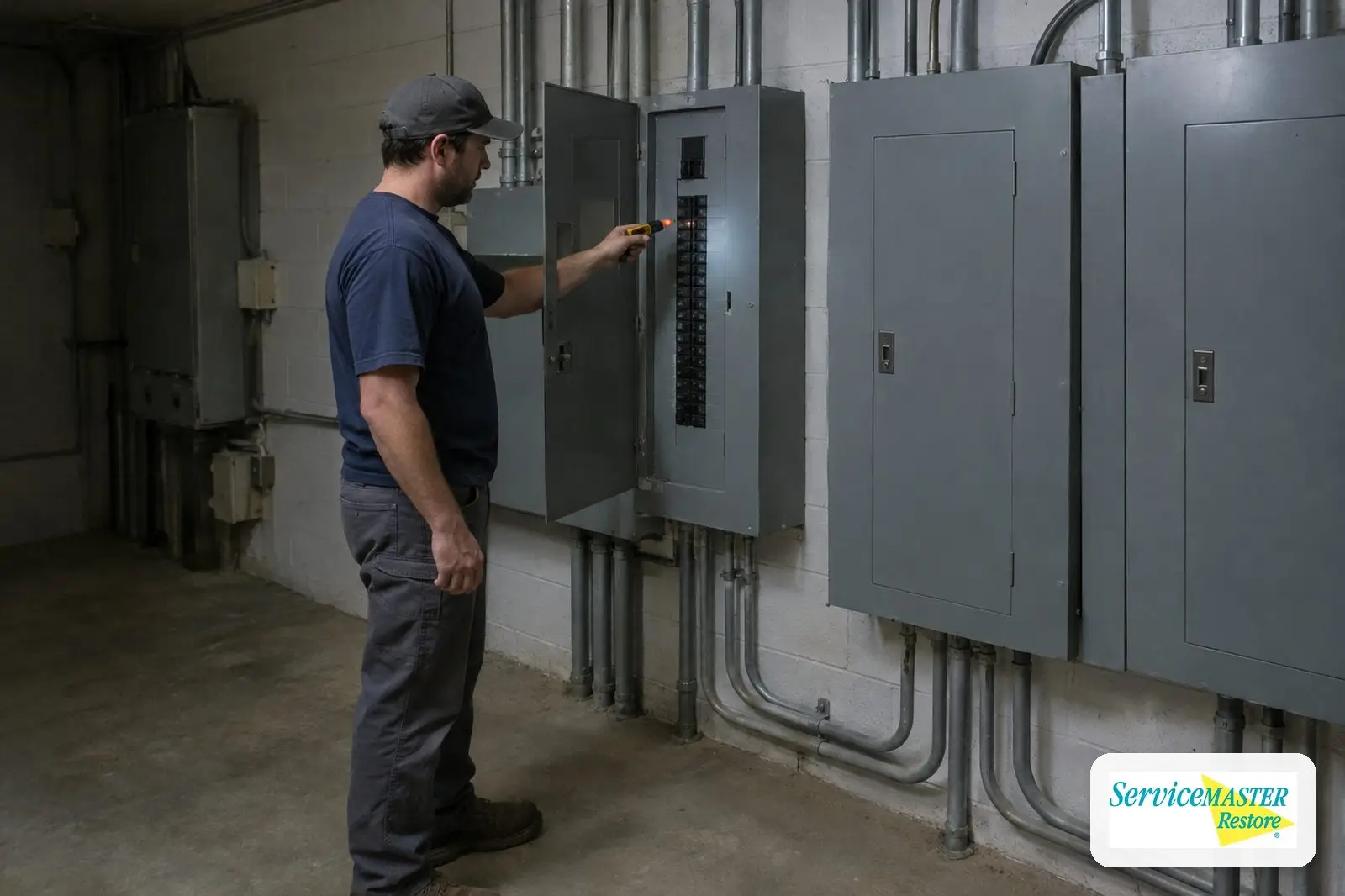
Short circuits and wiring problems caused about 8% of nonresidential fires and 11% of the larger fires that spread beyond the room of origin. In offices, NFPA ranked electrical distribution and lighting equipment second, at 12% of fires and 15% of damage.
5. Heating
Heating caused about 7% of nonresidential fires, but the injury numbers stand out. In NFPA’s office study, heating equipment was involved in 11% of fires but 19% of civilian injuries, and fixed or portable space heaters were involved in just 2% of fires but 12% of injuries.
How the causes change by property type
The national average hides big differences between a restaurant and a warehouse.
| Property type | Leading causes (share of fires) | Data |
|---|---|---|
| Eating and drinking places | Cooking 63.8%, heating 6.4%, electrical malfunction 5.6% | USFA, 2017-2019 |
| Stores and offices | Cooking 32.7%, electrical malfunction 11.0%, heating 8.3% | USFA, 2017-2019 |
| Offices only | Cooking equipment 29%, electrical distribution and lighting 12%, heating 11%, intentional 10% | NFPA, 2007-2011 |
| Storage buildings | Careless actions 26.0%, open flame 10.8%, electrical malfunction 9.7% | USFA, 2017-2019 |
| Warehouses | Shop tools and industrial equipment 19%, electrical distribution 16%, HVAC 13%, cooking 6% (equipment involved) | NFPA, 2020-2024 |
| Manufacturing | Other equipment 16.5%, heating 15.4%, equipment misoperation or failure 13.9% | USFA, 2017-2019 |
NFPA’s February 2026 warehouse report estimates an average of 1,544 warehouse fires a year from 2020 to 2024, causing $314 million in direct property damage annually. Arcing from operating equipment caused 13% of fires but 25% of damage. Processed wood or paper, such as cardboard, sawn wood, and plywood, was the first material ignited in 41% of fires. Fires that started in storage areas were 37% of incidents and 69% of the damage.
Commercial fire prevention checklist for owners and property managers
Each item maps to a cause above. Give every line an owner and a date.
Cooking and break rooms
- Office kitchens: no unattended cooking, and no paper or packaging next to toasters and microwaves.
- For commercial kitchens, follow the hood and exhaust inspection schedule in NFPA 96. The 2017 edition’s Table 11.4 calls for grease buildup inspections monthly for solid fuel cooking, quarterly for high-volume operations such as 24-hour, charbroiling, or wok cooking, semiannually for moderate volume, and annually for low volume (NFPA 96-2017 summary, Village of New Paltz). Ask your fire department which edition it enforces.
- Keep the kitchen’s fire suppression system and portable extinguishers on a service schedule with a licensed company.
Electrical systems
- Call a licensed electrician for breakers that keep tripping, warm outlets, flickering lights, or a burning smell.
- Replace damaged cords, and do not use extension cords as permanent wiring.
- In warehouses and shops, put charging areas, conveyors, and production equipment on a maintenance plan.
- Keep electrical rooms and panels clear of storage.
Heating equipment
- Service rooftop units, boilers, and unit heaters every fall, before heating season.
- Write a space heater policy: away from paper and trash cans, and off at the end of the day.
Storage, trash, and housekeeping
- Break down and remove cardboard and pallets often. Rubbish, trash, or waste was the item first ignited in 15% of warehouse fires in NFPA’s 2026 report.
- Keep storage clear of heat sources, light fixtures, and sprinkler heads, and keep exits open.
- Store flammable liquids in approved containers, and keep only what you need on site.
Security and arson deterrence
- Light the exterior, lock dumpster enclosures, and keep dumpsters and pallet stacks away from walls.
- Secure vacant suites quickly. In NFPA’s warehouse data, vacant and unsecured buildings accounted for 15% of fires.
Sprinklers, alarms, and extinguishers
In USFA’s data, smoke alarms were missing in 50% of the larger fires in occupied nonresidential buildings, and automatic extinguishing systems were present in only 22%. Where installed, sprinklers work: NFPA’s office report found wet pipe sprinklers operated in 90% of fires large enough to activate them and were effective in 88%.
- Sprinkler systems: NFPA 25 is the standard for inspection, testing, and maintenance of water-based fire protection systems. In Illinois, anyone who inspects and maintains automatic sprinkler systems, other than weekly or monthly checks of control valves and gauges, must be an OSFM-licensed fire sprinkler contractor (Illinois State Fire Marshal FAQ).
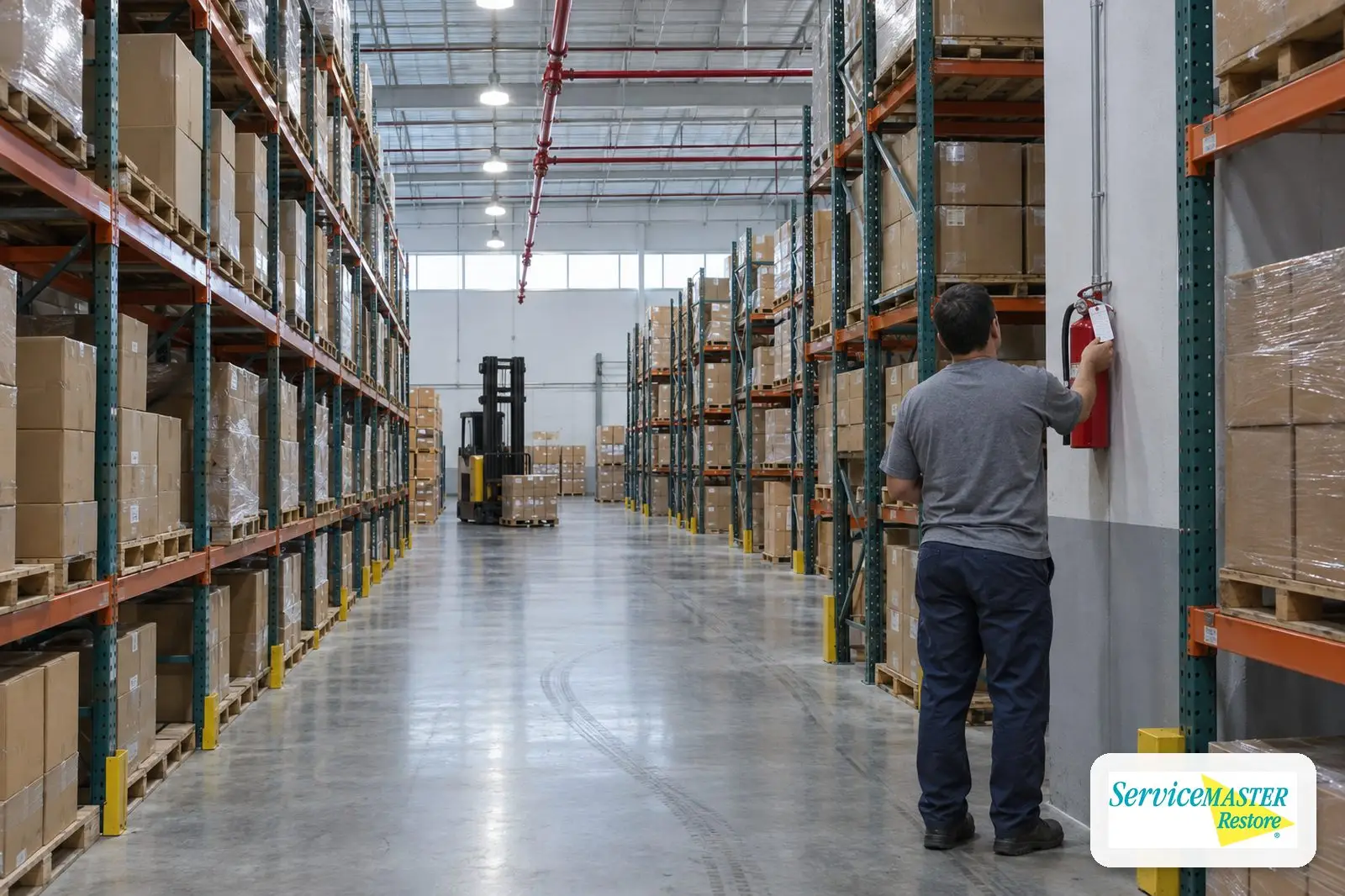
- Portable extinguishers: OSHA requires employers to visually inspect extinguishers monthly and give them an annual maintenance check, with the date recorded (OSHA 29 CFR 1910.157). Service companies work to NFPA 10, and Illinois requires anyone who services or inspects extinguishers to hold a State Fire Marshal license. If employees are expected to use extinguishers, OSHA requires training at hire and yearly.
- After-hours monitoring: NFPA found office fires between 7 p.m. and 7 a.m. were 31% of incidents but 67% of damage, and warehouse fires between midnight and 6 a.m. were 18% of fires but 40% of damage. Monitored alarms help close that gap.
Illinois and local fire inspections
The Office of the Illinois State Fire Marshal adopted the 2015 edition of the NFPA Life Safety Code, effective January 1, 2020. OSFM also notes that locally adopted codes apply at the same time and may be stricter. Day to day, your city fire department or fire protection district does the inspecting. Naperville, for example, inspects all commercial and multi-family occupancies every year and expects violations corrected within two weeks (Naperville Fire Department). Other towns run their own programs, so ask your local fire prevention office what applies.
An emergency plan your staff has practiced
When OSHA requires an emergency action plan, it must be written and kept in the workplace, though employers with 10 or fewer employees may communicate it orally. It must cover how to report a fire and how to evacuate, including exit routes (OSHA 29 CFR 1910.38). Pair it with our guide to business continuity after commercial damage.
What to do if a fire happens anyway
Prevention lowers the odds but never to zero. If a fire happens, protect people first and your claim second.
- Get everyone out and call 911. Account for every employee at your meeting point.
- Wait for the fire department’s all-clear before anyone goes back in, and get the incident report number.
- Secure the building. Broken windows and roof openings from firefighting let in weather and intruders. Emergency board-up and site securing helps keep the loss from growing.
- Call your insurance agent and photograph the damage before anything is moved. Policies vary, so ask your adjuster what your coverage requires.
- Start professional cleanup quickly. Firefighting leaves a lot of water behind, and the EPA advises drying water-damaged materials within 24 to 48 hours to prevent mold growth (EPA, A Brief Guide to Mold, Moisture and Your Home).
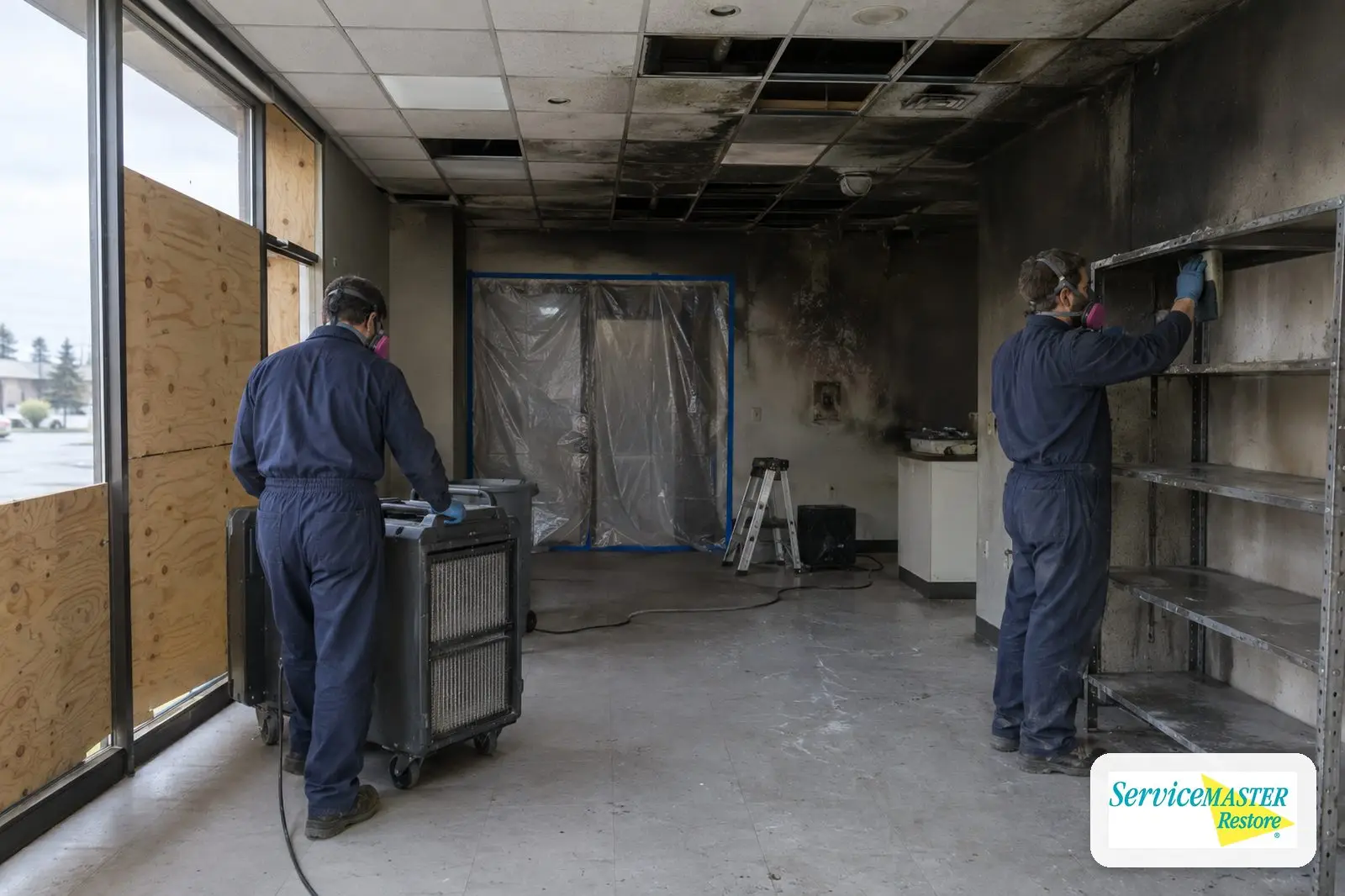
The industry’s reference for this work is ANSI/IICRC S700, the standard for professional fire and smoke damage restoration. Our commercial fire damage restoration service covers smoke and soot cleanup, odor treatment, and water damage cleanup after firefighting. Damage mitigation for businesses is about limiting further loss while you plan repairs, and we help with insurance claims. For local service, see fire damage restoration in Naperville and fire damage restoration in Lemont. For the full first-week playbook, read what to do after a fire at your business.
This is general safety information, not legal, code, or insurance advice. Requirements and coverage vary; check with your fire department and your agent or adjuster.
Frequently Asked Questions
What is the most common cause of commercial fires?
Cooking. In USFA’s 2017 to 2019 data, cooking caused 30% of nonresidential building fires where a cause was determined, more than twice the next category. It led in restaurants, stores, offices, and schools. Most were small and confined, but kitchens and break rooms are still the first place to focus prevention.
What causes most warehouse fires?
NFPA’s 2026 report on warehouses found shop tools and industrial equipment were involved in 19% of fires from 2020 to 2024, and electrical distribution and lighting equipment in 16%. Operating equipment was the leading heat source at 43%. Processed wood or paper, such as cardboard and plywood, was the first material ignited in 41% of warehouse fires.
How often do fire extinguishers need to be inspected in a business?
Under OSHA 29 CFR 1910.157, portable extinguishers must be visually inspected every month and receive an annual maintenance check, and the employer must record the annual maintenance date. In Illinois, the company doing that service must be licensed by the Office of the State Fire Marshal.
Who inspects businesses for fire safety in Illinois?
Usually your city fire department or fire protection district. The State Fire Marshal has adopted the 2015 NFPA Life Safety Code, and local codes apply alongside it and can be stricter. Naperville, for example, inspects every commercial occupancy annually. Ask your local fire prevention office which schedule applies.
How often should a restaurant hood be cleaned?
NFPA 96 sets how often the hood and exhaust system is inspected for grease buildup, and contaminated parts must then be cleaned. The 2017 edition calls for monthly inspection for solid fuel cooking, quarterly for high-volume kitchens, semiannually for moderate volume, and annually for low volume. Confirm the edition your fire department enforces.
Related guides and services
- Commercial fire damage restoration for DuPage and Will County businesses
- Damage mitigation for businesses
- Emergency board-up and site securing
- Smoke and soot cleanup
- What to do after a fire at your business
- Restaurant kitchen fire damage restoration
- The fire and smoke damage restoration process
- Business continuity planning for commercial property
- All restoration guides
Fire or smoke damage at your business? Call (630) 241-1111, 24/7, to reach ServiceMaster Restoration Services in Lisle, or send us a message. Our certified technicians handle commercial fire, smoke, and water damage across DuPage and Will County and work with your insurance company.
Sources
- U.S. Fire Administration (FEMA), Nonresidential Building Fires (2017-2019), Topical Fire Report Series Vol. 21, Issue 9
- U.S. Fire Administration, Nonresidential Building Fire Statistics, National Estimates
- U.S. Fire Administration, Nonresidential Building Fire Causes (2014-2023)
- NFPA Research, Warehouse Structure Fires (Tucker McGree, February 2026)
- NFPA, U.S. Structure Fires in Office Properties (Richard Campbell, August 2013)
- NFPA 96, Standard for Ventilation Control and Fire Protection of Commercial Cooking Operations
- Village of New Paltz, NY, Kitchen Hood Cleaning Requirements (summary of NFPA 96-2017, Table 11.4)
- NFPA 25, Standard for the Inspection, Testing, and Maintenance of Water-Based Fire Protection Systems
- NFPA 10, Standard for Portable Fire Extinguishers
- OSHA, 29 CFR 1910.157 Portable Fire Extinguishers
- OSHA, 29 CFR 1910.38 Emergency Action Plans
- Office of the Illinois State Fire Marshal, Fire Prevention and Building Safety FAQ
- Naperville Fire Department, Inspections and Permits
- IICRC, ANSI/IICRC S700 Standard for Professional Fire and Smoke Damage Restoration
- U.S. EPA, A Brief Guide to Mold, Moisture and Your Home