
Water, fire and mold restoration in Clarendon Hills, IL
ServiceMaster Restoration Services offers round-the-clock water damage restoration, fire and smoke cleanup, mold remediation, biohazard cleanup and cleaning in Clarendon Hills. The local fact worth knowing: in the village's April 2013 flood study, about 70% of reported home flooding came from surface water entering through basement windows and doorways, not from the sewer.
Which way does storm water drain in Clarendon Hills?
The village straddles a watershed divide. According to the Village of Clarendon Hills stormwater management page, land in the north drains through the Bronswood Creek watershed northeast to Salt Creek, while the southern part drains through Flagg Creek southeast toward the Des Plaines River. Blue Lake, Hosek Park, Prospect Park, the Park Avenue basin and the privately owned Hinsdale Golf Club all hold water during big storms.
The whole village lies in DuPage County, and it administers the county's stormwater ordinance as a partial waiver community. In practice, that means grading and drainage changes on a lot are reviewed against county rules, which matters if you plan to regrade after a flood. Heavy thunderstorms are the usual trigger here, and the National Weather Service office in Chicago keeps severe weather preparedness guidance on damaging wind, hail and lightning. Winter adds a quieter risk when a sump discharge line freezes solid.

What the April 2013 storm showed
Rain began late on April 17, 2013 and continued into the next morning. The USGS gage on Salt Creek at 22nd Street, about 3.5 miles from Village Hall, logged 6.48 inches over roughly 19.5 hours. Of 41 resident questionnaires collected afterward, about 70% traced structure flooding to overland flow, 16% to seepage through basement walls and 14% to sanitary backup or sump pump failure.
That breakdown, from the village's 2013 stormwater study, changes how a homeowner should think about protection. A backwater valve does nothing for water pouring over a window well. Grading, window well covers, raised thresholds and clear swales between houses deal with the most common path.
The village also runs a Stormwater Improvement Cost Share Program for drainage problems that cross property lines. When flooding affects more than one adjacent property, participating owners can be reimbursed 50% of labor and materials, up to $2,000 each and $10,000 per project, subject to annual funding.
What does the age of local homes mean for repairs?
Clarendon Hills has 3,342 housing units, with a median year built of 1982 in the American Community Survey. The data show two clear building waves rather than one steady stream.
Homes in Clarendon Hills by decade built
Share of all 3,342 housing units, Clarendon Hills village, ACS 2020–2024 5-year estimates
Source: U.S. Census Bureau, American Community Survey 2020–2024 5-year estimates, table B25034
More than a quarter of homes date from 1940 to 1959, and another 30.8% from 1980 to 1999. Overall, 45.3% were built before 1980. Postwar houses may still have original window wells, older sewer laterals and basements that were finished decades after construction. Newer homes often have fully finished lower levels where carpet, drywall and built-ins raise the cost of any water that gets in.
The older group also brings regulatory steps. EPA's lead-safe RRP rule covers paid work that disturbs paint in homes built before 1978, and EPA advises having suspect building materials checked by an accredited professional before remodeling or removing damaged materials. A flooded basement in a 1950s ranch often means cutting drywall or lifting old floor tile, so testing belongs at the start of the job.
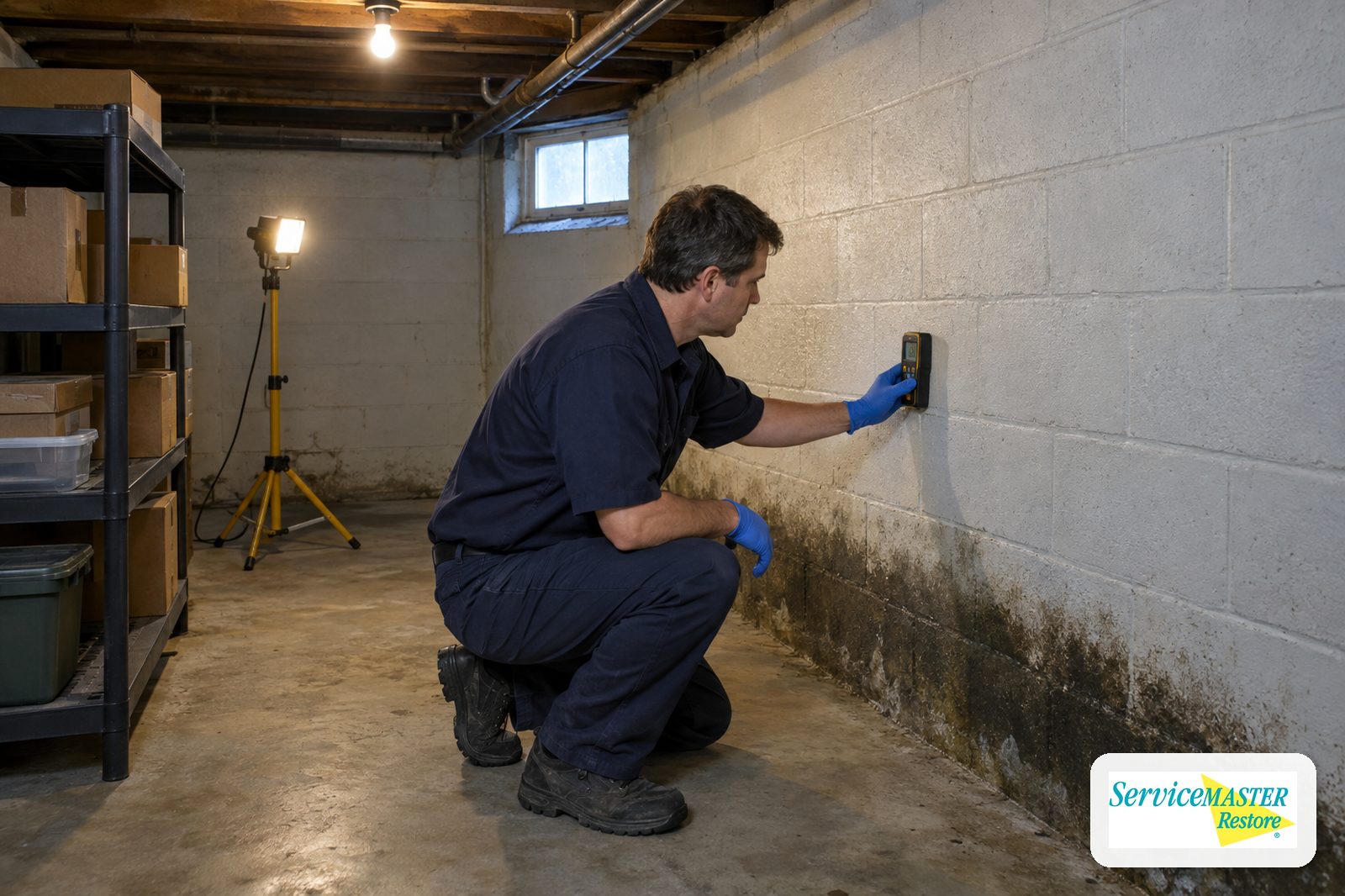
Seepage looks different from a flood
Water that seeps through a foundation wall usually shows as a damp band along the base of the wall and a musty smell rather than standing water. It still wets drywall, carpet pad and stored boxes, and EPA's mold guidance calls for drying damp materials within 24 to 48 hours of a leak.
Restoration services for Clarendon Hills homes
Water. Our Clarendon Hills water damage restoration work covers extraction, drying and moisture monitoring after storms, appliance leaks and frozen pipes. The guide to basement flooding after heavy rain explains why DuPage basements take on water.
Fire and smoke. From a small kitchen fire to a full-house loss, fire damage restoration in Clarendon Hills includes board-up, soot removal and odor treatment. More detail is on our fire damage overview.
Mold. Basements that stayed damp after a storm are the usual source. See mold remediation for Clarendon Hills properties.
Biohazard and cleaning. We provide confidential biohazard and trauma cleanup in Clarendon Hills, plus professional cleaning in Clarendon Hills for homes and businesses.
For storm-driven losses, our flood and storm damage cleanup page walks through the process, and help with insurance claims covers documentation.
Water in the basement: what to do in the first hour
- Do not walk into a flooded basement with the power on. Ready.gov warns against touching wet electrical equipment or standing in water near it.
- Find where the water is entering. A window well, a doorway, a floor drain and a wall crack each point to a different fix and a different insurance question.
- Keep the sump discharge clear. Make sure the outlet is not buried in snow, ice or debris so the pump can keep moving water out.
- Photograph high-water marks. The 2013 study used marks like these to map how deep water got, and adjusters use them too.
- Lift what you can off the floor. Boxes, rugs and electronics wick or short out quickly.
- Call your insurer, then a restoration company. Ask the insurer whether your policy treats surface water, seepage and backup differently.

Drying a finished lower level
Once standing water is gone, air movers push moist air off wet surfaces and dehumidifiers pull it out of the room. Baseboards and the lower edge of drywall often come off so wall cavities can dry, and readings are logged until materials reach normal levels.
Nearby communities
The village's drainage system also carries rain that falls on neighboring communities, and we serve those neighbors too, including Hinsdale, Westmont and Willowbrook, from our headquarters at 924 Ogden Ave in Lisle. Our team has worked across DuPage and Will County for more than 20 years, with certified technicians for both residential and commercial losses.
Have a wet basement or smoke damage now? Contact us online or call (630) 241-1111, 24/7.
Frequently asked questions
Do you cover every part of Clarendon Hills?
Yes. Clarendon Hills lies entirely in DuPage County, and we serve the whole village as part of our DuPage and Will County service area, along with nearby communities. Our headquarters is in Lisle, and we take calls 24/7 for water, fire, mold, biohazard and cleaning needs at homes and businesses.
What caused most basement flooding in Clarendon Hills in April 2013?
In the village's 2013 stormwater study, about 70% of reported structure flooding came from overland flow entering through basement windows or doorways, fed by street and yard ponding and overflow from the Hinsdale Golf Club. Seepage accounted for about 16%, and sanitary backup or sump pump failure about 14%, based on 41 resident questionnaires.
Does Clarendon Hills help pay for drainage fixes between neighboring yards?
It can. The village's Stormwater Improvement Cost Share Program, set up by Resolution R-20-06, reimburses 50% of labor and material costs, up to $2,000 per participating property and $10,000 per project, when flooding affects more than one adjacent property. Funding is set each year and paid first come, first served, so contact Community Development before you start.
Will regrading my yard after a flood need village review?
Often, yes. Clarendon Hills has adopted the DuPage County Stormwater Ordinance and administers it as a partial waiver community, so changes that alter how water leaves your lot may be reviewed against county and village rules. Ask the village's Community Development Department before moving soil, building berms or redirecting a swale toward a neighbor.
Is a damp basement wall something to worry about if there is no standing water?
It can be. Seepage still soaks drywall, carpet pad, framing and anything stored against the wall. EPA's mold guidance says damp or wet materials dried within 24 to 48 hours usually will not grow mold, so a wall that stays damp for days is worth measuring with a moisture meter and drying properly.
Sources
- U.S. Census Bureau: American Community Survey 2020–2024 5-year estimates, table B25034 (Year Structure Built)
- Village of Clarendon Hills: Stormwater Management
- Village of Clarendon Hills / Christopher B. Burke Engineering: 2013 Stormwater Study – Final Report (April 18, 2013 Storm Event)
- Village of Clarendon Hills: Stormwater Improvement Cost Share Program brochure
- U.S. EPA: Lead Renovation, Repair and Painting Program
- U.S. EPA: Protect Your Family from Exposures to Asbestos
- U.S. EPA: A Brief Guide to Mold, Moisture and Your Home
- Ready.gov (FEMA): Floods