Short answer: Usually not. Under OSHA's bloodborne pathogens rules, urine is not considered potentially infectious material unless it is visibly contaminated with blood. Still, heavy saturation in carpet, subfloor or drywall, rodent urine, and urine mixed with other body fluids call for protective gear, disinfection and often removal of soaked materials.
This question usually comes up in a hard moment: months of pet accidents under the carpet, a parent whose incontinence went unnoticed, a home affected by hoarding, an unattended death, or mice and rats in the attic. There are two answers. The regulatory answer is usually no. The practical answer is that large amounts of urine soaked into a house still need careful, sometimes professional, cleanup.
What OSHA's rules say about urine
The federal benchmark for body fluids is OSHA's Bloodborne Pathogens standard, 29 CFR 1910.1030. It defines "other potentially infectious materials," the body fluids treated like blood. Urine is not on that list. The definition does include "any body fluid that is visibly contaminated with blood," and "all body fluids in situations where it is difficult or impossible to differentiate between body fluids."
OSHA confirmed this in a 1992 interpretation letter about hotel housekeepers. Workers handling linens soiled with urine, feces, vomit, saliva or similar substances are not considered occupationally exposed, because those substances are not other potentially infectious materials "unless they are contaminated with visible blood."
The rule exists to protect workers, but it is the clearest federal line between ordinary bodily waste and infectious material. Blood-tinged urine changes the answer, and so does a scene where fluids are mixed and cannot be told apart, such as after an unattended death.
| Situation | Biohazard under OSHA's definition? | What cleanup involves |
|---|---|---|
| Pet urine in carpet or on floors | No | Odor and saturation: pad, subfloor or drywall may need removal and sealing |
| Human urine with no visible blood | No | Gloves, cleaning and disinfection; removal of soaked porous materials |
| Urine with visible blood | Yes, treated as potentially infectious | Bloodborne pathogen precautions; waste handled as regulated waste |
| Mixed fluids after an unattended death | Treated as potentially infectious when fluids cannot be told apart | Professional biohazard cleanup |
| Rodent urine and droppings | Not covered by the bloodborne rule, but a disease risk | CDC wet-cleaning method: never sweep or vacuum |
Why large-scale saturation still matters
Not being a regulated biohazard does not make urine harmless at scale. When it soaks into a home over weeks or months, three problems build up.
- Ammonia and odor. The sharp smell of old urine comes largely from ammonia. NIOSH's Pocket Guide entry for ammonia lists irritation of the eyes, nose and throat, breathing difficulty and wheezing among exposure symptoms. That guide covers workplace exposure, and levels in a home vary widely, but it explains why a heavily soaked room can be unpleasant or irritating to be in.
- Bacteria and residue. Urine soaked into carpet and pad stays damp and dirty underneath, even after the surface dries.
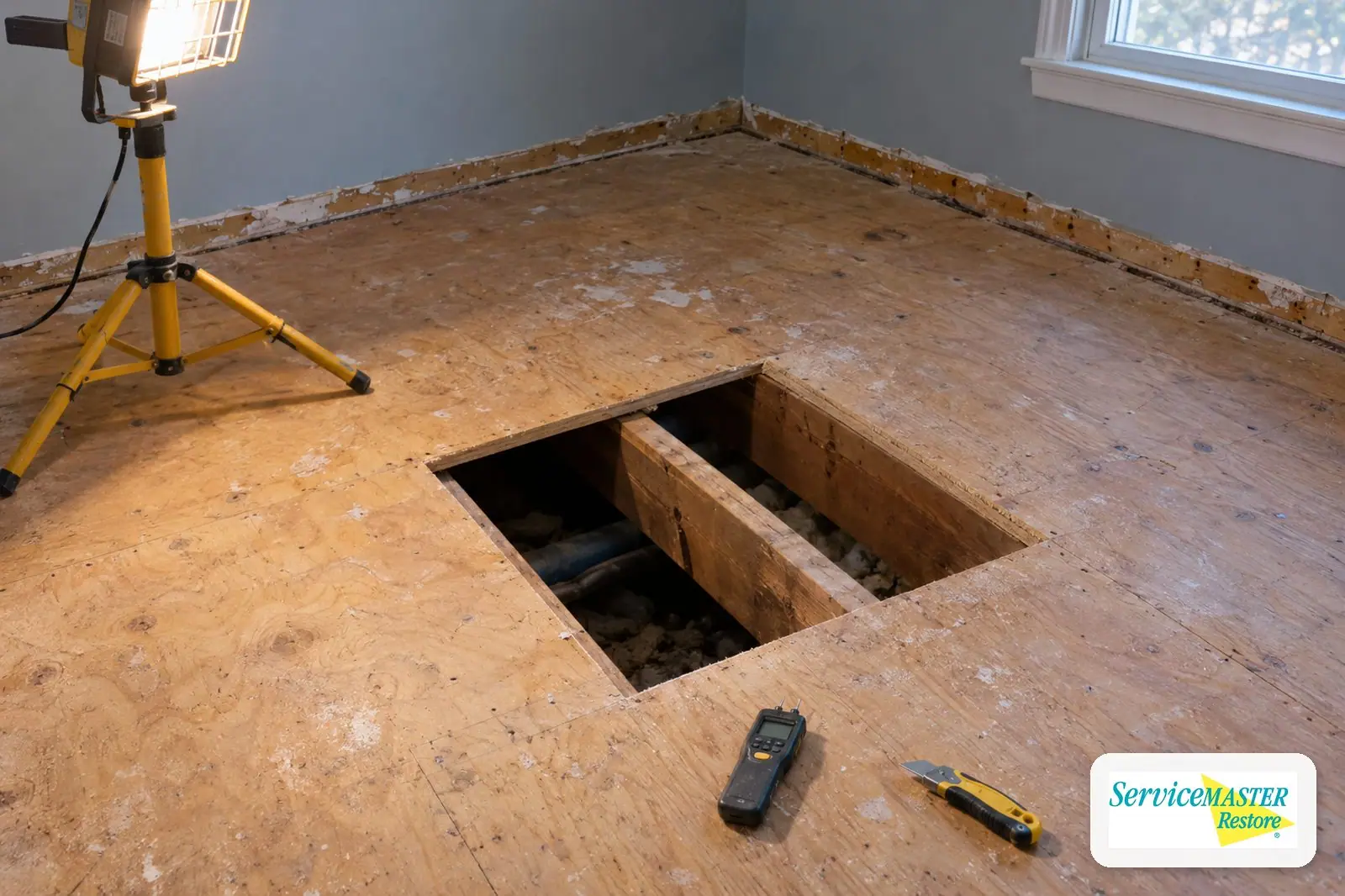
- Structural soaking. Urine runs through carpet into the pad and plywood subfloor, wicks into the bottom edge of drywall and baseboards, and gets into upholstered furniture. Surface cleaning cannot reach it, which is why the odor keeps returning.
If anyone in the home has headaches, breathing problems or other symptoms they think are related, they should talk to a doctor.
Catching it early saves the floor
Most heavy urine damage starts small and builds up where nobody looks: behind a couch, under a bed, in a closet corner or around the base of a toilet. Fresh spots on sealed surfaces clean up with gloves, an everyday cleaner and a disinfectant used as the label directs. The damage that forces flooring out comes from repeated soaking over time.
- Pets. Check hidden corners and the edges of rugs. On hardwood and laminate, urine works into the seams and can stain or swell boards so they need replacing.
- Caring for a relative with incontinence. Waterproof mattress and chair covers and prompt laundering protect furniture. If a smell seems to come from the room rather than one item, check the flooring underneath.
- Around toilets. A lasting smell at the toilet base can mean a failed wax ring is letting water and waste reach the subfloor. That is a plumbing repair first.
Rodent urine is its own case
Mouse and rat urine and droppings need a specific method. The CDC's guidance on how to clean up after rodents warns that sweeping or vacuuming can put tiny droplets containing viruses into the air, and that rodent diseases mainly spread when people breathe contaminated air. CDC's steps:
- Open doors and windows for 30 minutes before cleaning, and leave the area during that time.
- Put on rubber or plastic gloves.
- Spray the urine and droppings with an EPA-registered disinfectant or a bleach solution of 1.5 cups of household bleach in 1 gallon of water.
- Let it soak for 5 minutes, or as long as the disinfectant label directs.
- Wipe it up with paper towels and throw them in a covered garbage can.
- Never sweep or vacuum rodent urine, droppings or nesting materials.
Large infestations in attics, crawl spaces or garages are worth handing to a professional, both for the cleanup and for removing contaminated insulation.
What professional cleanup involves
For heavy urine damage, professional work looks more like restoration than cleaning:
- Mapping where urine traveled, including under flooring, behind baseboards and into furniture.
- Removing saturated carpet, pad, and sections of subfloor or drywall that cannot be cleaned.
- Cleaning and disinfecting remaining surfaces with EPA-registered products. EPA's guidance on selected registered disinfectants says the surface should stay visibly wet for the full contact time on the label.
- Sealing subfloor and framing with an odor-blocking primer once dry.
- Treating remaining odor in the air and structure.
Our sanitization and deodorization and odor removal and air quality treatment services handle this work. In homes affected by hoarding, cleanup should move at a pace the resident can manage, with respect for their belongings. Our hoarding cleanup and property restoration service and our guide to the hoarding cleanup process, safety and insurance explain how that works.
When to call a professional
Call when urine has soaked through flooring, when odor keeps coming back after cleaning, when blood is visible, when the situation involves an unattended death, or when rodents have contaminated an attic or crawl space. ServiceMaster Restoration Services in Lisle provides biohazard cleanup and odor removal for homes and businesses across DuPage and Will County, with more than 20 years of experience and IICRC-certified technicians. We can also help with insurance questions. Call (630) 241-1111, 24/7.
More questions
Are feces and vomit considered biohazards?
Under OSHA's bloodborne pathogens rules, no, unless they contain visible blood. OSHA's 1992 letter on hotel housekeeping lists feces, urine and vomit together as substances that are not other potentially infectious materials unless contaminated with visible blood. They still call for gloves, cleaning and disinfection.
Can I put urine-soaked carpet in the regular trash?
In most homes, carpet and pad soaked with urine but no visible blood is handled as ordinary household or bulk waste. Roll it, wrap it in heavy plastic to contain the odor, and check your hauler's rules for bulk items.
Will enzyme cleaners or vinegar fix old urine odor?
They can help with a fresh spot on the surface. They rarely fix old, heavy saturation, because the urine has reached the pad, subfloor or drywall where the cleaner cannot fully reach. If the smell returns on humid days, the source is still in the structure.
What should I wear to clean up a small amount of urine?
Disposable gloves are the basic step. Add eye protection if you might splash, open windows for ventilation, and wash your hands afterward. For rodent urine, follow CDC's method: ventilate for 30 minutes, wear rubber or plastic gloves, and never sweep or vacuum.
Sources
- 29 CFR 1910.1030 Bloodborne Pathogens standard (OSHA)
- Bloodborne pathogens standard's relationship to the coverage of housekeepers and laundry attendants in a hotel environment (OSHA interpretation letter, Aug. 7, 1992)
- NIOSH Pocket Guide to Chemical Hazards: Ammonia (CDC/NIOSH)
- How to Clean Up After Rodents (CDC)
- Selected EPA-Registered Disinfectants (EPA)