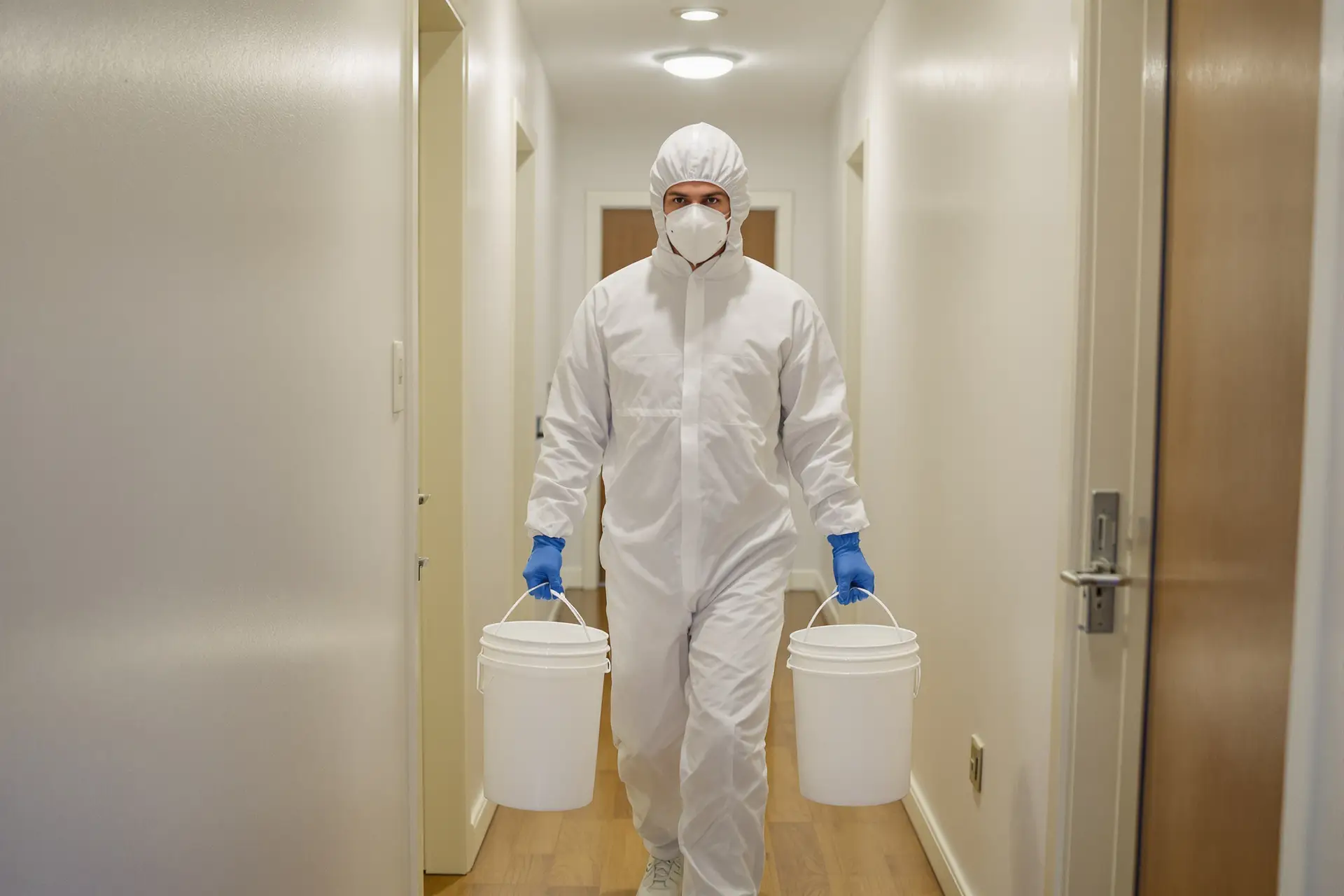
Biohazard and trauma scene cleanup is the professional cleaning, disinfection, and safe disposal of biological hazards after a death, accident, or serious contamination. Trained, PPE-equipped technicians restore the space so it is safe again. Homeowners insurance often pays, minus a deductible; for violent crimes, state victim compensation may help.
This guide is written to help during a hard time. It is general education, not legal, medical, or insurance advice, and it is intentionally non-graphic. Coverage and eligibility decisions rest with your insurer and, where applicable, the Illinois Attorney General’s Crime Victim Compensation Program. If you are in crisis, please call or text 988 for the Suicide & Crisis Lifeline.
If you are reading this, you may be facing something no one is ever ready for. Perhaps a loved one passed at home and was not found right away. Perhaps you are a property manager who just opened a unit in Naperville or Joliet and realized it needs far more than a standard clean. Whatever brought you here, we want to be clear and calm about what happens next, because uncertainty only adds to the weight you are already carrying. This article explains, gently and honestly, what biohazard and trauma cleanup actually involves, who typically pays for it, and why discretion and confidentiality are built into the work from the first phone call.
Our goal is not to sell you fear. It is to give grieving families, landlords, and business owners across DuPage and Will County practical footing at a moment when the ground feels anything but steady. You do not have to become an expert in any of this. You only need to know enough to make one good decision: call people who handle it with skill and care.
What biohazard and trauma scene cleanup involves
“Biohazard cleanup” is a broad term for restoring a space after it has been exposed to blood, bodily fluids, or other potentially infectious material. It covers unattended deaths, accidents, medical events, and, in some cases, hoarding conditions that have created a health risk. The common thread is that ordinary household cleaning is not safe or sufficient. These situations fall under federal workplace safety rules, specifically the U.S. Occupational Safety and Health Administration’s Bloodborne Pathogens standard (29 CFR 1910.1030), which requires that anyone with occupational exposure to blood or infectious material follow universal precautions, use proper personal protective equipment, and dispose of regulated waste through strict, documented procedures.
In plain terms, that standard exists because blood and bodily fluids can carry pathogens such as hepatitis B, hepatitis C, and HIV, and there is no reliable way to tell by looking whether a given surface is infectious. That is why professionals treat every scene as if it were, and why this is genuinely not a job for family members with household cleaners. The process is methodical and respectful, and it generally moves through the same stages, kept non-graphic here on purpose.
Assessment and a discreet arrival
The work begins before anyone puts on a suit. A technician quietly assesses the affected area, identifies what has been contaminated, and plans containment. In residential neighborhoods, a reputable crew arrives in unmarked or plain vehicles and works without drawing attention, because your privacy matters as much as the cleaning itself. More on that below.
Containment
Before cleaning, the team isolates the affected zone so that contamination cannot spread to unaffected rooms through foot traffic, air movement, or shared surfaces. This can involve physical barriers and controlled entry and exit points. Containment protects the rest of the home or building and keeps the work focused where it belongs.
Personal protective equipment (PPE)
Technicians wear the protective gear the situation calls for: gloves, protective suits, respiratory protection, and eye protection among them. Under the OSHA standard, employers are responsible for providing, maintaining, and properly disposing of that equipment. PPE is not for show. It is what makes it possible to do this work safely, and it is one of the clearest lines between a trained professional and an untrained one.
Cleaning, disinfection, and deodorization
Affected surfaces are cleaned and then disinfected with hospital-grade products designed to destroy pathogens. Porous materials that cannot be fully disinfected, such as certain flooring, drywall, or upholstered items, may need to be removed rather than salvaged, because safety comes before saving materials. Odor is treated at its source rather than masked, which is why professional deodorization is part of a proper restoration and an air freshener is not.
Safe disposal and verification
Contaminated materials become “regulated waste,” which cannot go in a household trash can. OSHA’s standard requires that regulated waste be placed in closable, labeled or color-coded, leak-resistant containers and then either incinerated or decontaminated by an approved method. A responsible company documents this disposal and verifies that the area has been returned to a safe condition before the job is considered complete. When it is done well, the space looks and smells like an ordinary room again, with no lingering sign of what happened.
You can see how ServiceMaster Restoration Services approaches each of these steps on our
biohazard cleanup and
trauma and crime scene cleanup pages.
How much does biohazard cleanup cost, and who pays?
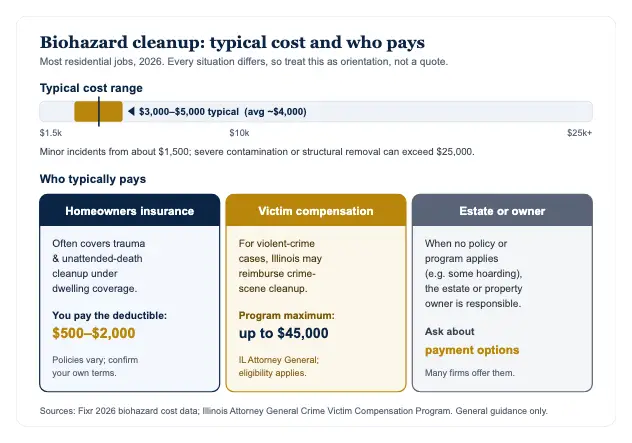
Two questions arrive together, usually within the first minute of a call: what will this cost, and am I the one who has to pay for it? Both deserve straight answers. On cost, the honest truth is that it varies widely, because every situation is different in scope, materials affected, and time elapsed. According to Fixr’s 2026 cost data, most residential biohazard cleanups run between $3,000 and $5,000, with a national average around $4,000. Minor incidents can start near $1,500, while severe contamination, extensive decontamination, or structural removal can reach $25,000 or more. Specialized services are often priced by the hour; Fixr reports unattended-death cleanup in the range of $200 to $300 per hour, and hoarding cleanup at roughly $1,000 per day.
The chart below shows that cost range at a glance, and then the three paths that most often cover it. Use it as an orientation, not a quote, and read the sections that follow for the reasoning behind each path.
Fixr;
compensation figures from the
Illinois Attorney General’s Crime Victim Compensation Program.
Homeowners insurance is the most common path
For most families, the first and best answer is homeowners insurance. Many standard policies treat trauma, unattended-death, and biohazard remediation as a covered loss under the dwelling portion of the policy, because the contamination is sudden, accidental damage to the home. In practice, that means the family is usually responsible only for the deductible, which typically runs between $500 and $2,000, and the policy covers the balance up to its limits. This is sometimes described informally as “no-fault” cleanup, meaning coverage does not depend on assigning blame for what happened; it responds to the loss itself.
The important caveat is the same one that applies to every insurance question: policies vary, and only your carrier can confirm what yours covers. Some policies have specific limits or conditions, and a few exclude certain circumstances. You do not need to sort this out alone at the worst possible moment. A reputable restoration company works directly with your insurer, documents the scope and the disposal, and helps you file, so you are not caught in the middle. Our
insurance claim assistance team does exactly that, coordinating with your adjuster while you focus on family.
Victim compensation for violent crimes
When a biohazard scene is the result of a violent crime, a second path may open. The
Illinois Crime Victim Compensation Program, administered by the state Attorney General’s office, reimburses eligible victims and their families for a range of crime-related expenses, and crime-scene cleanup is specifically a covered category. The program provides reimbursement up to $45,000 for crimes committed on or after August 7, 2022 (the cap was $27,000 before that date). Eligibility rules apply, and the cleanup benefit falls within that overall maximum, but for families reeling from a violent loss, it can lift a real financial burden. You can reach the Crime Victims Assistance Line at 1-800-228-3368. Many states run similar programs, so the same relief may be available even if you are outside Illinois.
When the estate or owner pays
Not every situation is covered by insurance or a compensation program. Some hoarding conditions, for example, may be viewed as a maintenance issue rather than sudden damage, and vacant-property or landlord scenarios can have their own coverage rules. In those cases, the estate of the deceased, the property owner, or a responsible family member typically pays. If you find yourself here, ask about payment options before you assume you cannot afford help. Many restoration firms, including ours, will talk through the scope honestly and work with you on the practicalities rather than adding pressure to a painful moment.
Confidentiality and compassion are part of the job
There is a reason this article keeps returning to discretion: for the people who call us, privacy is not a luxury, it is part of healing. A death or a crime inside a home is deeply personal, and no one wants it to become the subject of neighborhood conversation. Handled properly, biohazard cleanup is invisible to everyone but you.
In practice, confidentiality shows up in small, deliberate choices. Crews arrive in low-profile vehicles and plain clothing rather than anything that announces why they are there. They speak with you privately, keep details of the situation to themselves, and do not photograph or share your circumstances. The aim is that a neighbor watching from across the street in Wheaton or Bolingbrook sees nothing more than a service call. We treat every home and every family with the same respect we would want for our own, and we understand that we are often stepping into the hardest day of someone’s life.
Compassion is not separate from competence here; it is how the work gets done well. A technician who is careful with your feelings is usually the same one who is careful with the containment, the disposal, and the documentation. When you are choosing who to call, it is fair to expect both a steady, kind voice on the phone and the training to back it up.
A gentle note on unattended deaths and hoarding
Two situations deserve a few words of their own, because they are common and often misunderstood, and because families facing them frequently feel a private sense of shame that they should not carry.
Unattended death
When someone passes alone and is not found for a period of time, the home may require professional decontamination. This is far more common than people realize, and it carries no blame. The cleanup is priced according to scope and time elapsed, often on an hourly basis in the range noted above, and it is frequently covered by homeowners insurance as a sudden loss to the property. What matters most in these moments is that the family does not attempt the cleaning themselves, both for safety reasons under the bloodborne pathogens rules and because no grieving person should have to. Let trained professionals handle the room while you tend to everything else that a loss demands.
Hoarding
Hoarding cleanup sits at the intersection of compassion and safety. Severe hoarding can create genuine biohazards, including exposure to waste, mold, and pests, alongside structural and fire risks. The right approach is patient and non-judgmental, working with the person and the family rather than simply hauling everything away. Because insurance treatment varies and some hoarding is considered a maintenance condition, costs may fall to the family or estate, though the presence of a biohazard can change that. Our
hoarding cleanup and property restoration team approaches these projects with dignity, discretion, and a plan that respects both the person and the property.
Why this is not a do-it-yourself job
It is natural to wonder whether you can save money by handling a cleanup yourself, especially when a bill lands during grief. Please do not. The OSHA bloodborne pathogens framework exists precisely because these scenes can carry infectious risk that is invisible to the eye, and because proper decontamination and regulated-waste disposal require training, equipment, and documented procedures. Beyond the physical risk, there is the emotional one: no family member should have to clean a space connected to their loss. Bringing in professionals is not a luxury in these circumstances. It is the safe, humane, and often insurance-supported choice.
Restoration also protects the property itself. Contamination that is left too long, or cleaned improperly, can penetrate subfloors and structural materials and lead to lasting odor and damage. Prompt, thorough remediation is what allows a home to become a home again, or a rental to return to service.
Local, discreet help across DuPage & Will County
For more than 20 years, ServiceMaster Restoration Services has quietly helped families, landlords, and businesses across DuPage and Will County through some of their most difficult days. Our IICRC-aligned, trained technicians respond 24/7, follow the safety standards this work requires, and coordinate directly with insurance carriers so you are not left to navigate a claim alone. We serve Naperville, Lisle, Downers Grove, Wheaton, Bolingbrook, Woodridge, Hinsdale, Lombard, Glen Ellyn, Aurora, Plainfield, Romeoville, Lockport, and the surrounding communities, and we do so with the discretion this work demands.
You do not have to have all the answers before you reach out. A calm, confidential phone call is enough to begin.
We are here when you need us, day or night.
Compassionate, confidential biohazard and trauma cleanup across DuPage & Will County. We answer 24/7, work with your insurance, and handle everything with care and discretion.
Frequently Asked Questions
What is biohazard cleanup?
Biohazard cleanup is the professional cleaning, disinfection, and safe disposal of biological hazards such as blood or bodily fluids after an event like an unattended death, an accident, a medical emergency, or certain hoarding conditions. Trained technicians work under the OSHA bloodborne pathogens standard, using protective equipment and regulated-waste procedures to return the space to a safe, livable condition. It is not a task for ordinary household cleaning.
Who pays for trauma or unattended death cleanup?
In most cases, homeowners insurance pays, treating the contamination as a sudden, accidental loss to the property, with the family responsible only for the deductible, typically $500 to $2,000. When the scene results from a violent crime, a state victim compensation program may reimburse cleanup costs. When neither applies, the estate or property owner is usually responsible, and many restoration companies offer payment options.
Does insurance cover biohazard cleanup?
Often, yes. Many standard homeowners policies cover trauma, unattended-death, and biohazard remediation under dwelling coverage, since it is sudden damage to the home. Coverage varies by policy and carrier, and some situations, such as certain hoarding conditions, may be treated differently. Only your insurer can confirm your terms, and a restoration company can document the scope and disposal and coordinate directly with your adjuster to support the claim.
How much does biohazard cleanup cost?
Costs vary with scope, materials affected, and time elapsed. According to Fixr’s 2026 data, most residential biohazard cleanups run about $3,000 to $5,000, with a national average near $4,000. Minor incidents can start around $1,500, while severe contamination or structural removal can exceed $25,000. Some services are priced hourly, with unattended-death cleanup often $200 to $300 per hour.
Is crime scene and trauma cleanup confidential?
Yes. Reputable providers treat confidentiality as part of the service. Crews arrive in low-profile vehicles and plain clothing, keep the details of your situation private, and work without drawing attention from neighbors. For grieving families and property owners alike, discretion is essential, and a good company builds it into every step, from the first phone call to the final walkthrough.
Disclaimer: This article is for general education only and is not legal, medical, or insurance advice. Coverage varies by policy and carrier, and eligibility for victim compensation is determined by the administering program. Verify your specific terms with your insurer, and contact the Illinois Attorney General’s Crime Victim Compensation Program (1-800-228-3368) for compensation questions. If you or someone you know is in crisis, call or text the 988 Suicide & Crisis Lifeline.
Sources
- U.S. Occupational Safety and Health Administration, “Bloodborne pathogens, 29 CFR 1910.1030.”
- Fixr, “Biohazard Cleanup Cost” (2026).
- Illinois Attorney General, “Crime Victim Compensation.”
- Insurance Information Institute (Triple-I), “Which disasters are covered by homeowners insurance?”