Short answer: Regular cleaning usually means a home or small space cleaned around the occupant's schedule. Commercial cleaning covers offices, stores and other facilities, often after hours under a recurring contract, with more square footage, shared restrooms and break rooms, floor-care equipment, a plan for high-touch surfaces and workplace chemical-safety rules for the crew.
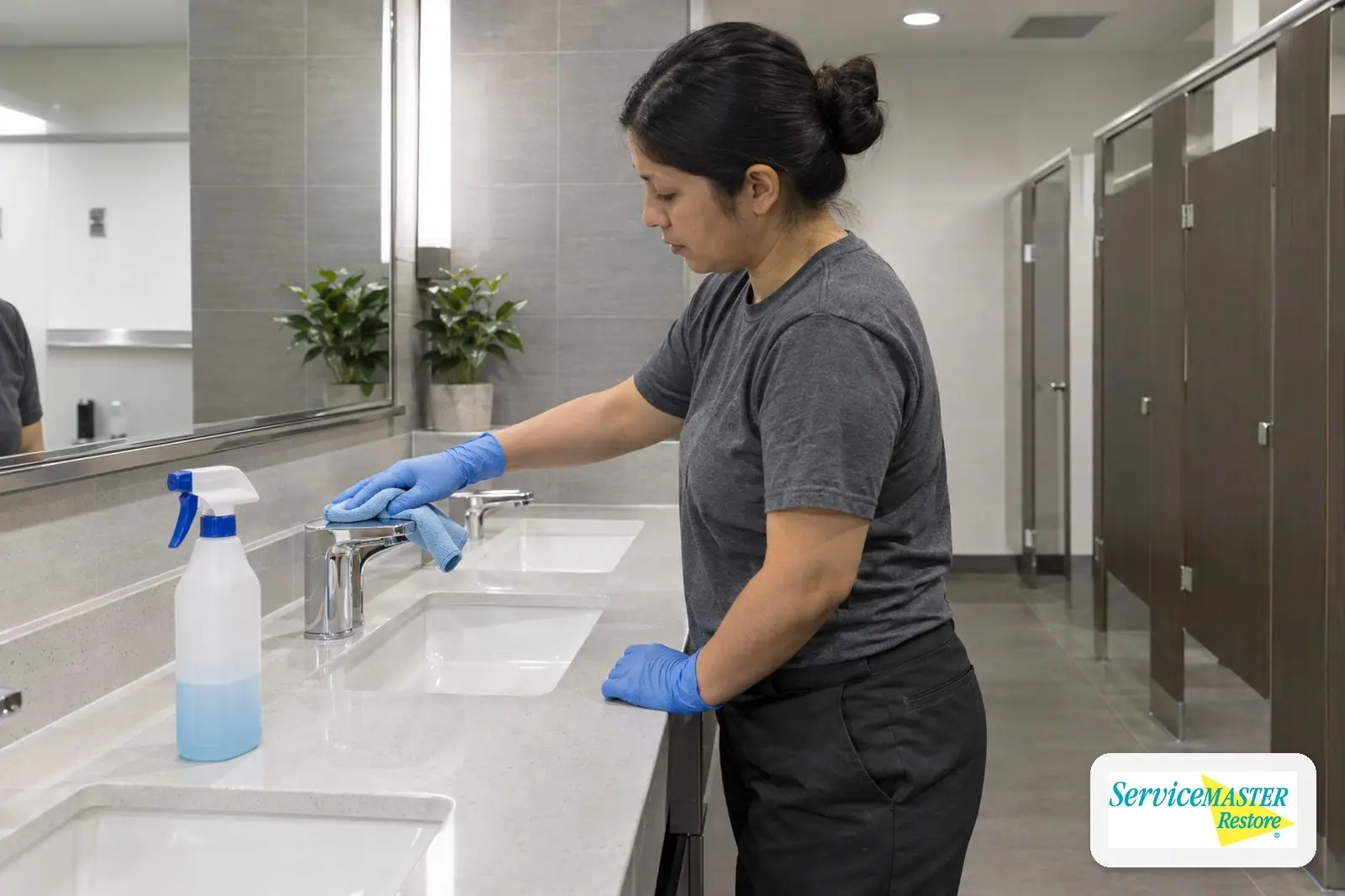
On the surface, a wiped counter is a wiped counter. The differences show up in everything around the task: how much space there is, how many people share it, when the work can happen and which rules apply to the people doing it. If you manage an office, store or other facility and you're weighing a house-cleaning style service against a commercial contract, here is what actually changes.
Scope and scheduling
Residential cleaning is built around one household. The cleaner works while you're home or out, covers a known set of rooms and adjusts to your preferences. Commercial cleaning is built around a building that has to be ready for many people at the same time, every working day.
| Factor | Residential cleaning | Commercial cleaning |
|---|---|---|
| Space | One home and a known set of rooms | Larger square footage, multiple floors or suites, lobbies and common areas |
| Schedule | Recurring or one-time visits, usually during the day | Recurring contract, often nightly or after hours, sometimes with daytime porter service |
| Restrooms and break rooms | Used by one household | Shared by staff and visitors, cleaned and restocked on a set routine |
| Floors | Vacuuming and mopping | Commercial vacuums, auto scrubbers, carpet extraction and hard-floor care programs |
| Supplies | Often the homeowner's own products | Contractor-supplied chemicals, plus paper goods and liners in many contracts |
| Access and security | A key or code for one home | Badges, alarm codes, key logs and after-hours procedures |
| Documentation | Usually informal | Written scope, task frequencies, inspections and safety data sheets for chemicals |
Commercial contracts also tend to spell out how often each task happens, from daily trash and restroom service to periodic floor and carpet work. That written scope is what lets a facility manager hold a vendor accountable and compare bids fairly.
Cleaning, sanitizing and disinfecting are not the same
The EPA draws a clear line between the three. Cleaning removes dirt and organic matter from surfaces using soap or detergent. Sanitizing kills bacteria on surfaces using chemicals but is not intended to kill viruses. Disinfecting kills viruses and bacteria. EPA regulates cleaning products only if they sanitize or disinfect, and disinfectants face more rigorous testing than sanitizers.
In shared spaces, the real question is how often each one is needed. The CDC's guidance for facilities says to clean high-touch surfaces regularly, clean other surfaces when they are visibly dirty, and disinfect areas where someone has obviously been sick, such as after vomiting. CDC's list of high-touch surfaces includes door handles, stair rails, elevator buttons, touchpads, restroom fixtures, counters and desks. It also says to clean before sanitizing or disinfecting, since dirt can keep the chemicals from working, and to keep the surface wet for the product's full contact time.
When disinfection is part of the job, product choice matters. EPA says the only way to accurately identify a disinfectant is its EPA registration number, and its lists of selected registered disinfectants are organized by pathogen, such as List G for norovirus. A product on a list qualifies only against the pathogen in that list's title, and the surface should stay visibly wet for the entire contact time on the label, even if that means reapplying.
A home rarely needs a building-wide disinfection plan. A busy office, gym or retail floor often needs one for restrooms and high-touch points. CDC notes that busy areas may need more frequent cleaning or disinfection, and that local health authorities may recommend specific procedures during outbreaks. Its facility guidance doesn't apply to healthcare, food service, manufacturing or childcare settings, which have their own rules.
Floors, equipment and after-hours access
Floors are often where the difference is most visible. A commercial building may have entry mats that trap grit and winter salt, hard floors that need machine scrubbing and periodic refinishing, and carpeted corridors that take far more foot traffic than any living room. That calls for commercial-grade vacuums and extraction equipment and a floor-care plan, not just a mop and a household vacuum. Our answer on how often an office should be cleaned breaks down task frequencies, including carpet care.
Access is the other big difference. Commercial crews often work unsupervised after hours with keys, badges and alarm codes, so background checks, key control and proof of coverage matter more. Our answer on whether a cleaning company can be bonded explains what to verify.
Worker safety and chemical handling
Once cleaning is someone's job in a workplace, workplace safety rules come into play. OSHA's cleaning industry page lists the hazards crews face, including skin contact with chemicals and occupational asthma, slips, trips and falls, physical strain, exposure to blood and needlesticks, carbon monoxide from fuel-powered floor machines, and electrical hazards. It points employers to standards on hazard communication, personal protective equipment, bloodborne pathogens and lockout/tagout.
In practice, a commercial crew should be trained on the products it uses, have safety data sheets on hand, wear the gloves and eye protection the label calls for and never mix products. CDC's facility guidance also tells employers to train staff on choosing protective equipment from the safety data sheet and on ventilation. When you hire a vendor, it's fair to ask how staff are trained and how chemicals are stored and handled in your building.
Which one does your space need?
- A home or home office: residential cleaning on a regular schedule, with periodic deep cleaning.
- A home-based business with client visits: residential service, plus extra attention to the entry, the restroom and any room clients use.
- A small office with light traffic: a scheduled commercial service, with restrooms and break areas cleaned as often as use requires.
- Retail, multi-tenant or high-traffic buildings: a full janitorial contract with after-hours service, floor care and, often, daytime porters.
- Specialized spaces such as gyms or warehouses: a provider who understands the equipment, surfaces and cleaning rules those spaces involve.
ServiceMaster Restoration Services provides both. On the home side, our residential cleaning services cover routine, deep, kitchen and bath, and move-out cleaning. For businesses, our commercial cleaning services include office cleaning, retail cleaning and ongoing janitorial maintenance.
Getting the right fit
Before you sign a commercial contract, walk the space with the vendor, agree on a written task list and frequency for each area, ask how keys and alarm codes are handled, and ask about chemical safety training. Our article on professional cleaning strategies for healthier spaces covers more of what to look for. If you manage a home or business in DuPage or Will County and want a walkthrough, call (630) 241-1111, 24/7.
More questions
Is janitorial service the same as commercial cleaning?
The terms overlap. Janitorial service usually means routine, recurring upkeep such as trash, restrooms, vacuuming and restocking. Commercial cleaning is broader and can also include periodic deep cleaning, carpet extraction, floor refinishing and one-time projects like post-construction cleanup.
Can a residential cleaner handle my small office?
Sometimes, for a very small space with light use. Check whether they can work after hours, supply commercial-grade products, handle shared restrooms, and provide the insurance documentation your landlord or building management requires.
Who supplies the cleaning products under a commercial contract?
Usually the cleaning contractor supplies chemicals and equipment, while paper goods and trash liners may be included or billed separately. Get that split in writing, and ask for the safety data sheets for any products used in your building.
Does a commercial cleaning contract lock me into one schedule?
Not usually. A good contract defines tasks and frequencies but allows changes as headcount, hours or use of the space change. Build in a review after the first few months so the schedule matches how the space is actually used.