Short answer: It depends on how many people use the space. Busy offices typically need restrooms, break rooms, trash and high-touch surfaces handled daily, desks and floors on a weekly or more frequent rhythm, and carpets and detail work periodically. The CDC advises cleaning high-touch surfaces regularly and disinfecting areas where someone has been sick.
No single number fits every office. A five-person suite that sits empty on Fridays and a 200-person floor with a shared kitchen have very different needs. A better approach is to set a frequency for each task based on how much traffic and touching that area gets, then adjust as headcount, seasons and the way the space is used change.
Frequency follows traffic and touch
The CDC's guidance for cleaning and disinfecting facilities gives a simple framework:
- Clean high-touch surfaces regularly. CDC's examples include door handles, stair rails, elevator buttons, touchpads, counters, desks and restroom fixtures.
- Clean other surfaces when they are visibly dirty.
- Disinfect areas where someone has obviously been sick, such as after vomiting, and clean surfaces before you sanitize or disinfect them.
- Expect busy areas to need more frequent cleaning or disinfection, and follow local health authorities if they recommend specific steps during an outbreak.
That is why most office schedules are tiered: daily for shared, heavily used areas, weekly for detail work, and monthly to yearly for deep and restorative tasks. Hybrid schedules matter too. If most people come in Tuesday through Thursday, weight the heavier cleaning toward the evenings of those days instead of spreading it evenly across the week.
A task-by-task office cleaning schedule
| Area or task | Typical frequency in an occupied office | Notes |
|---|---|---|
| Restrooms: clean fixtures, restock, empty bins | Daily; more often in high-traffic buildings | Faucets, handles and flush levers are high-touch surfaces |
| Break room and kitchen: counters, sinks, tables, appliance handles | Daily | Clear out the shared refrigerator on a set weekly day |
| Trash and recycling | Daily in kitchens and restrooms; daily or a few times a week at desks | Food waste left overnight attracts pests |
| Door handles, light switches, elevator buttons, shared touchscreens | Daily | Disinfect after someone has been sick |
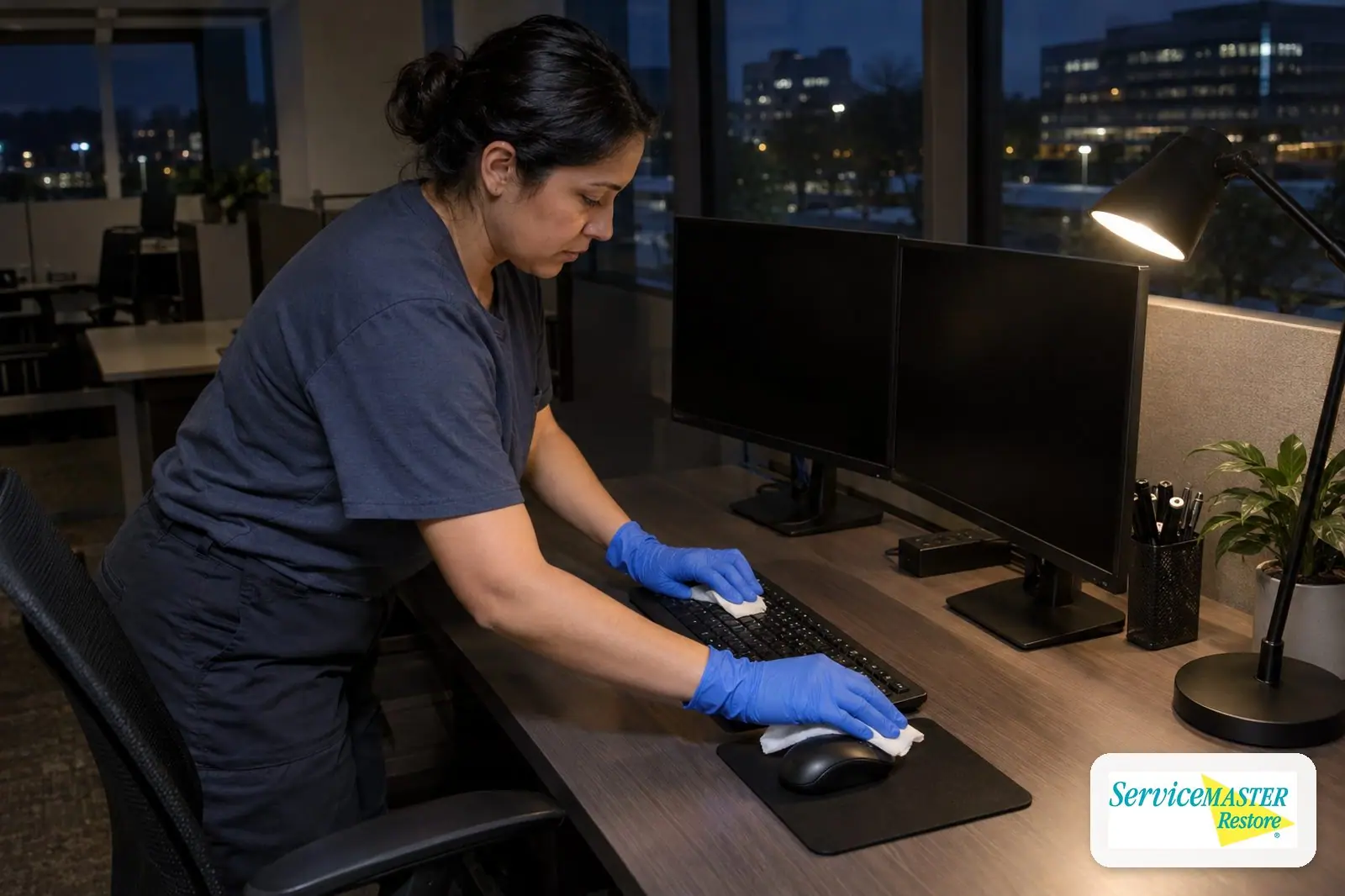
| Shared equipment: copiers, conference tables, shared phones and keyboards | Daily to several times a week | Follow the manufacturer's guidance for electronics |
| Individual desks | Weekly, or more often if staff clear them | Many offices ask staff to clear desks so they can be wiped |
| Hard floors: dust mop and damp mop | Daily at entries and kitchens; weekly or more elsewhere | Winter salt raises the need at entrances |
| Carpet vacuuming | Daily in high-traffic areas, less often in lighter areas | See the Carpet and Rug Institute guidance below |
| Dusting: ledges, vents, blinds, high surfaces | Weekly to monthly | Vents and blinds are easy to overlook |
| Glass: entry doors and interior partitions | Entry glass often daily; interior glass weekly | Exterior windows on a periodic schedule |
| Carpet deep cleaning and hard-floor refinishing | Periodically, based on traffic | See the Carpet and Rug Institute guidance below |
Treat these as starting points, not rules. Your lease, building management or industry may set different requirements, and a small office with light traffic may need some of these tasks less often.
Carpet: what the Carpet and Rug Institute recommends
Carpet can hold a lot of soil before it looks dirty. The Carpet and Rug Institute's cleaning and maintenance guidance recommends vacuuming daily in high-traffic areas, twice a week in medium-traffic areas and weekly in light-traffic areas. It also recommends mats both outside and inside entrances to stop dirt at the door, and professional deep cleaning every 12 to 18 months.
For heavily used commercial carpet, CRI's guidance on heavy and severe traffic areas goes further: daily vacuuming with a commercial-grade vacuum, weekly interim cleaning with a low-moisture encapsulation system, a monthly pass with a pile lifter to consider, and deep cleaning monthly in severe-traffic areas and quarterly in heavy-traffic areas. Main entrances, elevator lobbies and the hallway to the break room are the spots most likely to fall into those heavier categories.
When to clean more often
- More people: a growing headcount means more restroom use, more trash and more touched surfaces.
- Cold and flu season: step up attention to high-touch surfaces and disinfect after someone goes home sick, following CDC's approach.
- Customer-facing space: lobbies, reception desks and showrooms shape first impressions and may need daytime touch-ups.
- Food areas: shared kitchens and break rooms need daily attention, and food-service operations follow their own health-code rules.
- Medical, dental or lab space: CDC notes that its facility guidance doesn't apply to healthcare settings, which have their own infection-control requirements.
- Winter: salt and slush tracked in from parking lots wear down entry floors and carpet faster.
Restrooms, break rooms and the details that slip
Restrooms and break rooms drive most complaints, so give them the most detailed task lists. In restrooms, that means fixtures, handles, partitions, dispensers and floors, plus restocking soap, paper towels and toilet paper before they run out. In break rooms, it means counters, sinks, tables, the microwave, the coffee station and appliance handles, with a set day each week for clearing out the shared refrigerator.
Ask your crew to report problems it notices, too. A stained ceiling tile, a running toilet, a dripping faucet or a musty smell in a corner office is easy to spot on a nightly walk-through and much cheaper to deal with before it becomes water damage or mold.
Cleaning vs disinfecting in the office
Frequency and product choice go together. The EPA explains that cleaning removes dirt and organic matter, sanitizing kills bacteria but isn't intended to kill viruses, and disinfecting kills viruses and bacteria. Daily cleaning handles most of an office. Disinfection is for high-touch points when illness is going around and for areas where someone has been sick, and it only works if the surface is cleaned first and stays wet for the full contact time on the label.
Setting up your schedule
Walk the space with your cleaning provider, mark the high-traffic zones, and agree on a written frequency for each task. Review it after the first few months and again whenever headcount or the way the space is used changes. A short monthly check of restrooms, carpets at the entrances and vents tells you whether the schedule is keeping up.
ServiceMaster Restoration Services provides office cleaning and ongoing janitorial maintenance for businesses in DuPage and Will County as part of our commercial cleaning services. Our article on professional cleaning strategies for healthier spaces covers more ways to keep a workplace clean between visits. If you'd like help building a schedule for your space, call (630) 241-1111, 24/7.
More questions
Is it better to clean during the day or after hours?
After-hours cleaning avoids disrupting staff and lets crews reach desks and conference rooms freely. Many offices pair it with a daytime porter who checks restrooms, kitchens and the lobby when traffic is heavy.
Should employees clean their own desks?
It helps. Asking staff to clear desks at the end of the day makes nightly cleaning faster and more thorough, and keeping electronics-safe wipes on hand lets them handle keyboards and phones between professional visits.
How can I tell if my office isn't cleaned often enough?
Watch for restrooms running out of supplies, bins overflowing by afternoon, dust on vents and ledges, sticky break-room surfaces, dark traffic lanes in the carpet near entrances, and complaints from staff or visitors. Those signs usually mean a task needs a higher frequency.
Does a very small office need professional cleaning?
Usually, at least for restrooms, floors and a periodic detail clean. Some small offices pair a scheduled professional visit with staff handling kitchen wipe-downs and trash in between. The right mix depends on headcount, visitors and how much floor space you have.
Do we need to disinfect the whole office every night?
Not under CDC's facility guidance, which focuses on regularly cleaning high-touch surfaces, cleaning other surfaces when they're dirty, and disinfecting where someone has been sick or when local health authorities recommend it.