Short answer: Yes. Smoke from a house fire is a mix of poisonous gases, including carbon monoxide, and fine particles, and Ready.gov notes that smoke and toxic gases kill more people than flames do. The soot and ash left behind can also irritate your eyes, skin and lungs, so cleanup needs care and the right protection.
A house is not a campfire. When a fire burns through furniture, plastics, flooring, wiring, insulation and finishes, the smoke carries what those materials release, and much of it settles back onto every surface as soot. The danger comes in two stages: the smoke you breathe during and right after the fire, and the residue that stays in the house afterward.
During and right after the fire
The first rule is to get out and stay out. Ready.gov warns that smoke and toxic gases kill more people than flames do, that fire produces poisonous gases that make you disoriented and drowsy, and that heavy smoke and poisonous gases collect first along the ceiling, which is why you stay low on the way out. Once you are outside, call 911.
One of those gases is carbon monoxide. The CDC describes it as an odorless, colorless gas and lists common symptoms of exposure: headache, dizziness, weakness, upset stomach, vomiting, chest pain and confusion. Anyone who breathed smoke and has symptoms like these, trouble breathing, or a cough that will not settle should get medical care right away. This page is general safety information, not medical advice. Talk to a doctor about any health concern after smoke exposure.
Do not go back in until the fire department says so
Ready.gov’s after-a-fire guidance is direct: check with the fire department to make sure your residence is safe to enter, and do not attempt to reconnect utilities yourself. A fire that looks small can leave smoldering material inside walls, damaged wiring and weakened floors or ceilings. If the fire department or the utility shut off gas or power, let the utility or a licensed professional restore it.
What lingers after the smoke clears
Once the air looks clear, the hazard shifts to what the smoke left behind.
| Hazard | Where it ends up | Why it matters |
|---|---|---|
| Fine particles and soot | Walls, ceilings, fabrics, carpet, inside cabinets and HVAC ducts | The EPA calls fine particles the biggest health threat from smoke |
| Ash from burned building materials and contents | Floors, window sills, outdoor surfaces near the fire | The EPA says ash from burned structures generally contains more harmful chemicals than forest ash |
| Smoke odor | Porous materials: drywall, insulation, upholstery, clothing, wood | Shows that residue is still present and still off-gassing |
| Water from firefighting | Drywall, insulation, subfloors, contents | The EPA advises drying within 24 to 48 hours to prevent mold |
| Damaged fuel-burning appliances | Furnace, water heater, range | A damaged flue or appliance can leak carbon monoxide; have them checked before use |
The EPA’s ash guidance explains that ash may irritate your eyes, nose, skin or respiratory tract. Its indoor air quality guidance on smoke adds that smoke is a complex mixture of gases and fine particles, that the fine particles are the biggest health threat, and that children, older adults and people with heart or lung disease are especially at risk. Those EPA pages were written with wildfires in mind, but the ash guidance specifically addresses burned structures, and its protective steps are a sensible baseline indoors.
Who should stay out of cleanup, and how to protect yourself
The EPA says people with heart or lung disease, older adults and pregnant women should not take part in ash cleanup, and that children should stay away from ash until the area is cleaned. For everyone else, follow its basics:
- Wear a real respirator. Choose a NIOSH Approved respirator marked N95 or P100. Surgical masks and one-strap dust masks will not protect your lungs.
- Cover your skin. Work gloves, long sleeves, long pants, socks and sturdy shoes keep soot off your skin.
- Do not dry sweep or dust. Mist surfaces lightly and wet-mop, or use a damp cloth on lightly dusted areas.
- Use a HEPA vacuum, if you have one, for dusty surfaces. Never use a leaf blower indoors or out.
- Keep the air filtered. The EPA recommends a high-efficiency HVAC filter such as MERV 13 and portable air cleaners that do not produce ozone. Do not run the HVAC system until it has been checked for soot.
These steps are for light residue in a limited area. Heavy soot, greasy or sticky residue, or smoke that spread through several rooms is a different job. Our guide to the types of soot and smoke damage explains why dry, wet, protein and fuel-oil residues each need different methods.
Why the smell lingers, and why masking it does not help
Smoke odor is not just a memory of the fire. It comes from residue that has worked into drywall, insulation, wood, carpet, upholstery and clothing, and it keeps releasing odor until that residue is removed or sealed. Air fresheners, candles and scented sprays only add another layer on top. Opening windows helps while you are working, but it does not clean surfaces.
Be careful with quick fixes that promise to erase the smell. The EPA’s indoor smoke guidance specifically recommends air cleaners that do not produce ozone. Our guide on how to get smoke smell out of a house explains which methods work, which only mask the odor, and why the order of cleaning matters.
Why professional soot removal is done differently
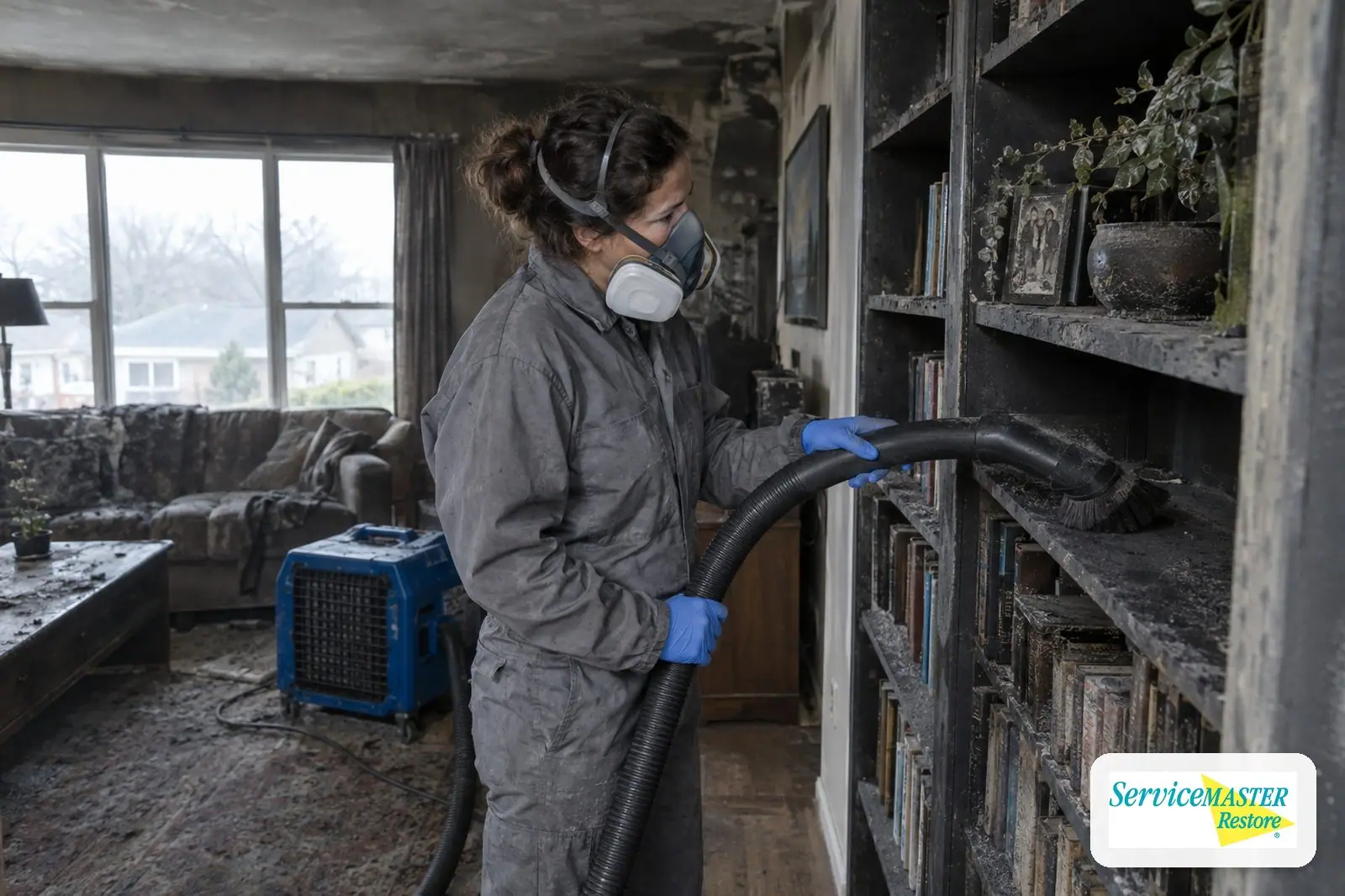
Restoration crews treat soot as a contaminant to contain and remove, not dust to wipe around. That means isolating work areas with plastic, running HEPA air scrubbers, removing loose soot with HEPA vacuums and dry chemical sponges before any wet cleaning, cleaning or sealing the HVAC system, and treating odor at its source. The ANSI/IICRC S700 Standard for Professional Fire and Smoke Damage Restoration, first published in 2025, sets out procedures for evaluating fire residues and odors and for restoration cleaning and odor management. Our page on smoke and soot cleanup describes how that work runs, and our odor removal and air quality treatment service covers the deodorization step.
When to call a professional
Call for help if soot reaches beyond the room where the fire started, the smell is still strong after airing out, the HVAC was running during the fire, or anyone in your home is in a higher-risk group. ServiceMaster Restoration Services provides 24/7 fire and smoke damage restoration across DuPage and Will County, with IICRC-certified technicians, and we help with the insurance claim. Call (630) 241-1111.
More questions
Is it safe to sleep in a house that smells like smoke?
A lingering smell means residue is still in the house. Whether it is reasonable to stay depends on how much soot there is, whether utilities and alarms work, and who lives with you. Our answer on whether you can stay in your house after a small fire walks through the checks.
Can smoke residue still bother you weeks later?
Residue left on surfaces, fabrics and ductwork can keep releasing odor and particles until it is cleaned. If you notice ongoing coughing, wheezing, headaches or eye irritation at home, talk to a doctor and have the home assessed.
Is smoke from a neighbor’s fire harmful inside my home?
It can be. Smoke enters through open windows, gaps and ventilation systems. The EPA’s indoor smoke guidance recommends a high-efficiency HVAC filter such as MERV 13 and a portable air cleaner that does not produce ozone. Keeping windows and doors closed while smoke is outside also helps.
Will an air purifier remove smoke damage?
A HEPA air cleaner reduces particles in the air, which helps. It does not remove soot already settled on walls, ceilings, fabrics and ducts, which is where most of the lingering odor comes from.