
Short answer: Rain coming through a ceiling usually gets in at damaged or missing shingles, failed flashing around chimneys, vents, skylights or roof valleys, overflowing gutters, or gaps around windows and siding, then runs along framing before it drips. Catch the water, stay clear of wet light fixtures, photograph the damage, and get the roof covered and the ceiling dried quickly.
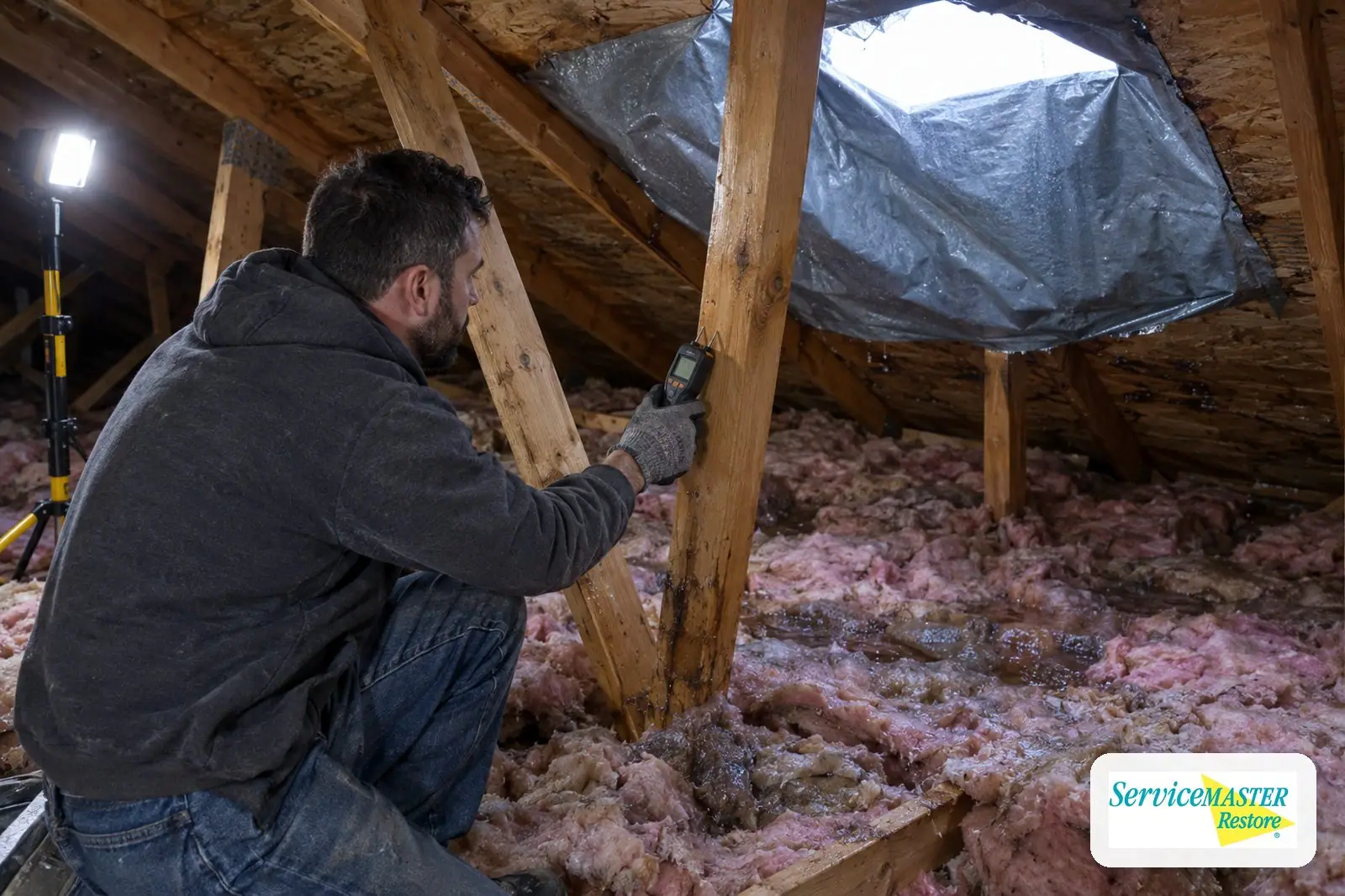
A ceiling that drips during or after a storm is telling you two things: water got past the roof or the walls, and it has already soaked through insulation and drywall on its way down. The drip is rarely directly under the opening. Water runs along the roof deck, rafters and ceiling joists, so the hole can be several feet away from the stain.
What to do in the first 30 minutes
- Keep electricity and water apart. If water is near a light fixture, ceiling fan or outlet, do not touch it. Turn off that circuit at the panel only if you can reach the panel from a dry spot. If you cannot, keep everyone out of the room and call an electrician.
- Catch the water. Set out buckets, lay towels, and move furniture, rugs and electronics out of the way.
- Watch for a bulge. A ceiling that sags or bulges is holding pooled water and can give way suddenly. Keep people and pets out from under it. If the bulge is small, well away from any light fixture, and you can reach it safely, some homeowners make a small hole at the lowest point with a screwdriver to let the water drain into a bucket, standing to the side. If it is large, near wiring, or you are not comfortable, leave it and call for help.
- Photograph before cleanup. Triple-I’s claim guidance says to photograph or videotape the damage, then take reasonable steps to protect your property from further damage. Save receipts for anything you buy.
- Report it. The NAIC recommends notifying your insurer right away, since reporting deadlines vary by state.
Where rain usually gets in
| Entry point | What to look for | Notes |
|---|---|---|
| Shingles | Missing, cracked, curled or lifted shingles; bare spots | Often follows high wind or hail |
| Flashing at chimneys, vents, skylights and valleys | Gaps, lifted or rusted metal, cracked sealant | Can leak even when the shingles look fine |
| Plumbing vent boots and roof vents | Cracked rubber collars, loose vent caps | Leaks may show only in wind-driven rain |
| Gutters and downspouts | Clogs, overflow, sagging sections | Overflow can soak fascia and soffits and run into walls |
| Windows, doors and siding | Failed caulk, missing head flashing, damaged siding | Water often appears at window tops or along an exterior wall |
The Insurance Information Institute recommends inspecting your roof for missing, damaged and aging shingles as part of routine maintenance. From the ground, binoculars are safer than a ladder on a wet roof. In the attic, follow the water stains uphill on the underside of the roof deck to find where they start.
Tracing the leak from inside
- Mark the drip. Note exactly where water lands and when it starts relative to the rain. A drip that begins within minutes points to an open hole; one that starts hours later suggests water traveling a long path or soaking through.
- Go into the attic during or just after rain, with a flashlight and only stepping on framing. Wet wood darkens and shines under the light.
- Follow the trail uphill. Track the wet line along the rafter or roof deck toward the ridge until it stops. The highest wet point is usually close to where water enters.
- Check penetrations first. Chimneys, plumbing vents, exhaust fan ducts, skylights and satellite mounts are the usual entry points.
- If the attic is dry, the water is probably coming through a wall, window or a flat roof section instead, and following an exterior wall down to the ceiling.
Mark what you find with tape or chalk so a roofer can match it to the outside. Roofers sometimes run a controlled hose test, wetting one section at a time from the bottom up, to confirm an entry point that only leaks in certain storms.
Rain damage vs. flood damage in your insurance
These are different situations for an insurer, so describe what happened accurately. Triple-I explains that water coming from the top down, such as rainfall, is covered by a standard homeowners policy, while water rising from the bottom up, such as an overflowing river, needs a separate flood policy. Its overview of which disasters homeowners insurance covers lists windstorm and hail as covered perils on standard forms and flood as excluded.
Maintenance still matters. Triple-I also says it is your responsibility to maintain your home, so a leak traced to an old, worn-out roof may be handled differently from one caused by a storm that tore off shingles. Policies vary, so check yours, and see our guide to homeowners insurance and water damage in Illinois for the claim steps.
Temporary roof protection
If the roof is open, the next rain will add to the damage. A properly secured tarp keeps water out until permanent repairs are made, and the receipt documents that you took reasonable steps to protect the property. Do not climb onto a wet or storm-damaged roof yourself. Our board-up and roof tarping guide for Chicago-suburb storms explains how emergency tarping works, and our roof tarping and structural stabilization service covers it 24/7.
Dry it within 24 to 48 hours
Stopping the drip is only half the job. The EPA says to dry water-damaged areas and items within 24 to 48 hours to prevent mold growth. Above a leaking ceiling, that usually means:
- Insulation: the EPA’s water damage table lists wet fiberglass and cellulose insulation as discard and replace.
- Ceiling drywall: the EPA allows drying in place only when there is no obvious swelling and the seams are intact. A ceiling that sagged or bulged usually needs that section replaced.
- Framing and roof deck: wood should be dried with dehumidifiers, gentle heat and fans, according to the same EPA table.
- The room below: pull up wet rugs and carpet pad, and move boxes, books and upholstered furniture to a dry room. Photograph anything ruined and set it aside for the adjuster instead of throwing it out.
Use a moisture meter around the stain, not just on it, because water spreads farther inside the ceiling than it shows on the surface. If water reached floors or walls below, our emergency water removal service handles extraction before drying starts.
When to call a professional
Call right away if the ceiling is sagging, water is near electrical fixtures, the attic insulation is soaked, or the roof is open to the weather. ServiceMaster Restoration Services responds 24/7 across DuPage and Will County for flood and storm damage cleanup, with IICRC-certified technicians who tarp, extract, dry and document the damage for your insurer. Call (630) 241-1111.
More questions
Should I call a roofer or a restoration company first?
Often both. A roofer finds and repairs the opening. A restoration company can tarp the roof right away, dry the attic and ceiling, and document the water damage for your claim. If water is actively coming in, start with whoever can stop it fastest.
Why does my ceiling only leak in heavy, wind-driven rain?
Wind can push water sideways under shingles, behind flashing and through roof vents that shed ordinary rain without trouble. That pattern points to flashing, vent boots or lifted shingles on the side of the roof facing the storm.
Can I wait until the rain stops to deal with it?
Catch the water and protect belongings now. Inspection on the roof can wait for dry weather, but the EPA’s 24 to 48 hour drying window starts as soon as materials get wet.
Will my ceiling need to be replaced?
Not always. Drywall that stays flat with intact seams can often be dried in place. Sagged, swollen or crumbling sections, and any wet insulation above them, are usually removed and replaced.
Sources
- How to file a homeowners claim (Triple-I)
- What You Need to Know When Filing a Homeowners Claim (NAIC)
- Water Damage: What's Covered; What's Not (Triple-I)
- Which disasters are covered by homeowners insurance? (Triple-I)
- A Brief Guide to Mold, Moisture and Your Home (EPA)
- Mold Remediation in Schools and Commercial Buildings Guide: Chapter 4 (EPA)