
Short answer: Not by itself. Most pin meters read on a wood or reference scale, so 15% does not mean the drywall is 15% water. What matters is how the reading compares with the same material in a dry part of the house. If it sits well above that dry reference after a leak, treat the wall as wet.
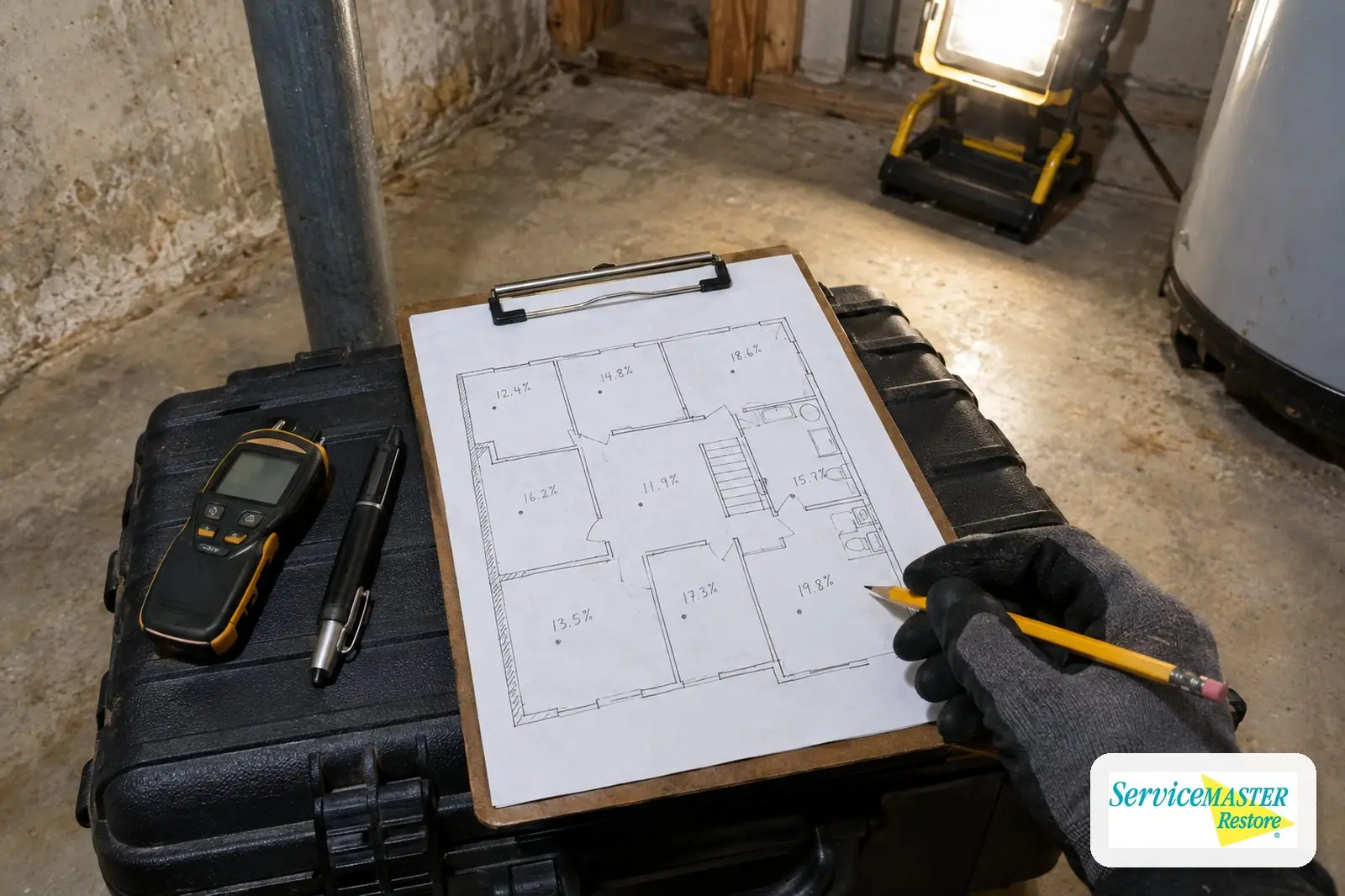
A moisture reading is easy to get and hard to interpret. Maybe a home inspector’s report flagged a wall at 15, or your own meter showed it after a leak. Search for a “normal” drywall number and you will find answers that disagree with each other, because the number on the screen depends on the meter, the scale it is set to and the material under the pins.
Why a meter percentage is not drywall moisture
Most handheld moisture meters were built for lumber. An EPA laboratory study by Greenwell and Menetrez tested a pin meter against gypsum board samples with known moisture content and found:
- The meters used on wallboard are primarily designed to measure the moisture content of wood, and there is no direct translation between wood and wallboard readings.
- In the field they are mostly used to compare moisture in one location with another.
- The tested meter read roughly half of the board’s actual moisture content, even on its gypsum setting.
- The authors concluded that moisture meters might not reflect the actual moisture content of gypsum wallboard.
The study also shows how little water gypsum holds at the levels that matter for mold. Board kept in air at 65 percent relative humidity, roughly where mold can start, held about 0.85 percent moisture by weight. Board kept in fully saturated air held about 1.4 to 1.7 percent, a condition the authors describe as all but certain to support mold growth. Next to those figures, a reading of 15 cannot be a literal percentage of water in the gypsum. It is a number on the meter’s own scale.
What scale is your meter on?
| Meter setting | What the number means on drywall | How to use it |
|---|---|---|
| Wood scale (% MC) | An equivalent reading for wood, not the gypsum’s water content | Compare with a dry reference wall |
| Reference or relative scale (often 0 to 100) | A unitless index of how wet one spot is compared with another | Compare only; never read it as a percent of water |
| Gypsum scale, if the meter has one | Closer to gypsum content, but still approximate | Follow the maker’s guidance and still compare |
| Pinless (surface) mode | Senses moisture below the surface; affected by density and metal | Good for scanning, then confirm with pins |
For context, the meter in the EPA study had a built-in gypsum scale, and its manual used a red warning light for readings above 1 percent in its guidance on painting or wallpapering. A wood-scale reading of 15 cannot be compared with that 1 percent at all, which is why the scale matters more than the digits.
The dry reference method
The reliable way to read any meter is to compare like with like:
- Pick a wall in the same house that never got wet, with the same material and similar conditions. An interior wall is a better match for an interior wall; an exterior wall for an exterior wall.
- Take several readings there with the same meter on the same setting. That range is your dry reference.
- Take readings on the suspect wall, low and high, near and away from the stain or the leak.
- If the suspect readings sit at or near the reference, the wall is probably dry. If they are clearly higher, especially in a pattern that grows toward the floor or the leak, the wall is wet.
Restoration crews call that reference a dry standard and use it as the drying goal. The drying science behind that work, including psychrometry and drying technology, is part of the ANSI/IICRC S500 water damage standard. Our post on how professionals classify water damage explains the categories and classes used alongside it.
Readings that can mislead you
Even a good meter can be fooled. Before you act on one number, rule out the usual suspects:
- Metal: corner bead, screws, nail heads, foil-faced insulation and wiring near the surface can push readings up.
- Surface moisture: condensation on a cold exterior wall, a recent wipe-down or steam from a shower wets the face without wetting the core.
- The wrong setting: a meter left on a wood species or concrete setting will give a different number on the same spot.
- Different materials: moisture-resistant board, plaster, paneling and tile backer each read differently from standard drywall.
The fix for all of these is the same: take more readings, compare them with a dry reference of the same material, and look for a pattern. A real wet zone usually shows a gradient, highest near the source and fading with distance. A single high spot surrounded by normal readings is more often a screw or a cold patch than a leak.
If the reading says the wall is wet
Speed matters. The EPA says to dry water-damaged areas and items within 24 to 48 hours to prevent mold growth. Whether the board can be saved depends on its condition: the EPA’s mold course says drywall may be dried in place if there is no obvious swelling and the seams are intact. Swollen board, bowed panels or broken seams mean replace, not dry. Wet insulation in the cavity is usually removed as well.
Before you paint, close a wall or buy a house
- Before painting: wait until readings match the dry reference. The EPA notes that paint applied over moldy surfaces is likely to peel, and paint over damp board can trap moisture.
- Before closing a wall: check framing and the back of the board, not just the face. Studs and bottom plates can stay wet after the face of the board reads dry.
- When buying: ask the inspector which meter and scale they used and what the dry reference read. One high number near a bathroom or window is worth a second check after rain or a long shower, along with a look at the likely source.
When to bring in a professional
A single reading is a clue, not a diagnosis. Bring in a professional when readings stay above the reference for more than a day or two, the wet area is larger than one wall, or you cannot find the source. Our technicians use calibrated meters, thermal imaging and dated moisture maps, described on our restoration equipment page, and our structural drying service keeps tracking the wall until it reaches the dry standard. ServiceMaster Restoration Services is IICRC-certified and responds 24/7 across DuPage and Will County. Call (630) 241-1111, or start with our water damage overview.
More questions
What is a normal moisture reading for drywall?
There is no universal number, because readings depend on the meter, its scale and the material. The useful normal is the range you get from a dry wall of the same material in the same house, measured with the same meter.
Can a moisture meter give a false reading on drywall?
Yes. Metal corner bead, screws, foil-backed insulation and condensation on the surface can push readings up, and the EPA study found meter readings well below actual moisture content. Confirm a surprising reading with a second spot, a second method or a professional.
Should I open the wall if one reading is high?
Not automatically. Recheck it, compare with the dry reference and look for swelling, soft spots or a musty smell. The EPA notes that a borescope can show what is behind a wall without significantly damaging the drywall.
Does a high reading mean mold is growing?
No. A meter measures moisture, not mold. Mold needs time on a wet surface, which is why the EPA recommends drying within 24 to 48 hours. Look and smell for signs of growth, and treat a wall that has stayed wet for days as a mold risk.
Do I need to retest after drying?
Yes. Take readings in the same spots, with the same meter and setting, until they match the dry reference. Only then is it safe to prime, paint or close up the wall.
Sources
- Comparing Moisture Meter Readings with Measured Equilibrium Moisture Content of Gypsum Board (Greenwell and Menetrez, EPA National Risk Management Research Laboratory)
- ANSI/IICRC S500 Standard for Professional Water Damage Restoration (IICRC)
- A Brief Guide to Mold, Moisture and Your Home (EPA)
- Mold Course Chapter 4: General Remediation Issues (EPA)