
Short answer: Wet drywall often shows stains, bubbling or peeling paint, a soft or crumbly feel, swelling or rippling near the floor, and a musty smell. Walls can look dry while the back of the board and the insulation stay wet, so confirm with a moisture meter and compare the readings with a dry wall in the same house.
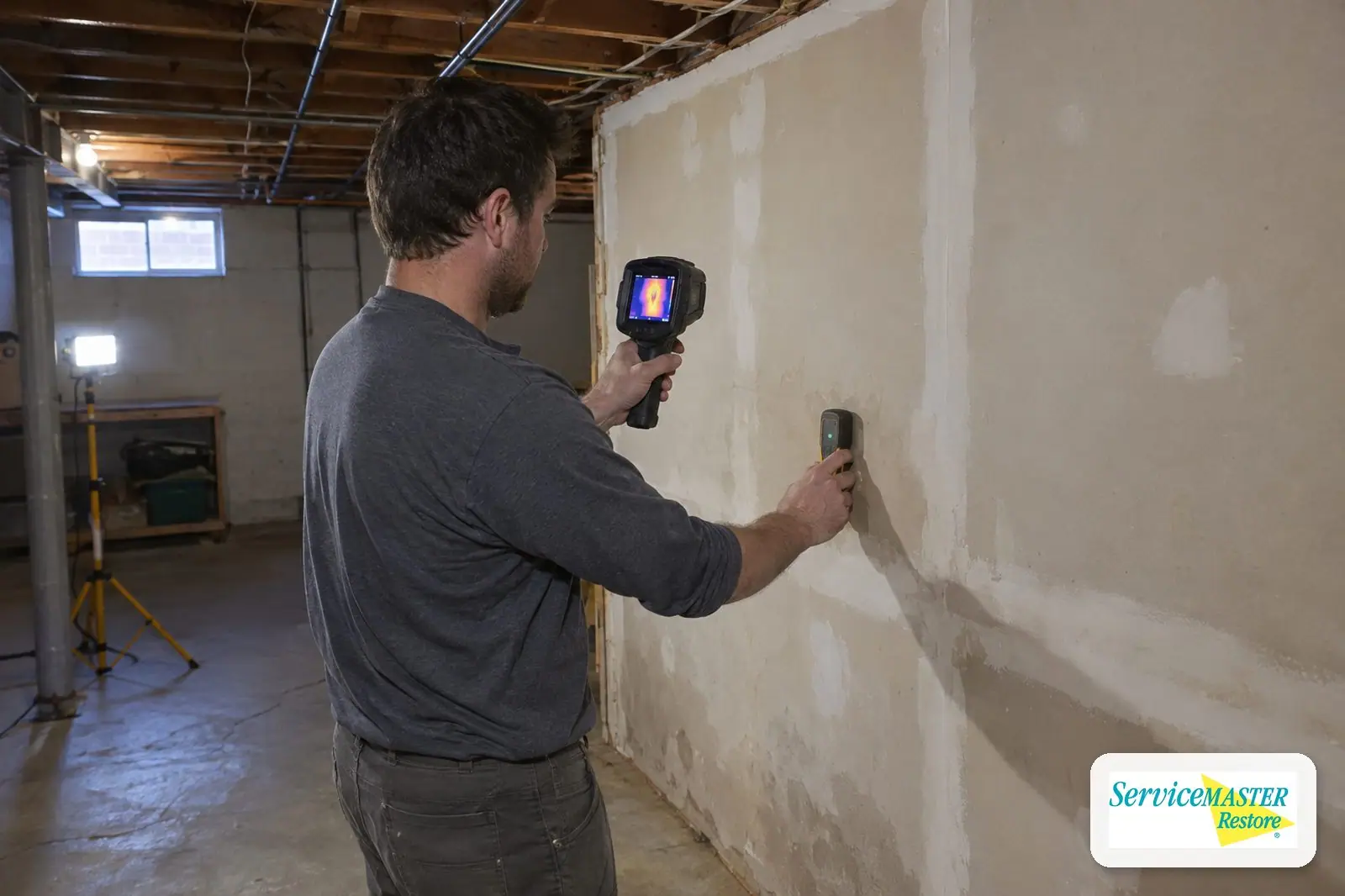
Drywall is a thin layer of gypsum between two sheets of paper, and both soak up water fast. After a leak, an overflow or a burst pipe, the surface can dry within hours while the core, the back paper and the insulation behind it stay wet for days. That gap is why a wall that looks fine can still grow mold or start to crumble.
Signs you can see, feel and smell
- Stains or tide lines. Yellow or brown rings, often darker at the edges, show where water spread and dried.
- Bubbling, blistering or peeling paint. Moisture behind the paint pushes it away from the paper face.
- Soft or crumbling spots. Press gently with a fingertip. Sound drywall is firm; wet gypsum gives, dents or flakes.
- Swelling, bowing or rippling. Look along the bottom of the wall and at seams, where tape may lift or show a ridge.
- Baseboard and trim changes. Swollen, separated or stained trim often means the board behind it wicked water up from the floor.
- A musty smell. EPA guidance for building investigators says moldy or musty odors should alert you to possible mold, even when nothing is visible.
None of these signs tells you how far the water went. A stain often covers less area than the wet zone behind it, because water spreads inside the wall cavity and up through the gypsum before it shows on the face.
Where to check first
Water follows gravity and framing, so a few spots deserve a closer look after any leak:
- The bottom 12 inches of every wall in the wet room, where drywall touches a wet floor and wicks water upward.
- Walls behind and beside toilets, sinks, dishwashers, refrigerators with ice makers, and washing machines.
- Walls shared with a bathroom or laundry room, and ceilings directly under them.
- Exterior walls below windows, where failed flashing or caulk lets rain in.
- Closets and spaces behind furniture, where damage goes unnoticed longest.
Check the room next door too. Water moves under bottom plates and through shared wall cavities, so a wet wall on one side often means the same wall is wet on the other side.
Confirm it with a moisture meter and a dry reference
Moisture meters are the standard tool. The EPA notes that investigators use them to find wet areas where mold may be growing. The catch is that most handheld meters were designed for wood. An EPA laboratory study of meters on gypsum board notes that they are often used simply to compare one spot with another, and found that their readings may not reflect the board’s true moisture content.
So use the meter that way:
- Take readings on a wall in the same house that never got wet, made of the same material. That is your dry reference.
- Take readings on the suspect wall in a grid, starting at the floor and working up and outward from the stain.
- Mark each reading on painter’s tape or a sketch. Readings clearly above the dry reference mark the wet zone.
- Recheck the same spots each day while the wall dries, until they match the reference.
Thermal cameras help map the area quickly because damp drywall usually shows as a cooler patch, but a cool spot can also be a draft or missing insulation, so every suspect spot should be confirmed with a meter. If you already have a reading and want to know what the number means, see our answer on whether 15% moisture in drywall is bad.
Why dry-looking drywall can still be wet behind
Water that reaches the bottom plate wicks upward through the gypsum. Insulation in the cavity soaks up water like a sponge and holds it against the back of the board, with almost no air moving to dry it. Vinyl wallpaper, oil-based paint and tile backer slow drying further by sealing the face. The result is a wall that feels dry to the touch while the cavity behind it stays wet enough to grow mold.
That is why the EPA’s water damage table treats wet fiberglass and cellulose insulation as material to discard and replace rather than dry in place.
Dry it in place or replace it?
| What you find | Usual action | Source of the rule |
|---|---|---|
| Wet drywall, no obvious swelling, seams intact | May be dried in place, with readings tracked until they match a dry wall | EPA |
| Drywall swollen, bowed or with broken seams | Remove, discard and replace the affected section | EPA |
| Wet insulation in the cavity | Discard and replace | EPA |
| Visible mold growth on wet drywall | Remove as part of mold cleanup; porous moldy materials may have to be discarded | EPA |
The rule in the first two rows comes straight from the EPA’s mold course: drywall may be dried in place if there is no obvious swelling and the seams are intact. Dirty water changes the picture. Water from a sewage backup or outdoor flooding carries contaminants, and our sewage backup cleanup guide explains why those materials are handled differently.
The 24 to 48 hour window
The EPA says to dry water-damaged areas and items within 24 to 48 hours to prevent mold growth. Its schools guide adds that mold will not always appear after 48 hours, since the window is a guideline, but risk climbs every day a wall stays wet. A fan pointed at the face of a wall rarely dries the cavity behind it in that time.
What to do now, and when to call for structural drying
- Stop the source. If a supply line or pipe is involved, our guide to what to do in the first hour after a burst pipe covers shutoffs.
- Turn off power to outlets on the wet wall if you can reach the panel safely from a dry spot.
- Move furniture away from the wall and pull up wet rugs.
- Run a dehumidifier and keep air moving. The EPA recommends keeping indoor humidity below 60 percent, ideally 30 to 50 percent.
- Photograph the wall, the stain and any meter readings for your insurer.
Call a professional when water has entered the wall cavity, more than one room is affected, the ceiling is involved, or readings are not dropping after a day or two. ServiceMaster Restoration Services provides 24/7 emergency water removal and structural drying and dehumidification for homes and businesses in DuPage and Will County. Our IICRC-certified technicians map moisture, open only what has to come out, and track the wall until it is dry, which is how proper drying helps prevent mold growth. Call (630) 241-1111.
More questions
Can wet drywall dry on its own?
A lightly dampened surface can dry with good airflow and a dehumidifier. Water inside the wall cavity, or insulation that got soaked, usually will not dry in time on its own. Use meter readings, not the calendar, to decide when it is dry.
How long does drywall take to dry?
There is no single number. It depends on how much water got in, whether insulation is wet, the room’s humidity and the drying equipment used. Professionals track daily readings until the wall matches a dry reference in the same house.
Can I use a space heater or hair dryer to dry a wet wall?
It is not a good idea. Concentrated heat dries the surface while the cavity stays wet, can crack paint and joint compound, and creates a fire risk if left running. Steady dehumidification and air movement, checked with a meter, works better.
Does wet drywall always grow mold?
No. The EPA notes that mold will not always grow after 48 hours, and that its 24 to 48 hour drying window is a guideline. The longer a wall stays wet, though, the higher the risk.
Can I paint over drywall that got wet?
Only after it is fully dry and shows no swelling, soft spots or mold. The EPA warns that paint applied over moldy surfaces is likely to peel. Seal any remaining stain with a stain-blocking primer before you repaint.
Sources
- Mold Course Chapter 3: Finding Mold and Moisture (EPA)
- Comparing Moisture Meter Readings with Measured Equilibrium Moisture Content of Gypsum Board (Greenwell and Menetrez, EPA National Risk Management Research Laboratory)
- Mold Remediation in Schools and Commercial Buildings Guide: Chapter 4 (EPA)
- Mold Course Chapter 4: General Remediation Issues (EPA)