
Short answer: Often you can, if the growth is small, the moisture source is fixed and nobody in the home is especially sensitive. Basement air reaches upstairs through stairwells and HVAC, so people with asthma, mold allergies or weak immune systems should avoid moldy areas. Growth larger than about 10 square feet usually needs professional remediation.
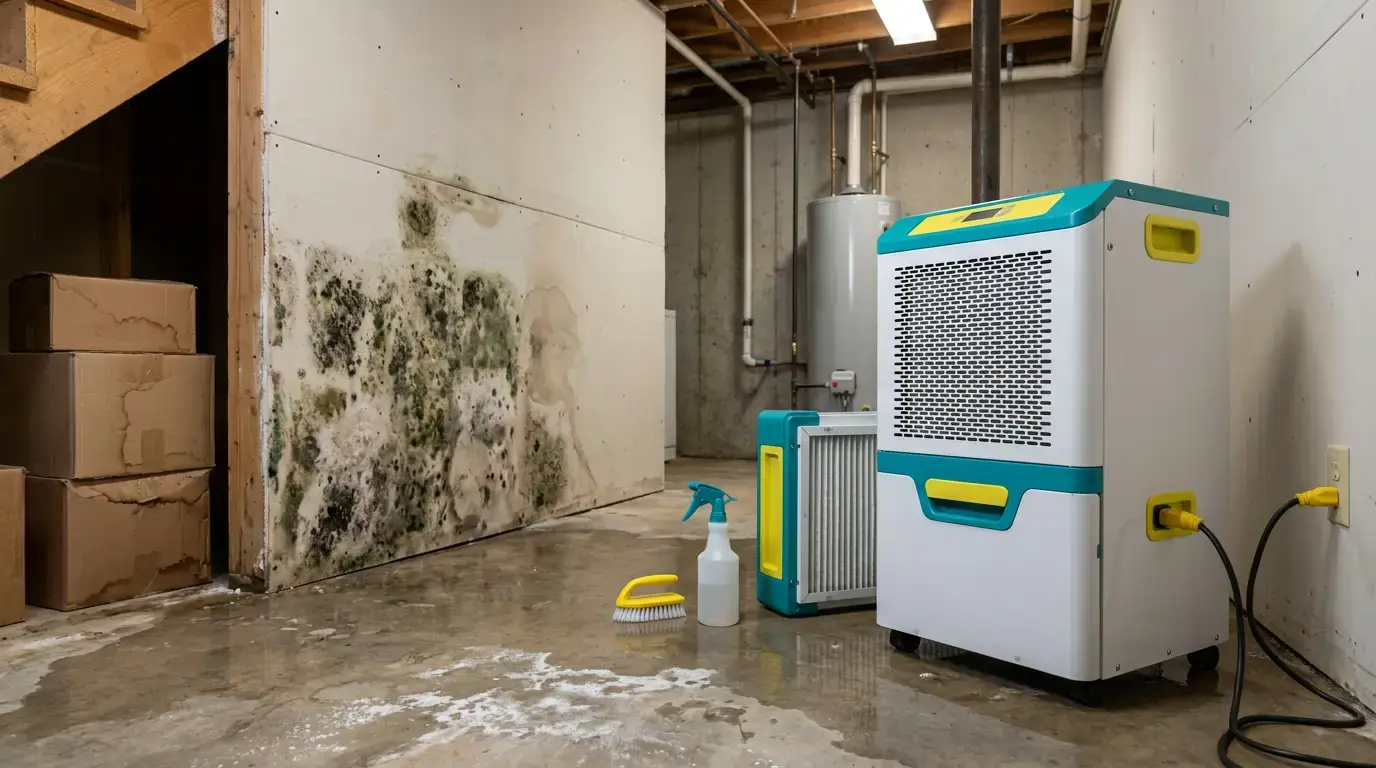
Basements in DuPage and Will County homes take on a lot of water. Sump pumps work hard after summer thunderstorms, foundation cracks and window wells let seepage in, humid summers leave cold walls damp, and many lower levels are finished with drywall and carpet that hold moisture. So finding mold down there is common. Whether you can keep living upstairs comes down to three questions: how much mold there is, whether water is still getting in, and who lives in the house.
It depends on who lives in the house
Mold affects people very differently. The CDC's mold and health page says exposure to damp, moldy environments "may cause a variety of health effects, or none at all." For some people it causes a stuffy nose, sore throat, coughing or wheezing, burning eyes or a skin rash.
Some groups face more risk. CDC says people with asthma or a mold allergy may have severe reactions, and people with weakened immune systems or chronic lung disease may develop lung infections from mold. If anyone in your home falls into those groups, keep them away from the moldy area and out of the basement until the work is done. If someone has symptoms they think are related to mold, they should talk to their doctor.
Basement air does not stay in the basement
Even if nobody spends time downstairs, basement air reaches the rest of the house. It moves up open stairwells, under and around doors, and through forced-air heating and cooling. In many homes the furnace, the return ducts and the air handler all sit in the basement, so the system can pull air from the moldy space and send it to every room.
EPA's Brief Guide to Mold, Moisture and Your Home says not to run the HVAC system if you know or suspect it is contaminated with mold. Until the problem is handled, a few habits help:
- Keep the basement door closed.
- Do not use a moldy basement room as a bedroom, playroom or home office.
- Move clothing, bedding and stored paper goods away from the affected area.
- If mold is on or near the furnace, air handler or ducts, turn the system off and have it checked before running it again.
Small growth versus large growth
EPA says that if the moldy area is less than about 10 square feet, roughly a 3-foot by 3-foot patch, you can usually clean it yourself. Beyond that, EPA points to the methods in its guide to mold remediation in schools and commercial buildings, which scales containment to the size of the job.
| Size or type of growth | What EPA guidance says | Who should handle it |
|---|---|---|
| Less than about 10 square feet on hard surfaces | Scrub with detergent and water and dry completely | A healthy adult with protective gear |
| Moldy drywall, carpet, pad or ceiling tile | Porous materials may have to be thrown away | A homeowner for a small piece; a professional for larger areas |
| About 10 to 100 square feet | Limited containment recommended | A professional |
| More than 100 square feet | Full containment recommended | A professional |
| Any amount after sewage or floodwater | OSHA requires protective gear and containment when water is contaminated (EPA mold course) | A professional |
If you clean a small area yourself, dress for it. The CDC's guide on what to wear before entering a home with mold damage lists goggles or eye protection, an N-95 respirator or better, protective gloves, a long-sleeved shirt, long pants and waterproof boots. People with allergies, asthma, other lung conditions or weakened immune systems should leave the cleanup to someone else.
Fix the moisture, or the mold comes back
Cleaning without fixing the water source buys you a few weeks at most. EPA recommends keeping indoor humidity below 60 percent, ideally between 30 and 50 percent, and drying any wet areas within 24 to 48 hours. An inexpensive humidity meter tells you where your basement stands.
Common basement moisture sources to check:
- Sump pump problems. A pump that fails, cannot keep up during heavy rain or loses power lets water in fast.
- Seepage. Water entering through foundation cracks, the joint where the floor meets the wall, or window wells.
- Drainage outside. EPA advises making sure the ground slopes away from the foundation and keeping gutters clean.
- Condensation. Humid summer air on cold walls and pipes. EPA suggests insulating cold surfaces such as cold water pipes and using a dehumidifier.
- Old water damage. A past flood or leak that was never fully dried behind drywall or under carpet.
Our pages on basement water damage and basement flooding after heavy rain in DuPage walk through the drying side of the job.
When temporary relocation makes sense
Many families can stay home while basement mold is handled. A professional crew can seal the basement or the affected rooms with plastic sheeting and run HEPA air filtration, which keeps dust and spores out of the living space during the work.
Moving out for a while is worth discussing in two situations. EPA's remediation guide says that in some cases, "especially those involving large areas of contamination," the plan may include temporary relocation of some or all occupants. It also lists the presence of sensitive people, such as those with severe allergies or asthma, as a reason to take a more cautious approach. If your heating and cooling system has to be shut down and cleaned, that can also affect whether staying home is practical. For a sense of how long work takes by job size, see how long mold remediation takes.
When to call a professional
Call for help if the growth is larger than about 10 square feet, keeps coming back, follows a flood or sewer backup, or seems to be inside walls or ductwork. The same is true if anyone at home is in a higher-risk group. Our residential mold remediation team contains the area, removes moldy materials, dries the structure and helps you find the moisture source.
ServiceMaster Restoration Services is based in Lisle and has worked in homes across DuPage and Will County for more than 20 years. Our IICRC-certified technicians can also help with your insurance claim. See our mold remediation services or call (630) 241-1111, 24/7.
More questions
Is it safe for children to sleep in a basement bedroom that has mold?
It is better to move them upstairs until the mold is removed and the moisture source is fixed. Children with asthma or allergies may be more sensitive. If a child has symptoms such as coughing, wheezing or a stuffy nose that seem tied to the basement, talk to their doctor.
Will a dehumidifier get rid of basement mold?
No. A dehumidifier lowers humidity, which helps prevent new growth and helps materials dry, but it does not remove mold that is already there. Existing growth has to be cleaned off hard surfaces or removed with the porous material it is growing in.
Should I test the air before deciding whether to stay?
Usually not. CDC does not recommend mold testing, and EPA notes that no federal limits exist for mold or mold spores, so an air test cannot tell you whether a level is safe. Decide based on how much growth there is, whether water is still getting in, and who lives in the home.
Can a portable air purifier make the basement safe?
A HEPA air cleaner can capture some airborne particles, but it cannot remove mold growing on drywall, wood or carpet. Treat it as a short-term comfort measure, not a substitute for cleanup and moisture control.