DuPage & Will County · Seasonal Home Guide
The fall tasks that prevent winter water damage are simple: clean gutters and extend downspouts, disconnect and drain outdoor hoses, insulate pipes in unheated spaces, test your sump pump and add a battery backup, seal air gaps, and inspect the roof and attic before DuPage’s first hard freeze arrives.
Every year around here it plays out the same way. The first genuinely cold snap rolls through Naperville, Lisle and Wheaton sometime in November, a homeowner who “meant to get to it” hears water where water should not be, and a small autumn to-do list turns into a five-figure claim. It is one of the most preventable losses in home ownership — and the fix costs a Saturday afternoon and a few dollars of foam insulation.
Water damage is not a rare, freak event. Nationally, water damage and freezing accounted for 27.6% of all homeowners insurance claims in 2022 — the second-largest cause behind only wind and hail — and about one in 60 insured homes files a property-damage claim for water or freezing every year, according to the Insurance Information Institute. The average paid claim ran $13,954 (2018–2022). For our region specifically, freeze-thaw swings, ice dams and spring-thaw sump strain make late fall the single most important maintenance window of the year.
This is the checklist we wish every homeowner in DuPage and Will County ran before the cold sets in. Work top to bottom, and by the time the first freeze warning hits Downers Grove or Bolingbrook, your house is ready.
Already dealing with a leak, a burst pipe or a flooded basement? Our IICRC-aligned crews answer 24/7 across DuPage & Will County. Call (630) 241-1111 — we work directly with your insurance.
The fall home maintenance checklist (do these before the first freeze)
Run these seven jobs in order. None require a contractor for the average home, and together they close off the paths water actually takes into a house during an Illinois winter.
1. Clean the gutters and extend the downspouts
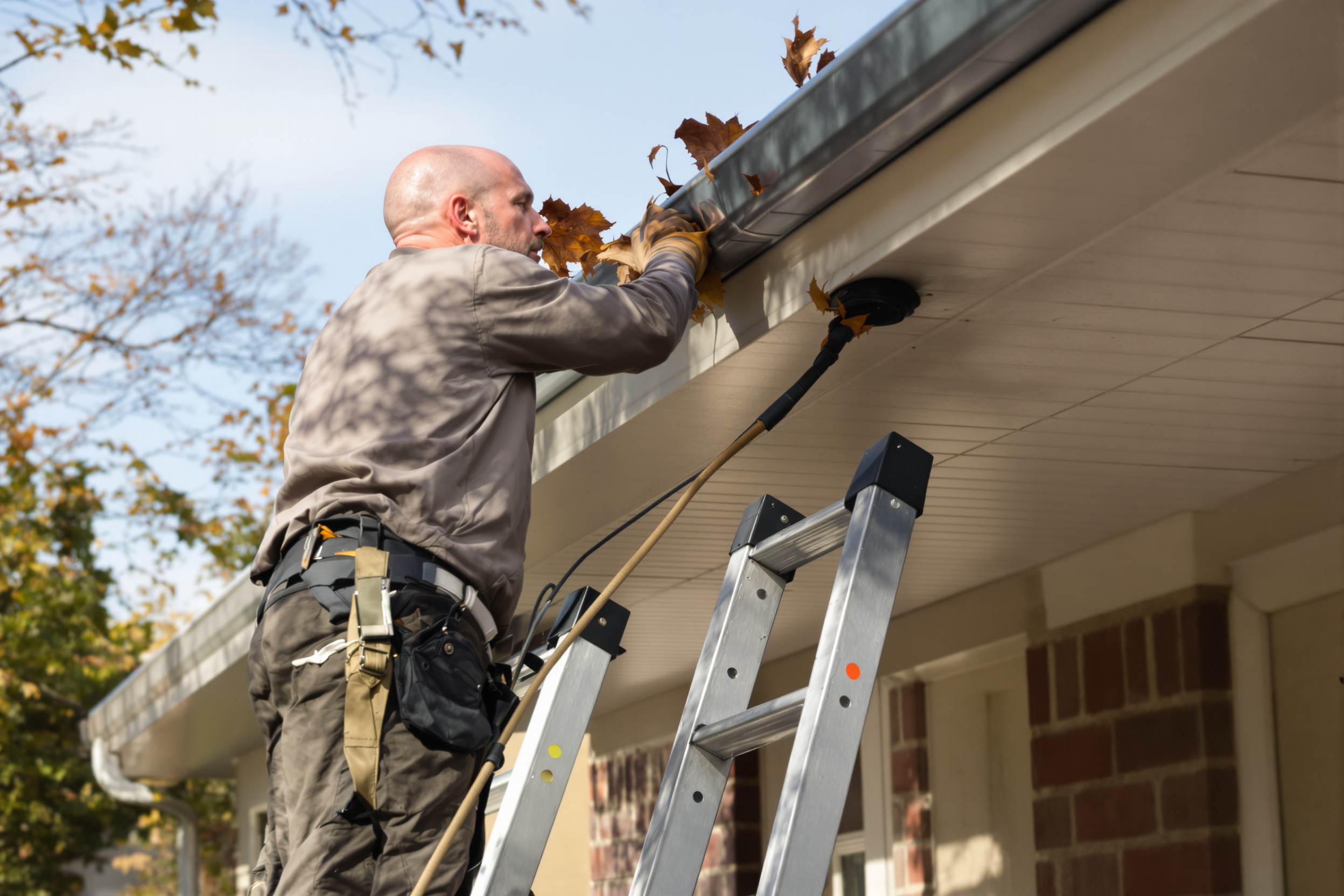
Clogged gutters are the quiet cause behind a huge share of cold-weather water damage. When leaves pack a gutter, meltwater has nowhere to go: it backs up, freezes, and forms ice dams along the roof edge that push water under your shingles and into ceilings and walls. Clear every gutter and downspout of leaves and debris — a wet, heavy job that is worth doing after most of the maple and oak leaves are down, usually mid-to-late October in DuPage.
Then look at where the water lands. Downspouts should carry runoff at least four to six feet away from the foundation, sloping away from the house. Water pooling next to the foundation in fall becomes hydrostatic pressure against your basement wall in spring — one of the top reasons DuPage basements flood after heavy rain.
2. Disconnect outdoor hoses and shut off exterior faucets
This is the five-minute task that prevents one of the most common burst pipes we see. Detach every garden hose and drain it before freezing weather begins, and shut off the interior valve that feeds each outdoor spigot (then open the spigot to let it drain). A hose left connected traps water in the bib and the pipe just inside the wall; when it freezes and expands, the pipe splits — and you do not find out until you turn the water on in spring and it pours inside the wall. The Insurance Information Institute lists detaching and draining hoses and winterizing outdoor systems as a core freeze-prevention step. If you have an in-ground irrigation system, have it blown out before the ground freezes.
3. Insulate pipes in unheated spaces
Any water line running through an unheated or poorly heated area — crawl spaces, the garage, an unfinished basement rim joist, an exterior wall — is a freeze risk. Slip foam pipe-insulation sleeves over exposed lines; they cost a few dollars per length at any hardware store in Lombard or Glen Ellyn and install by hand in minutes. The federal Ready.gov winter-weather guide recommends insulation, caulking and weather-stripping to keep the cold out and learning how to keep pipes from freezing before the season starts.
One detail people miss: the air inside the wall where a pipe runs gets far colder than the room. That is why the Insurance Information Institute advises keeping your home heated to at least 65°F — even when you travel — because a thermostat lower than that will not keep the inside of exterior walls above freezing. When a hard freeze is forecast, open kitchen and bathroom cabinet doors so warm room air reaches the pipes under the sink, and let a faucet on an exposed line run at a slow trickle overnight. Moving water is far harder to freeze, and a dripping faucet relieves the pressure that actually bursts a pipe.
4. Test the sump pump and add a battery backup
In a region this dependent on sump pumps, this is non-negotiable. Pour a bucket of water into the sump pit and confirm the float rises, the pump kicks on, and the pit empties. Check that the discharge line runs well away from the house and is not itself prone to freezing. If your pump is more than seven to ten years old or struggled last spring, replace it now rather than during the March thaw.
Then install a battery backup (or a water-powered backup). Winter storms and the wet spring thaw are exactly when power outages and pump failures overlap — and a dead sump during snowmelt is how a finished basement in Woodridge or Romeoville ends up under several inches of water. A backup pump keeps working when the grid or the primary pump quits.
5. Seal air gaps and cracks
Cold air pouring into a wall cavity or crawl space is what drops the temperature around a pipe below freezing. Caulk gaps where pipes, cables and vents penetrate exterior walls; add weather-stripping around doors and windows; and seal foundation cracks and rim-joist gaps in the basement. Sealing these openings also cuts the warm-air leaks into the attic that feed ice dams (more on that below), so this one task pays off in two places at once.
6. Inspect the roof and attic
From the ground or a ladder, scan the roof for missing, cracked or lifted shingles and reseal any gaps around flashing, vents and the chimney — these are the entry points meltwater exploits all winter. Inside, check that attic insulation is adequate and evenly distributed, and that soffit and ridge vents are clear. Here is the counter-intuitive part: a warm attic is the problem. Heat escaping into the attic melts the snow on your roof; the meltwater runs to the cold eaves and refreezes into an ice dam, and the water trapped behind it works back under the shingles. Good insulation and ventilation keep the roof deck cold and uniform, which is the real fix for ice dams.
7. Service the water heater and know your main shutoff
Fall is a good time to drain a few gallons from the water heater to flush sediment, check for corrosion or moisture at the base, and confirm it is running efficiently before the season of hot showers and holiday guests. A water heater that fails in January can dump 40-plus gallons onto a basement floor. While you are down there, make sure everyone in the house knows where the main water shutoff is and how to close it — the single most valuable thing you can do to limit damage when a pipe does let go.
- Gutters cleared, downspouts extended 4–6 ft from the foundation
- Outdoor hoses disconnected and drained; exterior faucets shut off
- Exposed pipes insulated; irrigation blown out
- Sump pump tested and battery backup installed
- Air gaps, rim joists and foundation cracks sealed
- Roof shingles/flashing inspected; attic insulation and venting checked
- Water heater flushed; everyone knows the main shutoff
Why DuPage & Will County winters cause water damage
Not every cold climate creates the same risk. What makes our corner of Illinois particularly hard on homes is the pattern of the winter, not just the low temperatures.
Freeze-thaw whiplash
DuPage and Will County sit in a humid-continental climate where temperatures rarely stay put. A week can swing from a hard freeze to well above freezing and back again. Every one of those cycles works joints, seals and small cracks a little looser — and, critically, refreezes water that had a chance to seep into a gap. Water expands roughly 9% when it freezes, and that expansion is what splits pipes, widens foundation cracks and lifts shingles. A single 20°F night is manageable; it is the repeated freeze-thaw whiplash across a Naperville or Plainfield winter that finds every weakness.
Ice dams on the roof
Ice dams are the classic DuPage winter surprise. After a snowfall, heat leaking from the living space into the attic melts the snow on the upper roof. That meltwater runs down to the cold overhang, refreezes, and builds a ridge of ice at the eaves. Behind that dam, water pools — and because shingles are designed to shed water flowing down, not water sitting still or being pushed up, it wicks under the shingles and into the ceiling below. The damage shows up as stained ceilings and wet exterior walls, often weeks into winter. This is exactly why fall attic insulation, air-sealing and clear gutters matter so much: they keep the roof cold and uniform so the melt-refreeze cycle never gets started.
Sump pumps and the spring thaw
Our region runs on sump pumps. Many homes across Wheaton, Lockport and Aurora have finished basements protected by a single pump — and the heaviest demand on that pump comes not in a summer storm but during the late-winter and early-spring thaw, when snowmelt and saturated, slowly thawing ground drive the water table up fast. If the pump is worn, the discharge line is frozen, or the power blinks during a storm, water rises in the pit and then over the floor. Servicing the pump and adding a backup in fall is what keeps a March thaw from becoming a flooded basement. If you want the full emergency playbook, see our guide to basement flooding after heavy rain in DuPage.
Put the three together — freeze-thaw stress on pipes and seals, ice dams overhead, and thaw-season pressure on the sump — and you can see why late fall is the maintenance window that matters most here. Nationally, winter storms alone drove nearly $6 billion in insured losses in 2022, one of the costliest winter-storm years on record, per the Insurance Information Institute.
What to do if water damage happens anyway
Even a well-maintained home can take on water — a pipe in an exterior wall gives out during a deep freeze, or a backup fails during the thaw. If it happens, move quickly and in order. The first hours decide how much you lose.
- Stop the water. Shut off the main water valve for a burst pipe. If water is anywhere near outlets, the panel or appliances, cut the power to that area at the breaker first — only if you can reach it safely and without standing in water.
- Protect people and valuables. Move family, pets and anything you can lift out of the affected area. Watch for slip and shock hazards.
- Document everything. Photograph and video the damage before you clean up — standing water, soaked materials, the source. Your insurer will want it.
- Start removing water and moisture. Mop and blot what you safely can and get air moving, but do not run a household vacuum on standing water or wade into a flooded, energized space.
- Call a professional restoration company fast. Timing is everything with water. The U.S. EPA advises that wet materials be dried within 24 to 48 hours to prevent mold from taking hold — the same urgency the IICRC S500 water-restoration standard is built around.
A qualified crew brings commercial extraction, air movers and dehumidifiers, plus moisture meters to confirm that wall cavities and subfloors are actually dry — not just dry to the touch. That verification is what separates a proper restoration from a mold problem that surfaces in spring. If you are weighing what a professional job runs, our breakdown of water damage restoration cost in DuPage County lays out the 2026 numbers, and our main water damage restoration page covers the full process.
Water where it shouldn’t be? ServiceMaster Restoration Services responds 24/7 across DuPage & Will County — residential and commercial — with IICRC-aligned technicians and 20+ years of local experience. We work directly with your insurance and help with the claim. Call (630) 241-1111 or contact us here.
Frequently asked questions
How do I prevent water damage in my home during winter?
Do the work in fall, before the first freeze: clean gutters and extend downspouts away from the foundation, disconnect and drain outdoor hoses, insulate pipes in unheated spaces, seal air gaps, test the sump pump and add a battery backup, and inspect the roof and attic. During cold snaps, keep the thermostat at 65°F or higher, open cabinet doors under sinks, and let a faucet on an exposed pipe drip. In DuPage and Will County, the freeze-thaw pattern and spring thaw make sump-pump readiness and attic sealing especially important.
How do I keep my pipes from freezing?
Insulate exposed pipes in crawl spaces, garages and exterior walls; seal the air leaks that let cold reach them; and keep your home heated to at least 65°F, even when you travel, since the air inside walls runs much colder than the room. When a hard freeze is forecast, open cabinets so warm air reaches the pipes and let a slow trickle run from faucets on exposed lines — moving water resists freezing and a drip relieves the pressure that actually bursts a pipe. The American Red Cross recommends never setting the thermostat below 55°F if you leave for an extended period.
When should I winterize my house in Illinois?
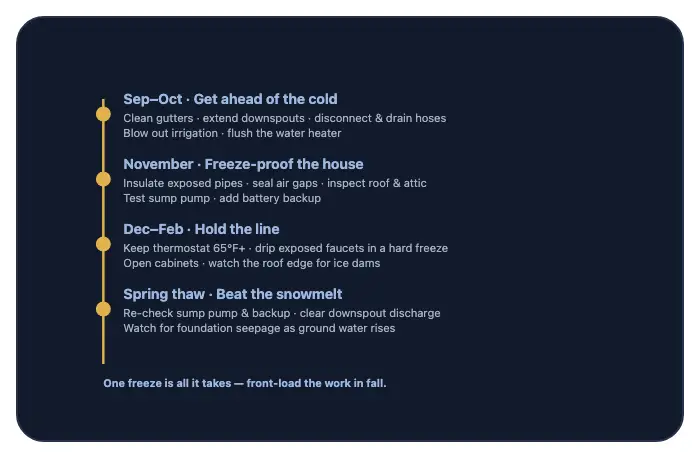
Aim to finish the outdoor work — gutters, hoses, irrigation, roof — through September and October, and complete freeze-proofing (pipe insulation, air-sealing, sump-pump service) in November before the first sustained hard freeze, which typically arrives in DuPage and Will County by mid-to-late November. Getting ahead of the first cold snap is the whole point; scrambling during a freeze warning is how tasks get skipped.
Does homeowners insurance cover frozen pipe and winter water damage?
Sudden, accidental water damage from a burst pipe is typically covered by standard homeowners policies — but most insurers require that the home was properly heated and, if you were away, that the water was shut off or the heat maintained. Damage blamed on neglected maintenance, or flooding from overland water and snowmelt, is generally not covered (flood needs a separate NFIP policy). Coverage varies by policy, so read yours and, in Illinois, the Department of Insurance can help with consumer questions. This is general information, not legal or insurance advice.
What causes ice dams and how do I prevent them?
Ice dams form when heat escaping into the attic melts snow on the upper roof; the meltwater runs to the cold eaves, refreezes, and dams up, forcing water back under the shingles and into the home. The fix is to keep the roof deck cold and uniform: add and even out attic insulation, seal the warm-air leaks from the living space into the attic, and keep gutters clear so meltwater can drain. Doing this in fall is far cheaper than repairing water-stained ceilings mid-winter.
Sources: Insurance Information Institute — Facts + Statistics: Homeowners and renters insurance and Facts + Statistics: Winter storms; Ready.gov — Winter Weather; American Red Cross — Preventing & Thawing Frozen Pipes; U.S. EPA — Mold Cleanup in Your Home (dry within 24–48 hours).
This guide is general educational information, not legal, insurance, or medical advice. Insurance coverage varies by policy — review yours or consult the Illinois Department of Insurance for specifics.