Short answer: Not in the regulatory sense. Mold is not covered by OSHA's bloodborne pathogens rules, and no federal exposure limits exist for it. EPA says bagged moldy materials can usually go out as ordinary construction waste. It is still a biological hazard, though, so cleanup calls for protective gear, containment and HEPA filtration.
"Biohazard" gets used loosely. People call anything biological and unpleasant a biohazard, from mold to pet waste. In regulation, the word has a narrower meaning tied to blood, certain body fluids and the waste they create. Mold sits in between: it is a biological hazard that deserves care, but it is not handled under the same rules as blood or medical waste.
What counts as a regulated biohazard
For most cleanup work, the federal line is drawn by OSHA's Bloodborne Pathogens standard, 29 CFR 1910.1030. It protects workers from germs carried in human blood, such as hepatitis B, hepatitis C and HIV, and from "other potentially infectious materials," a defined list of body fluids and human tissue.
The same standard defines "regulated waste," the material people usually mean by biohazardous waste. It covers liquid or semi-liquid blood or other potentially infectious materials, items that would release them if compressed, items caked with dried blood that could release it during handling, contaminated sharps, and pathological and microbiological wastes containing blood or those materials. That waste goes into closable, leak-resistant containers that are labeled or red, and it must be disposed of according to federal, state and local rules. For a closer look at each category, see our answer on examples of biohazardous waste.
Mold is not on that list. Moldy drywall is not "regulated waste" under the bloodborne pathogens rule.
How mold is handled instead
There is no standalone federal mold rule. OSHA's page on mold standards says mold "is addressed in specific OSHA standards for general industry, shipyard employment and construction," and points to general sanitation and environmental-control standards rather than a mold-specific one. EPA's Brief Guide to Mold, Moisture and Your Home adds that "no EPA or other federal limits have been set for mold or mold spores."
In place of a regulation, the restoration industry follows ANSI/IICRC S520, the consensus standard that describes procedures and precautions for mold remediation. EPA's guidance documents fill in the rest.
| Question | Regulated biohazard (blood and body fluids) | Mold |
|---|---|---|
| Main rule | OSHA Bloodborne Pathogens standard, 29 CFR 1910.1030 | No mold-specific federal rule; general OSHA standards, EPA guidance and ANSI/IICRC S520 |
| Federal requirements | Employers need an exposure control plan, training and protective equipment for exposed workers | No mold-specific rule; no federal limits set for mold or spores (EPA) |
| Waste handling | Regulated waste in labeled or red containers, disposed of under applicable federal, state and local rules | Double-bagged in 6-mil plastic; usually disposed of as ordinary construction waste (EPA) |
| Typical cleanup | Trained technicians working under OSHA's standard | Homeowners for areas under about 10 square feet; professionals for larger areas |
How moldy materials are thrown away
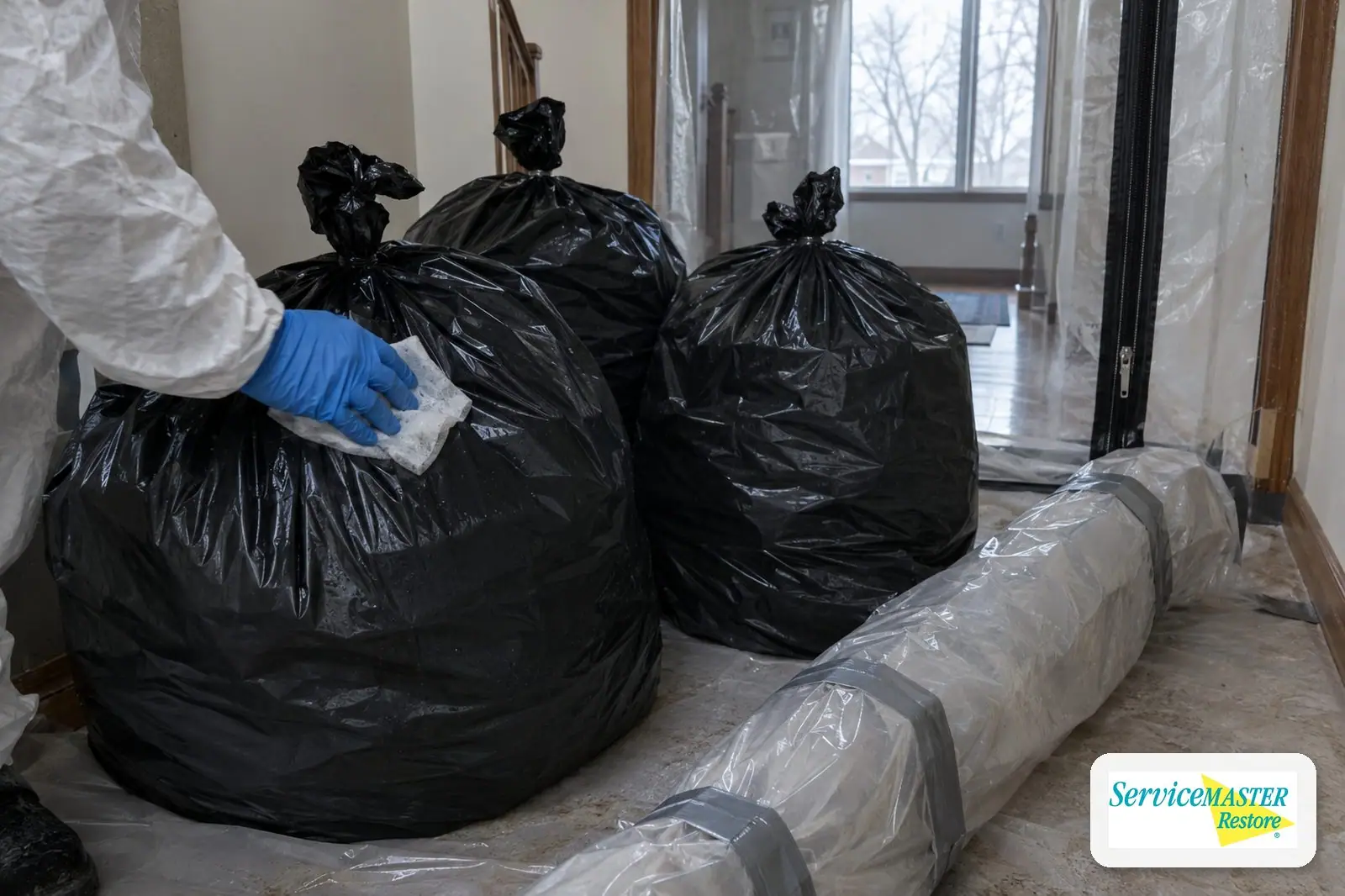
EPA's mold course chapter on remediation says contaminated materials that cannot be saved should be "double-bagged in 6-mil or thicker polyethylene bags," and that these bags "usually can be discarded as ordinary construction waste." Large items, such as a moldy mattress or a long section of carpet, are wrapped in plastic sheeting and sealed with duct tape before they leave the work area. The filter and contents of a HEPA vacuum used on mold are sealed in plastic bags, too.
The point of bagging is not that mold is legally hazardous waste. It is to keep spores and dust from spreading through the house on the way out. Local landfill or hauler rules can still apply to large loads of construction debris, so check with your waste hauler if you are doing a big tear-out yourself.
Still a health hazard, so it is handled with care
Not being a regulated biohazard does not make mold harmless. The CDC's mold page says mold can cause a stuffy nose, sore throat, coughing or wheezing, burning eyes or a skin rash in some people. People with asthma or mold allergies may have severe reactions, and people with weakened immune systems or chronic lung disease may get lung infections. If you have symptoms you think are tied to mold, talk to your doctor.
That is why mold cleanup uses its own set of precautions:
- Protective gear. EPA's course lists an N-95 respirator, gloves and goggles as the minimum. CDC's cleanup guidance recommends a half-face or full-face respirator for extended removal of moldy items or drywall.
- Containment. EPA's remediation guide for schools and commercial buildings recommends limited containment for about 10 to 100 square feet of growth and full containment above 100 square feet.
- HEPA filtration and vacuuming. HEPA air scrubbers capture airborne spores during the work, and EPA recommends HEPA vacuums for final cleanup.
- Sealed bagging. Debris is bagged inside the work area before it is carried out.
Our page on containment and HEPA air filtration shows how this setup looks in a home, and our guide to black mold health risks and signs covers symptoms in more depth.
When mold comes with sewage or other biohazards
The rules change when mold is not the only problem. EPA's mold course says that if you know or suspect water is contaminated with sewage or with chemical or biological pollutants, protective equipment and containment are required by OSHA. Sewage backups are treated as the most contaminated class of water damage, and that cleanup follows its own protocols. Our guide to sewage backup cleanup and Category 3 water explains what that involves.
The same goes for mold found during cleanup after an unattended death, a serious injury, or in a home with blood, used needles or other body fluids present. Then the bloodborne pathogens rules apply to that material, and the job is handled as biohazard cleanup with mold remediation as one part of it.
When to call a professional
Call for help if mold covers more than about 10 square feet, follows a sewage backup or flood, or turns up alongside blood or other body fluids. ServiceMaster Restoration Services in Lisle provides both mold remediation and biohazard cleanup for homes and businesses across DuPage and Will County, with more than 20 years of experience and IICRC-certified technicians. We can also help with the insurance claim. Call (630) 241-1111, 24/7.
More questions
Do I need a special permit to throw away moldy drywall?
Usually not. EPA says bagged moldy materials usually can be discarded as ordinary construction waste. Local rules on construction debris and bulk pickup still apply, so ask your hauler or village before putting out a large amount.
Is black mold a biohazard?
Color does not change how mold is classified or cleaned up. CDC does not recommend mold testing to identify the type. Its advice is to safely remove the mold and prevent it from growing back. Black mold is handled under the same EPA guidance and S520 practices as any other mold.
Do mold remediation workers wear hazmat suits?
Protective gear scales with the size of the job. EPA lists an N-95 respirator, gloves and goggles as the minimum, and CDC recommends a half-face or full-face respirator for extended removal of moldy drywall or items. Larger jobs usually add disposable coveralls so spores are not carried out on clothing.
Can a homeowner remove mold without a professional?
For small areas, yes. EPA's guidance says areas under about 10 square feet, roughly a 3-foot by 3-foot patch, can usually be handled yourself with detergent, water and protective gear. People with allergies, asthma, other lung conditions or weakened immune systems should leave the work to someone else.
Sources
- Mold: Standards (OSHA)
- 29 CFR 1910.1030 Bloodborne Pathogens standard (OSHA)
- Mold Course Chapter 4: General Remediation Issues (EPA)
- Mold (CDC)
- A Brief Guide to Mold, Moisture and Your Home (EPA)
- Mold Clean Up Guidelines and Recommendations (CDC)
- Mold Remediation in Schools and Commercial Buildings Guide: Chapter 3 (EPA)
- ANSI/IICRC S520 Standard for Professional Mold Remediation (IICRC)