
What is mold containment and why does it matter?
Mold containment is a sealed plastic enclosure around the work area, kept under negative air pressure by a HEPA-filtered fan so air flows in, not out. EPA says its purpose is to limit the release of mold into the air and surroundings, so spores and debris from removal don't spread to clean parts of the building.
Without containment, the act of removing mold can make a problem bigger. Cutting moldy drywall or pulling up carpet releases spores that ride air currents through hallways, stairwells and ductwork, then settle on furniture and surfaces in rooms that were never affected. Containment turns the work area into a controlled space with one way in and one direction of airflow.
Limited vs. full containment: what's the difference?
EPA's guide Mold Remediation in Schools and Commercial Buildings describes two levels. The larger the moldy area, the greater the need for containment, but EPA stresses that professional judgment decides. A small area with heavy growth next to occupied rooms may justify full containment, while a large, lightly contaminated wall that cleans easily may only need limited containment.
| Feature | Limited containment | Full containment |
|---|---|---|
| Typical use | Generally 10 to 100 sq ft of mold contamination | More than 100 sq ft, or wherever occupied space would likely be contaminated otherwise |
| Barrier | Single layer of 6-mil fire-retardant polyethylene, taped for small areas or on a stud frame for larger ones | Double layers of polyethylene |
| Entry | Slit entry with a covering flap on the outside | Decontamination chamber or airlock with flapped slit entries on each side |
| Air pressure | Negative relative to surrounding areas | Negative relative to surrounding areas |
| Leaving the area | Clean the surfaces of objects before they are removed | Bag contaminated PPE, except respirators, inside the chamber |
Source: U.S. EPA, Mold Remediation in Schools and Commercial Buildings, Chapter 3: Containment

Sealing the openings people forget
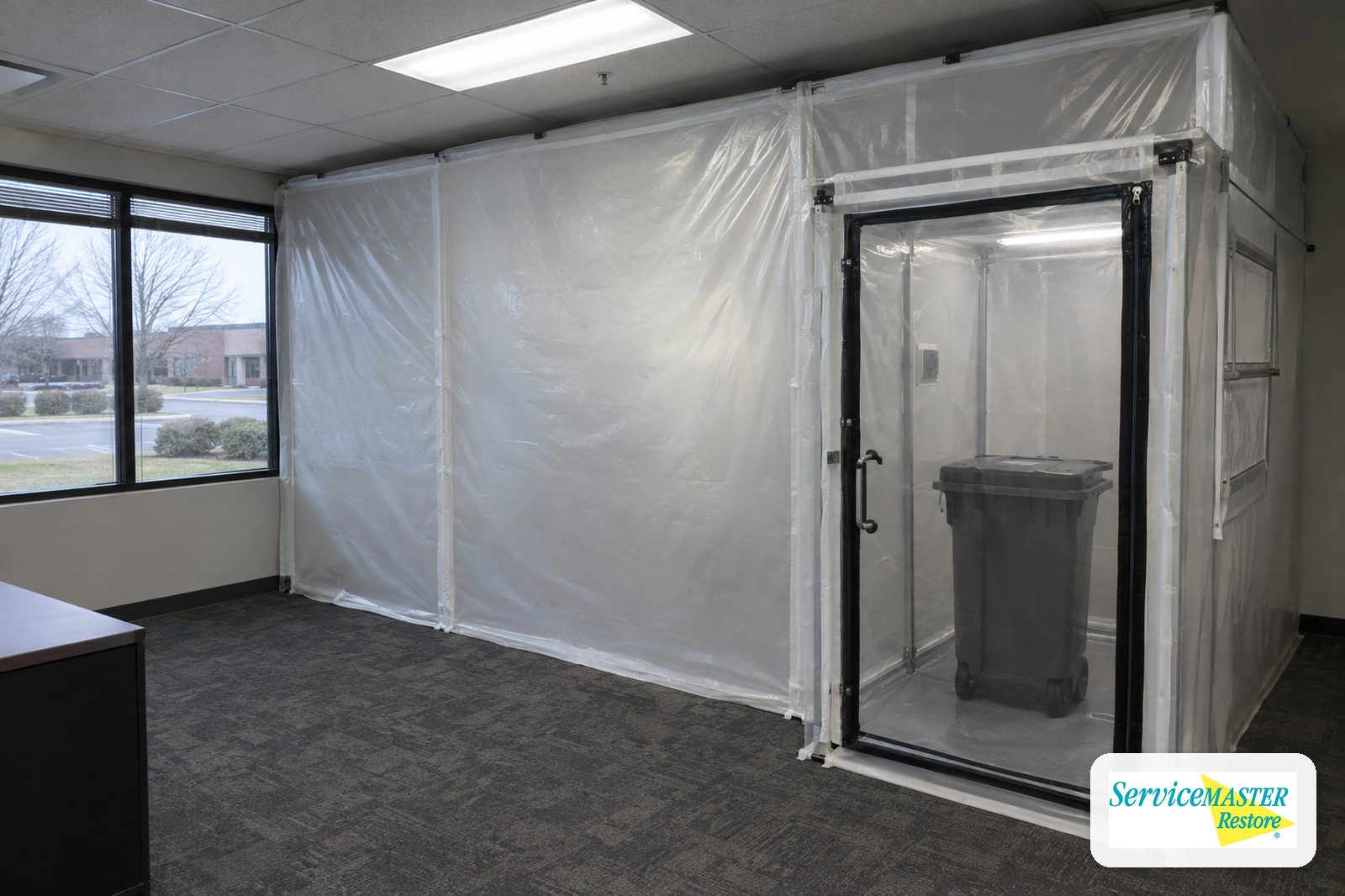
Inside the work area, EPA calls for sealing all supply and air vents, doors, chases and risers with polyethylene, since those are the paths spores use to travel between floors and rooms. Many crews use zippered doors set into the sheeting so the entry closes tight between trips, serving the same purpose as EPA's flapped slit entry.
How does negative air pressure keep spores in the work area?
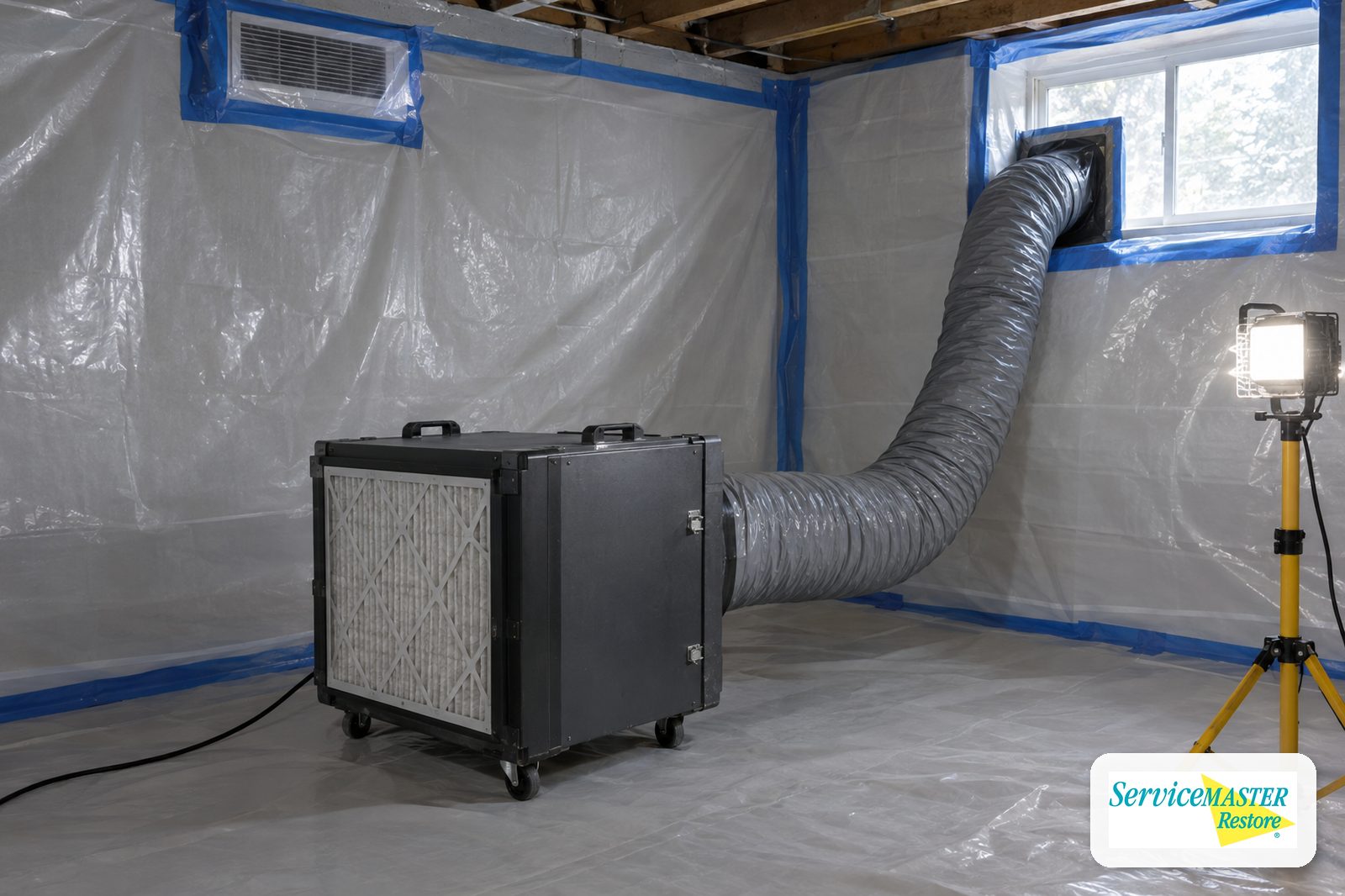
Negative pressure means more air is pulled out of the enclosure than leaks in, so any air movement through gaps runs from the clean side into the work zone. EPA says this can be done with a HEPA-filtered fan unit exhausted outside the building, or, for small, easily contained areas, an exhaust fan ducted outdoors. It also advises providing adequate makeup air.
You can see whether it is working. According to EPA, the polyethylene should billow inward on all surfaces. If it flutters or bulges outward, containment has been lost, and the problem should be found and corrected before work continues. Equipment is sized to the volume of the enclosure, and pressure is watched throughout the job, not just at setup.
What do HEPA air scrubbers actually filter?
HEPA stands for high-efficiency particulate air. EPA's explainer What is a HEPA filter? says a HEPA filter can theoretically remove at least 99.97% of airborne particles 0.3 microns in size, including dust, pollen and mold. That size is the hardest to catch; larger and smaller particles are trapped even more efficiently. Ordinary furnace filters are rated on the MERV scale instead.
HEPA air scrubbers serve two roles. Ducted outside the containment, they create negative pressure. Running inside an area, they scrub airborne particles during and after removal. EPA notes that HEPA filters don't remove vapors or gases, so they help with spores and dust but aren't a cure for odors on their own. EPA also suggests considering MERV 8 filters in the building's HVAC system during remediation and changing them afterward.
Keep the HVAC out of it
EPA warns against running a heating or cooling system you know or suspect is contaminated, because it can spread mold throughout the building, and points to its guide Should You Have the Air Ducts in Your Home Cleaned? When a drop ceiling serves as a return-air plenum, EPA says containment should run from the floor to the ceiling deck, and air handler filters serving the area may need replacing after remediation.
- Plan the zone. Use the assessment to size the enclosure and choose limited or full containment, following EPA guidance and the IICRC S520 standard.
- Shut down and seal HVAC. Turn off systems serving the area and cover supply and return vents.
- Build the barrier. Hang 6-mil fire-retardant polyethylene from floor to ceiling or deck, framed where needed, and seal seams.
- Install the entry. Add a flapped slit or zippered door, plus an airlock or decon chamber on full containment.
- Set negative air. Position HEPA air scrubbers, duct exhaust outdoors, and confirm the sheeting pulls inward.
- Maintain and monitor. Check barriers and pressure daily and keep equipment running through final cleaning.
When does containment come down?
Containment stays up until removal, HEPA vacuuming and damp wiping are complete. EPA says protective equipment must be worn throughout those final cleaning stages and during HEPA vacuum filter changes. Teardown usually waits for a final inspection or post-remediation verification, because once the plastic comes down, any missed debris is back in the open. For how this affects schedules, see how long mold remediation takes, and for the bigger picture, our guide to mold removal vs. mold remediation.
Containment for homes and businesses near you
Our certified technicians set up containment for residential mold remediation and commercial mold remediation projects across DuPage and Will County from our Lisle base, including mold remediation in Willowbrook, Burr Ridge, West Chicago and Batavia. Containment supports safe mold removal and follows the mold inspection and assessment; see every phase on our mold remediation page.
Need a work area sealed off before mold removal? Reach out online or call (630) 241-1111 around the clock.
Frequently asked questions
Why is the plastic sheeting pulled inward during mold remediation?
That inward pull is the sign containment is working. EPA explains that a containment area should be kept under negative pressure, so air flows from clean areas into the work zone. When it is, the polyethylene sheeting billows inward on all surfaces. If it flutters or billows outward, containment has been lost and the problem should be fixed before work continues.
Can I use a box fan to air out a room with mold?
Not while mold is being disturbed. EPA lists using fans to dry items among the actions likely to stir up mold and spores, and cautions that when fans are used to bring in outdoor air, care must be taken not to spread spores into unaffected areas. Professional setups exhaust filtered air outdoors and keep the room under negative pressure instead.
Do HEPA air scrubbers get rid of mold odor?
Not by themselves. HEPA filters capture particles such as spores and dust; EPA says a HEPA filter can theoretically remove at least 99.97% of particles 0.3 microns in size. EPA also notes that HEPA filters do not remove vapors or gases, and musty odors come from gases released by growing mold. Removing the growth and drying the area is what ends the smell.
Will my heating and air conditioning be shut off during containment?
Usually the system serving the work area is turned off and its vents are sealed. EPA calls for covering supply and air vents inside containment and warns against running any system you know or suspect is contaminated, because it can carry spores through the building. Other zones may keep running when they are fully separated from the work area.
How long does mold containment stay in place?
Containment stays up through removal, HEPA vacuuming and damp wiping, and typically until a final inspection or post-remediation verification confirms the area is clean. EPA says protective equipment must be worn through those final cleaning stages. The total time depends on the size of the area, the materials involved and drying time.