“Mold removal” means physically taking out the visible mold you can see. “Mold remediation” is the whole professional process of containing, removing, and correcting the moisture behind it, then verifying the space is back to normal. Removal is one step inside remediation. Because mold spores exist everywhere, no honest company can promise 100% removal, only a return to safe, normal levels.
This guide is educational and is not medical, legal, or insurance advice. Health effects vary from person to person, and coverage decisions rest with your insurer. For health questions, talk to a medical professional; for coverage questions, read your policy or contact your agent and the
Illinois Department of Insurance.
If you have called around for mold help in Naperville, Lisle, or Wheaton, you have probably heard both words used as if they mean the same thing, sometimes on the same phone call. They do not. The gap between “removal” and “remediation” is not marketing fluff. It shapes how the work is done, whether the mold actually stays gone, and how cleanly your insurance claim goes through. This guide breaks down exactly what each term means, walks through the real remediation process step by step, and explains why one honest sentence, that nobody can guarantee total mold removal, is actually a sign you are talking to the right company.
What “mold removal” actually means
Mold removal is the literal act of getting rid of mold you can see: scrubbing it off a hard surface, wiping down a windowsill, or tearing out a moldy piece of drywall. It is a task, not a plan. And for a genuinely small, surface-level spot, the U.S. Environmental Protection Agency says a homeowner can often handle it. The EPA’s guidance is specific: “If the moldy area is less than about 10 square feet (less than roughly a 3 ft. by 3 ft. patch), in most cases, you can handle the job yourself,” scrubbing mold off hard surfaces “with detergent and water” and drying completely.
Here is the problem with treating removal as the whole job. Mold is a symptom. It only grows where there is a moisture problem, and the EPA is blunt about the core principle: “The key to mold control is moisture control.” If you wipe the mold away but never fix the leaking pipe, the humid crawlspace, or the basement that takes on water in a storm, the mold comes back, usually in the same spot. Removal alone treats the stain on the wall while ignoring the reason the stain is there.
There is a second trap in the word “removal” itself. It implies you can reach a mold-free, zero state. You cannot. The EPA states plainly that “it is impossible to get rid of all mold and mold spores indoors; some mold spores will be found floating through the air and in house dust.” Spores are a normal part of the air you are breathing right now. So when a company promises “100% mold removal” or a “mold-free guarantee,” they are promising something that does not physically exist. That matters, and we will come back to why.
What “mold remediation” means, and why it’s the bigger job
Mold remediation is the professional process that includes removal but is built around a different, more honest goal: returning the indoor mold back to normal, natural levels and making sure it stays there. The industry standard that governs this work is the ANSI/IICRC S520, described by the IICRC as “a procedural standard for the remediation of mold damaged structures and contents.” It is the reference document restoration professionals across the country follow to assess, contain, clean, and verify a mold job.
The guiding principle of the S520 is source removal: physically removing the mold and the materials it has colonized, rather than trying to spray it away or simply kill it in place. That last point is important and often misunderstood. Killing mold is not the same as removing it. The EPA warns that “dead mold may still cause allergic reactions in some people, so it is not enough to simply kill the mold, it must also be removed.” This is also why bleach is not the magic fix people assume. The EPA notes that using a biocide such as chlorine bleach “is not recommended as a routine practice during mold cleanup.”
So the real split looks like this: removal is a single action, while remediation is a controlled, verified process that fixes the moisture, protects the rest of your home from cross-contamination, and confirms the result. The chart below lays the two side by side.
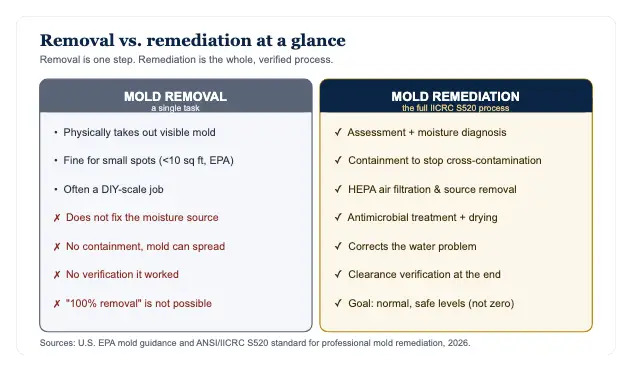
“Mold Cleanup in Your Home,”
and the ANSI/IICRC S520 standard.
The remediation process, step by step
A professional mold job is not one action repeated in more rooms. It is a sequence, and each step exists to solve a specific problem: contain the spores, remove the source, and stop it from returning. Here is how a proper remediation unfolds, in line with the IICRC S520 approach.
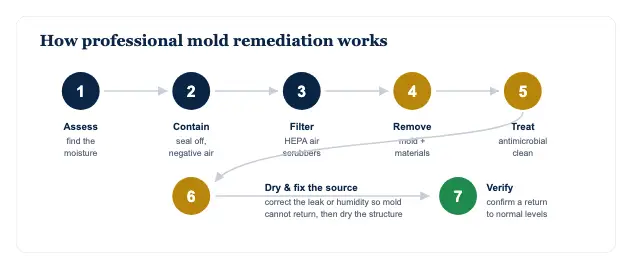
ANSI/IICRC S520 standard.
Note that removal (step 4) is only one stage inside the larger process.
1. Assessment and moisture diagnosis
Before anyone touches the mold, a technician finds the water. Using moisture meters and a visual inspection, the goal is to locate the source, a leaking supply line, a failed sump pump, condensation on cold ductwork, or seepage through a foundation wall, and to map how far the mold has actually spread, since a patch on the surface often signals more behind the drywall. This step sets the scope, which is what your insurer will later want to see documented.
2. Containment
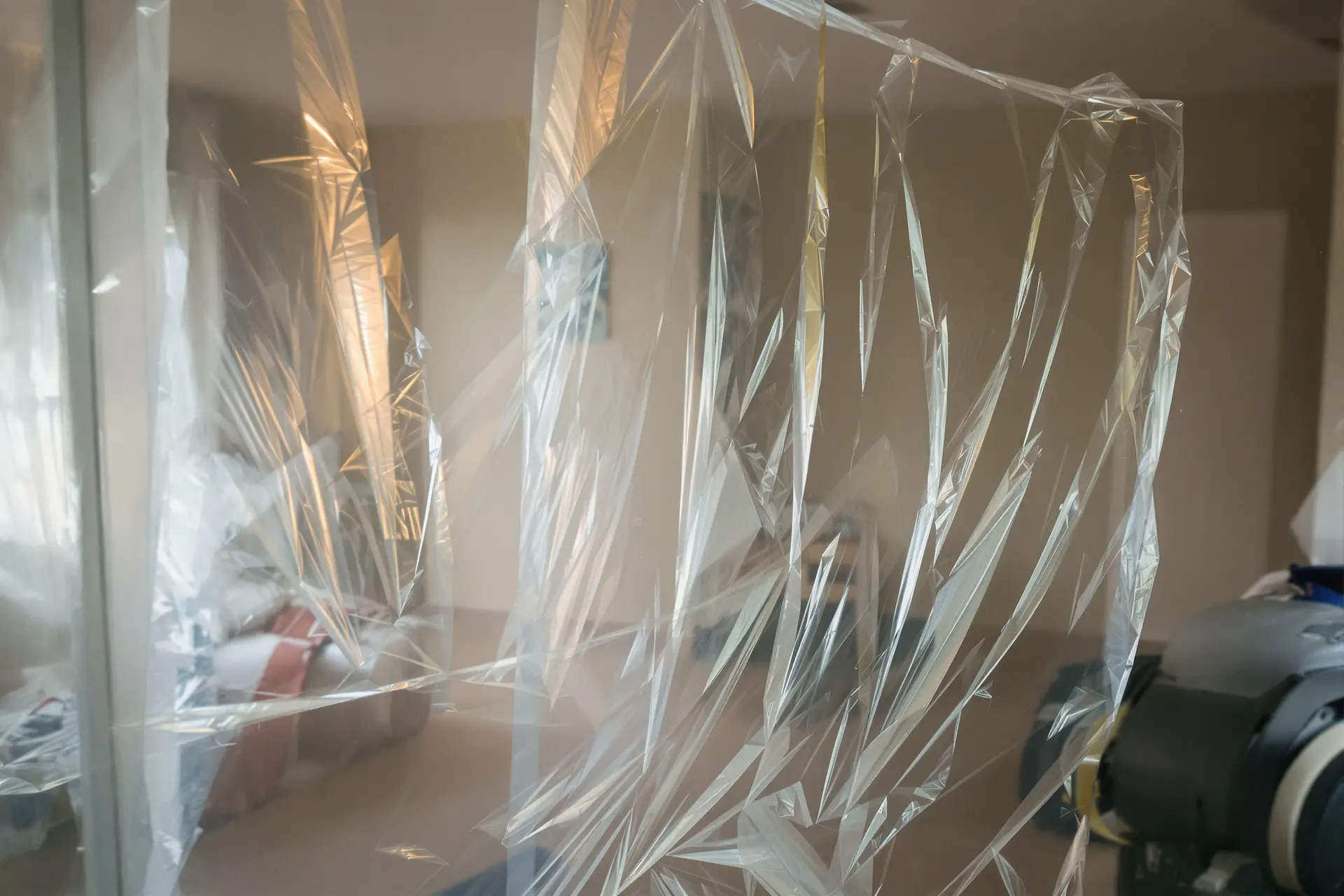
This is the step DIY removal skips, and it is the one that protects the rest of your house. Disturbing mold sends spores airborne, so professionals seal the work area off with polyethylene sheeting and run the space under negative air pressure so contaminated air flows out through filtration rather than drifting into your kitchen or bedrooms. The S520 organizes this around defined containment levels scaled to the size and severity of the job. Without containment, a small bathroom problem can seed a much bigger one down the hall.
3. HEPA air filtration
Inside containment, air scrubbers fitted with HEPA filters run continuously to capture airborne spores and fine particulate. This filtration keeps the airborne spore load down during the messy work of removal and is a core part of returning the space to a normal condition rather than just a clean-looking one.
4. Removal of mold and affected materials
Now the actual removal. Non-porous surfaces like framing, glass, and metal can often be HEPA-vacuumed and cleaned in place. Porous materials that have absorbed mold, however, usually cannot be salvaged. The EPA is direct on this: absorbent or porous materials such as ceiling tiles, drywall, and carpet “may have to be thrown away if they become moldy.” Trying to clean colonized drywall instead of removing it is a classic shortcut that leaves the problem behind the paint.
5. Antimicrobial cleaning
Remaining surfaces are cleaned and, where appropriate, treated with EPA-registered antimicrobial products to address residual growth. This is a supporting step, not the headline, and it does not replace physical removal, because, again, dead mold still has to be taken out, not just killed.
6. Drying and fixing the moisture source
The structure is dried with air movers and dehumidifiers, and, critically, the underlying water problem is corrected. Remediation that does not fix the leak, the grading, or the humidity is not remediation; it is a temporary cleanup. This is the direct application of the EPA’s core rule that moisture control is mold control. It is also why mold work and
water damage restoration so often go hand in hand in DuPage basements.
7. Clearance verification
Finally, the work is confirmed. Post-remediation verification, sometimes called clearance testing, checks that the area is visibly clean, dry, and returned to normal fungal conditions, through a visual inspection, moisture readings, and, on larger jobs, sampling. For the most rigorous results, this verification is performed by a qualified party independent of the company that did the removal, so the check is genuinely a check. It is the difference between “we’re done” and “here is proof it worked.”
Why the distinction matters for your insurance claim
This is where the vocabulary stops being academic and starts affecting your wallet. Mold coverage is one of the most restricted areas in home insurance, and understanding the difference between removal and remediation helps you set the right expectations before you file.
Start with the baseline. The Insurance Information Institute (Triple-I) explains that “mold, like rot and insect infestation, is a home maintenance issue and these are generally not covered by standard homeowners insurance policies.” In other words, if mold grew because of a slow leak you did not catch, chronic humidity, or deferred maintenance, most Illinois policies will not pay to fix it. Many carriers add specific mold exclusions or dollar caps on top of that.
There is one important exception, and it is the whole ballgame. Triple-I notes that “in the event that mold growth is the direct result of a covered peril such as a burst pipe, the cost of eliminating the mold may be covered.” So if a pipe bursts in your Downers Grove home and mold follows, the mold work can ride along with the covered water claim, though often subject to a mold cap. This is exactly why the assessment and documentation steps of a real remediation matter so much: a properly scoped remediation ties the mold back to its cause and produces the moisture logs, photos, and line-item scope your adjuster needs to connect it to a covered event. A quick “removal” with no documentation gives your insurer nothing to work with.
It also explains why the “100% mold removal guarantee” pitch is a red flag on a claim. No company can deliver a mold-free result, because spores are always present, and an insurer knows it. Reputable remediation is measured against a return to normal conditions and verified by clearance, not against an impossible promise. A firm selling guarantees it cannot keep is not a firm you want representing your loss to an adjuster. For a fuller look at what mold work runs before insurance, see our
breakdown of mold remediation cost in Illinois, and for the health side of the decision, our guide to
black mold health risks and warning signs.
A quick note on flood-related mold
Mold that follows a flood sits in a different bucket. Standard homeowners insurance excludes flooding entirely, so flood-driven mold generally is not covered by a homeowners policy. Federal flood insurance through the National Flood Insurance Program may cover mold or mildew, but only when it is directly attributable to the flood, according to Triple-I. If you are untangling what is and is not covered, our guide to
homeowners insurance and water damage in Illinois maps out the full picture.
How ServiceMaster Restoration Services handles mold in DuPage & Will County
For more than 20 years, ServiceMaster Restoration Services has helped homeowners and businesses across DuPage and Will County deal with mold, water, and storm damage the right way, not a quick wipe-down, but a documented, contained remediation that fixes the moisture behind the problem. Our IICRC-aligned, certified technicians respond 24/7, work directly with your insurance company, and document the source, the scope, and the result so your claim rests on clear evidence. We serve Naperville, Lisle, Downers Grove, Wheaton, Bolingbrook, Woodridge, Hinsdale, Lombard, Glen Ellyn, Aurora, Plainfield, Romeoville, Lockport, and the surrounding communities. And we will tell you the honest thing that other companies will not: the goal is safe, normal mold levels and a dry home, not a guarantee no one can keep.
Found mold, or water that could turn into mold?
The first 24 to 48 hours matter. Call for a straight assessment, and we will help document everything for your insurer.
Frequently Asked Questions
What is the difference between mold removal and mold remediation?
Mold removal is the single act of physically taking out visible mold, like scrubbing it off a surface or tearing out a moldy section of drywall. Mold remediation is the full professional process that includes removal but adds assessment, containment, HEPA air filtration, antimicrobial treatment, drying, fixing the moisture source, and clearance verification. Removal is one step; remediation is the whole controlled job that keeps the mold from coming back.
What does the mold remediation process include?
A professional remediation following the IICRC S520 standard typically runs through seven stages: assessing and locating the moisture source, containing the area with sheeting and negative air pressure, running HEPA air filtration, removing mold and affected porous materials, cleaning remaining surfaces with antimicrobial products, drying the structure and correcting the water problem, and verifying the result with post-remediation clearance. Each step targets a specific risk, from airborne spores to a recurring leak.
Is 100% mold removal actually possible?
No. The EPA states that it is impossible to get rid of all mold and mold spores indoors, because spores naturally float in the air and settle in house dust. A “100% removal” or “mold-free guarantee” promises something that does not physically exist. Legitimate remediation aims to return indoor mold to normal, safe levels and to fix the moisture that caused the problem, then verifies that result, rather than claiming a mold-free home.
What is clearance testing after mold remediation?
Clearance testing, also called post-remediation verification, is the final check confirming the work succeeded. It combines a visual inspection, moisture readings, and, on larger jobs, air or surface sampling to confirm the space has returned to normal conditions. For an unbiased result, it is best performed by a party independent of the company that did the remediation, so the verification is a true, separate check rather than the contractor grading their own work.
Does homeowners insurance cover mold removal or remediation?
Usually only when the mold results from a sudden, covered peril. The Insurance Information Institute notes that mold is generally treated as a maintenance issue and excluded, but that mold growth caused directly by a covered event, such as a burst pipe, may be covered, often up to a dollar cap. Mold from gradual leaks, humidity, or flooding is typically not covered by a standard policy. Documentation from a proper remediation helps tie the mold to a covered cause. Always check your own policy.
Disclaimer: This article is for general education only and is not medical, legal, or insurance advice. Health effects of mold vary by individual; consult a medical professional for health concerns. Coverage varies by policy and carrier, and only your insurer can determine what your policy covers. Verify your terms with your agent or company, and contact the
Illinois Department of Insurance
with questions about a claim.
Sources
- U.S. Environmental Protection Agency, “Mold Cleanup in Your Home” (10 sq ft guidance, cleaning and porous-material removal).
- U.S. Environmental Protection Agency, “A Brief Guide to Mold, Moisture and Your Home” (moisture control, spores everywhere, dead mold still allergenic, 24-48 hour drying, biocides not routine).
- IICRC, “S520 Standard for Professional Mold Remediation” (procedural standard, source removal, containment, post-remediation verification).
- Insurance Information Institute (Triple-I), “Protecting your home from mold” (mold as a maintenance issue, covered-peril exception, flood/NFIP note).