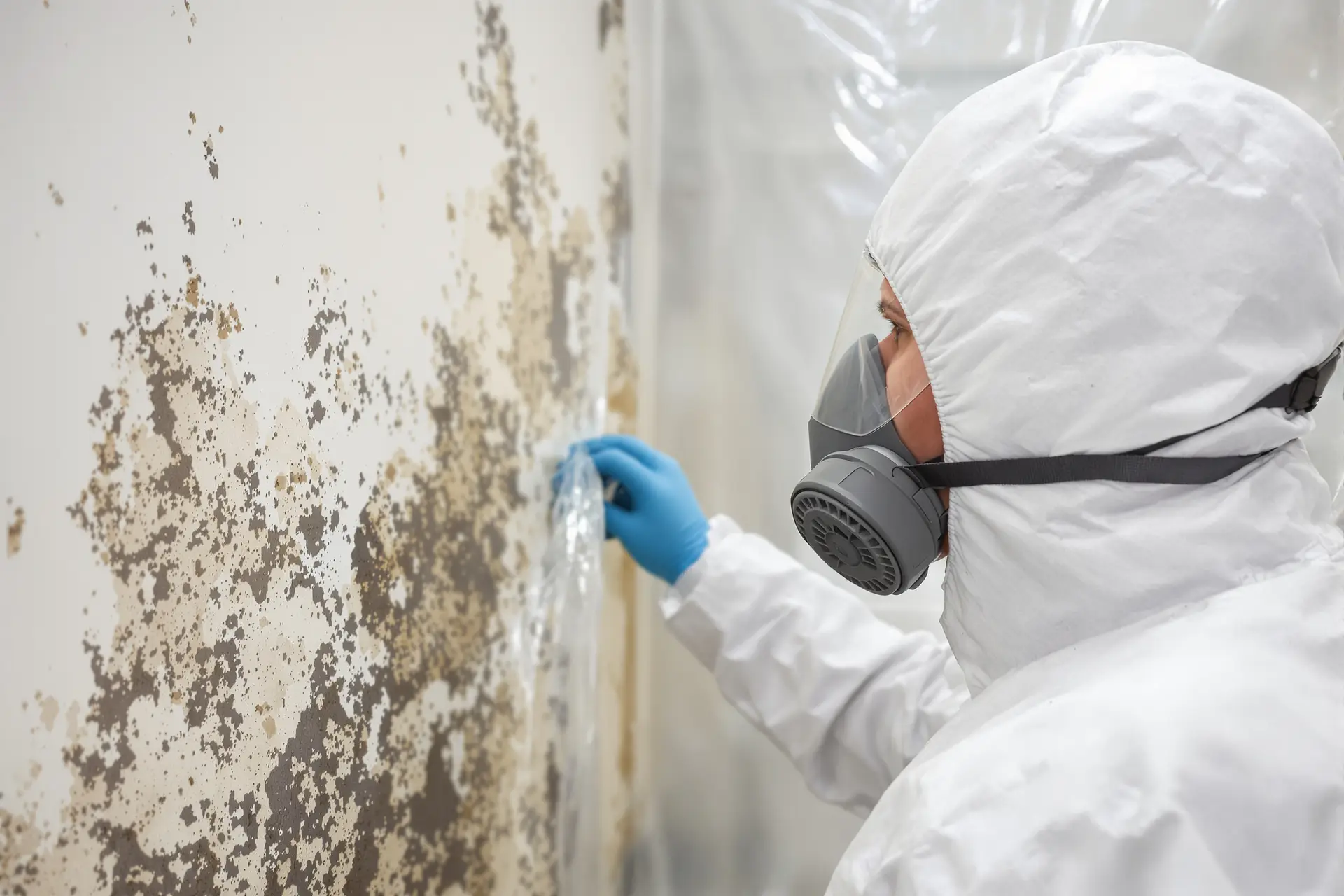
In 2026, mold remediation in the Chicago suburbs averages about $1,599, with most jobs landing between roughly $984 and $2,233 (Angi). Statewide the range runs from about $1,575 for a small contained area to $31,500 for whole-home remediation, and a typical project sits near $5,775. Size, location, and mold type set the final price.
If you found fuzzy growth behind a Naperville bathroom vanity or a musty smell creeping up from a Lisle basement, the quotes you get back can feel wildly inconsistent. One company says a few hundred dollars, another says five figures. Both can be right, because mold remediation is priced by how much there is, where it lives, and why it grew. Below is the honest 2026 math for DuPage and Will County homeowners, built from published cost data, the EPA’s remediation guidance, and the insurance rules that decide who pays.
What mold remediation costs in Illinois right now
For a typical residential job in the Chicago metro, homeowners pay an average of $1,599, with most projects falling between about $984 and $2,233, according to Angi’s Chicago cost data. That figure covers a contained, moderate problem caught before it spread through the structure. It is not the whole story, though, because mold quotes have one of the widest ranges in the restoration trade.
Zoom out to the state level and the spread is dramatic. Illinois mold remediation runs from roughly $1,575 for a small, well-contained patch to about $31,500 for extensive whole-home work, with a typical project around $5,775. Nationally, HomeGuide puts most remediation between about $1,200 and $3,750, or roughly $15 to $30 per square foot of affected area. The Chicago average sits comfortably inside those national bands, which is what you would expect for a market whose labor and material costs track close to the national midpoint.
The reason the range is so wide comes down to a simple truth: mold you can see is often the smallest part of the job. Two homes on the same Downers Grove street can get very different invoices depending on whether the growth is a surface stain on tile grout or the visible edge of a colony feeding on soaked drywall inside a wall cavity. The most useful way to read a quote is by affected area, so that is where we will start.
Mold remediation cost by affected area
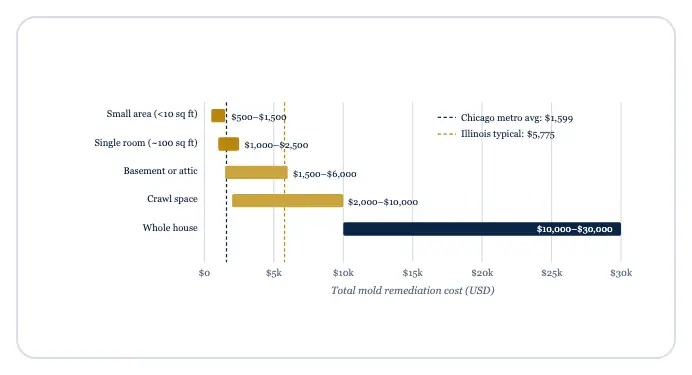
Professionals scope mold jobs by the size and accessibility of the growth, and the price climbs steeply as the affected area grows. Here is what the 2026 numbers look like as you move from a small contained spot to a whole-house project, using HomeGuide figures with the Chicago and Illinois midpoints marked for reference.
Small area, under 10 square feet
A patch of surface mold smaller than about 10 square feet, roughly a three-foot by three-foot area, is the least expensive scenario at around $500 to $1,500 if you bring in a pro. This is also the size the EPA says most homeowners can handle themselves, which we cover further down. The catch is that visible surface mold on non-porous material is genuinely small; if the same spot is the tip of growth spreading behind the wall, the real job is larger.
Single room, around 100 square feet
Contained growth in one room, such as a bathroom or a section of a bedroom, typically runs $1,000 to $2,500. A bathroom specifically often lands between $500 and $2,000 depending on how much of the wall, subfloor, or vanity has to come out. Rooms with constant humidity are the usual suspects, and fixing the moisture source is always part of the price.
Basement or attic
These larger, moisture-prone spaces usually cost $1,500 to $6,000, and a heavily affected basement can reach $15,000 if finished walls, flooring, and framing are involved. Attics climb toward the top of the range when insulation has to be removed and replaced or when access is tight. In the western suburbs, basements are the single most common place we are called for mold, for reasons we will get to.
Crawl space
Crawl spaces are among the trickiest and priciest scenarios, typically $2,000 to $10,000. The cost is driven less by square footage than by access: technicians work in a confined, low space, often on soil or a vapor barrier, and moisture control down there frequently requires additional work to keep the problem from returning.
Whole house
When mold has spread through multiple areas or into the HVAC system, whole-home remediation runs $10,000 to $30,000, including the removal work and the repairs needed to keep it from coming back. Jobs this large almost always trace back to a long-running moisture problem, a major water loss that was never dried properly, or growth that went undetected for months.
What black mold removal actually costs
Homeowners searching for black mold removal cost are usually picturing Stachybotrys chartarum, the dark, slimy mold that grows on cellulose-rich materials like drywall and wood that have stayed wet for a long time. Here is the honest answer: there is no separate black-mold price sheet. Remediation is priced by the same factors as any other mold, chiefly the affected area at roughly $15 to $30 per square foot.
That said, black mold jobs do tend to cost more, for two practical reasons. First, its presence usually signals a chronic or hidden moisture source, so the real project includes finding and fixing that source and removing the saturated material feeding it, not just wiping a surface. Second, because it is more hazardous to disturb, a responsible remediation uses full containment, negative air pressure, HEPA filtration, and protective equipment, which is exactly the scope the EPA recommends for larger jobs. So the color of the mold does not set the price; the size, the hidden moisture, and the containment it demands do, and black mold tends to bring all three. For a plain-English breakdown of the health questions behind that fear, see our guide to black mold health risks and warning signs.
Mold inspection and testing cost
A professional mold inspection with sampling generally costs about $250 to $800, depending on the size of the home and how many air or surface samples are collected. Inspection earns its keep in a few specific situations: confirming a musty smell you cannot trace, checking for hidden growth after a water loss, or verifying with clearance testing that a completed remediation actually worked.
For a small, obvious patch of surface mold, testing is often unnecessary; you can see it, and the fix is the same regardless of the exact species. One thing worth watching for on the trust side: the company that inspects and tests your home ideally should not be the same one that profits from a large remediation it recommends. Independent verification keeps everyone honest, which matters when a quote suddenly balloons.
What else drives the price up or down
Affected area is the biggest lever, but several other factors show up on nearly every mold estimate:
- The moisture source. Remediation that does not fix the underlying leak, humidity, or drainage problem is money wasted, because the mold returns. A hidden or hard-to-fix source adds cost but is non-negotiable.
- What the mold is growing on. Non-porous surfaces like tile and sealed concrete clean up cheaply. Porous materials such as drywall, carpet, insulation, and framing usually have to be removed and replaced.
- Whether it reached the HVAC system. Mold in ductwork can spread spores throughout the house and requires specialized cleaning, which raises both the scope and the price.
- Access. Crawl spaces, tight attics, and behind-wall cavities all add labor and containment time compared with an open, reachable wall.
- Post-remediation repairs. The remediation removes the mold and the damaged material; rebuilding the drywall, flooring, and paint afterward is often a separate line item, and on whole-home jobs it can rival the removal cost.
Why Chicago-suburb homes see so much mold
Mold is a moisture problem before it is anything else, and the western suburbs supply plenty of moisture. DuPage and Will County sit in a humid-continental climate with hot, humid summers and heavy late-summer thunderstorms, so indoor humidity runs high for months at a time. That is the exact condition, warm and damp, that mold needs to take hold on drywall, wood, and insulation.
Local housing patterns make it worse. Naperville, Lisle, Downers Grove, Wheaton, and the surrounding towns have a high share of homes with finished basements, the lowest and dampest part of the house and the space most exposed to seepage, sump-pump failures, and storm-driven water. When a basement floods or simply stays humid, mold can begin growing on wet materials within 24 to 48 hours if they are not dried quickly, which is why the EPA urges drying wet materials within that window. Add in the older housing stock found in parts of the suburbs, with aging plumbing and less-than-modern ventilation, and you have a region where small leaks quietly become mold problems. None of this makes DuPage remediation pricier per square foot, but it does mean local jobs more often involve finished basements, which pushes the total up.
For the full picture of how professionals contain, remove, and verify a mold problem, see our mold remediation service page.
DIY or hire a pro? The EPA’s 10-square-foot rule
The most widely used guideline comes from the EPA’s mold remediation guidance, which sorts jobs into three action levels by size: under 10 square feet, 10 to 100 square feet, and more than 100 square feet. The practical rule of thumb that grew out of it: if visible mold covers less than about 10 square feet, roughly a three-by-three patch, most healthy adults can clean it themselves using an N-95 respirator, goggles, and gloves, with no containment required.
Above that threshold, the EPA’s guidance points toward professional help, because larger colonies release far more spores when disturbed and need containment barriers and HEPA filtration that a DIY cleanup cannot replicate. You should also call a pro regardless of size if the mold came from contaminated water such as a sewage backup, if it has gotten into the HVAC system, or if anyone in the home has asthma, allergies, or a weakened immune system. When in doubt, a modest inspection costs far less than a spreading problem. This is educational guidance, not medical advice; if mold is affecting someone’s health, talk to a doctor.
Does homeowners insurance pay for mold remediation?
This is the question that decides the real out-of-pocket cost, and the answer is a careful “sometimes.” The Insurance Information Institute treats mold like rot or insect infestation, as a home-maintenance issue that standard homeowners policies generally do not cover. The important exception: when mold is the direct result of a covered peril, such as a burst pipe or a sudden appliance failure, the cost of removing it may be covered, often up to a specific capped limit.
In Illinois, that mold cap is frequently in the range of $5,000 to $10,000 when coverage applies, and some policies exclude mold entirely unless you buy an optional endorsement. What almost never gets covered is mold that grew from a gradual leak, ongoing humidity, or deferred maintenance, because insurers view those as preventable. Flooding from overland water is a separate matter that needs a flood policy, and sewer or drain backup usually requires its own endorsement. The takeaway: the cause of the moisture, and how quickly you addressed it, often matters more to a claim than the mold itself. We do not give coverage or legal advice, but we can document the loss to support your claim. Policies vary widely, so read yours or ask your agent.
How to read a mold remediation quote without getting overcharged
Because mold pricing swings so widely, it is the restoration service where homeowners feel most exposed to being oversold. A transparent quote is your best defense, and it should show its work rather than hand you one alarming number. Look for these things on any mold estimate, from us or anyone else:
- A written scope tied to the moisture source. The document should name the cause of the moisture and the plan to fix it, not just the mold to be removed.
- Containment that matches the size. Small surface jobs do not need a full containment chamber; large or black-mold jobs should include containment, negative air, and HEPA filtration. The scope should fit the problem.
- Removal versus rebuild kept separate. Remediation and the reconstruction that follows are different phases at different prices, and they should be itemized so you can see what you are paying for.
- Independent clearance testing. On larger jobs, verification that the area passed should ideally come from a party that is not also billing you for the removal.
- Clarity on insurance. Ask up front whether the company documents the loss for your carrier and how any deductible or mold cap is handled.
If a quote lands far outside the ranges on this page for the size of your problem, that is your cue to ask for the line-item detail behind it. It also helps to understand exactly what you are buying, because “removal” and “remediation” are not the same thing; our guide on mold removal versus mold remediation explains why the difference matters for both your home and your claim.
Found mold, or smell it and can’t find it?
ServiceMaster Restoration Services provides 24/7 emergency response across DuPage & Will County, with IICRC-aligned certified technicians. We contain the growth, fix the moisture source, and document the loss for your insurance. 20+ years serving the western suburbs.
Call (630) 241-1111 — 24/7 emergency response
Frequently Asked Questions
How much does it cost to remediate mold in Illinois?
In the Chicago suburbs, professional mold remediation averages about $1,599, with most homeowners paying roughly $984 to $2,233, according to Angi. Statewide, jobs range from about $1,575 for a small contained area to $31,500 for whole-home remediation, with a typical project near $5,775. Size, location, and mold type set the final number.
How much does black mold removal cost?
Black mold has no separate price list, but it usually costs more than ordinary surface mold because it signals a chronic moisture problem and typically requires full containment, HEPA filtration, and protective equipment. Most remediation runs about $15 to $30 per square foot, per HomeGuide, and black mold jobs tend to sit at the higher end once the hidden moisture source and affected materials are addressed.
Does the size or location of the mold change the price?
Yes, both are major drivers. A small area under 10 square feet may run $500 to $1,500, a single room about $1,000 to $2,500, a basement or attic $1,500 to $6,000, a crawl space $2,000 to $10,000, and whole-home remediation $10,000 to $30,000, according to HomeGuide. Hard-to-reach spaces and porous materials push costs higher.
How much does a mold inspection cost?
A professional mold inspection with testing typically costs about $250 to $800, depending on the size of the home and the number of samples. Testing is most useful for confirming a suspected problem, finding hidden growth, or verifying that a completed remediation passed clearance, rather than for a small patch of visible surface mold.
Does homeowners insurance pay for mold remediation in Illinois?
Sometimes. The Insurance Information Institute treats mold as a home-maintenance issue that standard policies generally exclude, but mold caused by a sudden, covered peril such as a burst pipe may be covered, often up to a capped limit of roughly $5,000 to $10,000. Gradual leaks, humidity, and neglect are usually excluded. Coverage varies by policy, so check yours.
Cost figures are 2026 estimates from Angi and HomeGuide and are provided for general guidance; your actual price depends on the scope of your problem and its moisture source. This article is educational and is not medical, legal, or insurance-coverage advice. ServiceMaster Restoration Services, 924 Ogden Ave, Lisle, IL · (630) 241-1111.