
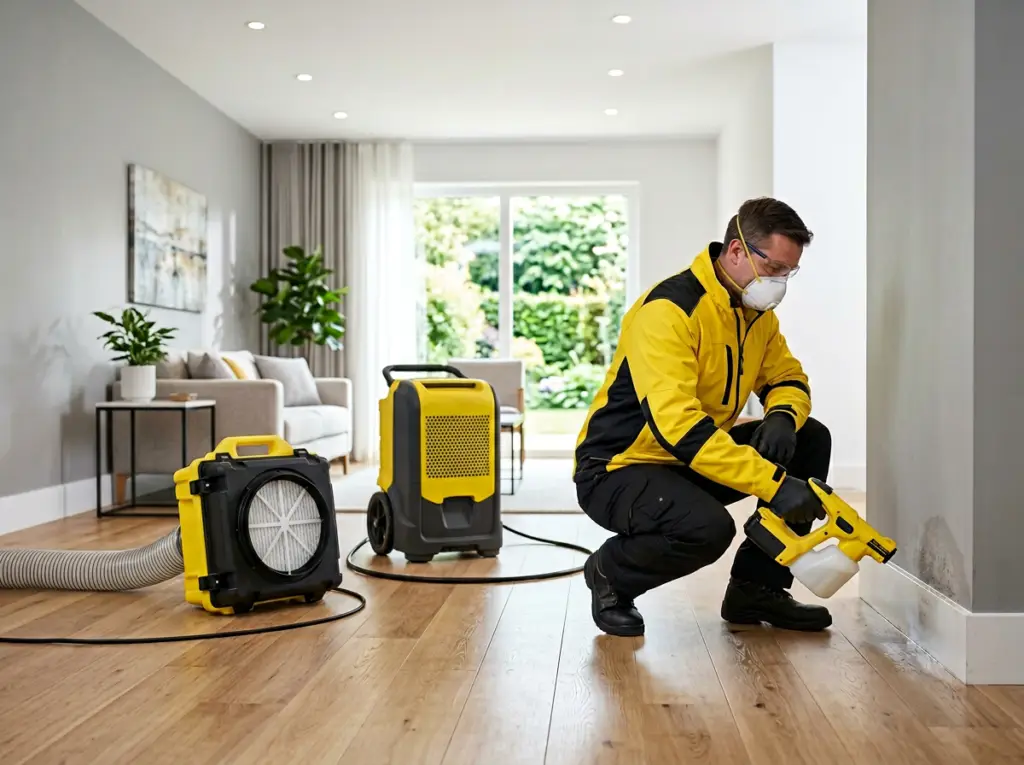

What do sanitizing and moisture control involve after a commercial water loss?
They are the two jobs that stop a water loss from becoming a health or mold problem. Sanitizing means cleaning affected surfaces and, where the water was contaminated, applying an EPA-registered antimicrobial exactly as its label directs. Moisture control means drying materials and holding indoor humidity low enough that mold, odor and condensation can't follow.
For a facility manager, both carry liability. Tenants, staff, students or patients may return to the space, and the decisions made in the first days, which products to use, which materials to remove and how dry is dry enough, should hold up to questions later. This page explains how those decisions are made under the industry standard and EPA guidance.
When does a commercial water loss need antimicrobial treatment?
It depends on the water. Under the ANSI/IICRC S500 standard, clean Category 1 water from a supply line usually needs cleaning and drying, not disinfection. Category 2 water, which carries some contamination, and Category 3 water, such as sewage or rising floodwater, are another matter.
The IICRC's 2026 S500 position statement quotes the standard's rule: with Category 2 or 3 water, remediation should occur before restorative drying, and restorers shall use contamination controls and appropriate worker protection. Antimicrobial (biocide) technology is one of the subjects the S500 covers in its own chapter.
Cleaning comes before chemistry
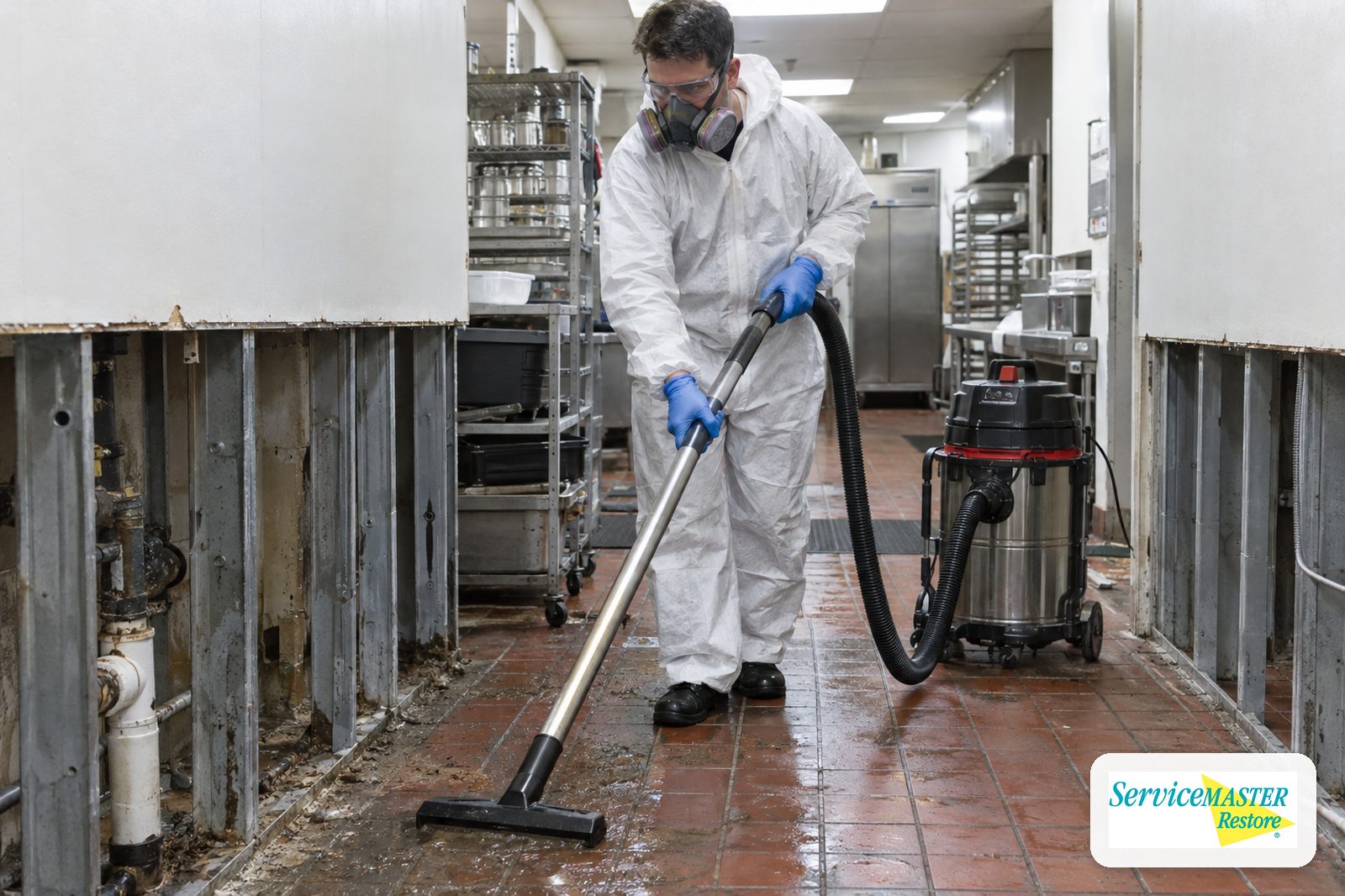
No antimicrobial works well on dirty surfaces. Contaminated porous materials, such as carpet, pad, ceiling tile and soaked drywall, are typically removed and bagged, and remaining surfaces are cleaned of silt and residue before any product is applied.
For mold, the EPA is direct: in its commercial buildings guidance it says the purpose is to remove mold, not just kill it, because dead mold is still allergenic, and that routine use of a biocide such as chlorine bleach is not recommended during mold remediation.
What is the difference between cleaning, sanitizing and disinfecting?
The words get used interchangeably on job sites and in estimates. They mean different things, and the EPA defines the product classes precisely.
| Term | What it does | Where it fits after a water loss |
|---|---|---|
| Cleaning | Physically removes soil and residue with detergent and water | Always first; EPA says to pre-clean if a surface is visibly dirty or the label calls for it |
| Sanitizing | Reduces, but does not necessarily eliminate, microorganisms to levels public health codes consider safe | Common on food-contact and high-touch surfaces in kitchens and break rooms |
| Disinfecting | Destroys or irreversibly inactivates infectious fungi and bacteria, but not necessarily their spores | Hard, non-porous surfaces touched by Category 2 or 3 water |
| Sterilizing | Eliminates fungi, spores, viruses and bacteria, including bacterial spores | Medical instruments, not buildings; EPA notes it is usually not possible or desirable to sterilize an area |
Source: U.S. EPA, What Are Antimicrobial Pesticides? and EPA guidance on disinfectant use and mold remediation.
Why does the product label matter so much?
Because it is legally binding. The EPA's introduction to pesticide labels notes that every antimicrobial label carries the statement that it is a violation of federal law to use the product in a manner inconsistent with its labeling. In the EPA's words, the label is the law.
In practice, the EPA's six steps for disinfectant use boil down to this: confirm the EPA registration number, check the listed use sites and surface types, pre-clean, keep the surface wet for the full contact time, protect the people applying it, and store it securely. A product used on a surface or organism its label doesn't list hasn't been reviewed by EPA for that use.

Questions to ask your restorer
Which product are you applying, and what is its EPA registration number? Is this surface and use on the label? What is the contact time? Where are the safety data sheets? Those four answers belong in the job file.
How does humidity control prevent secondary damage?
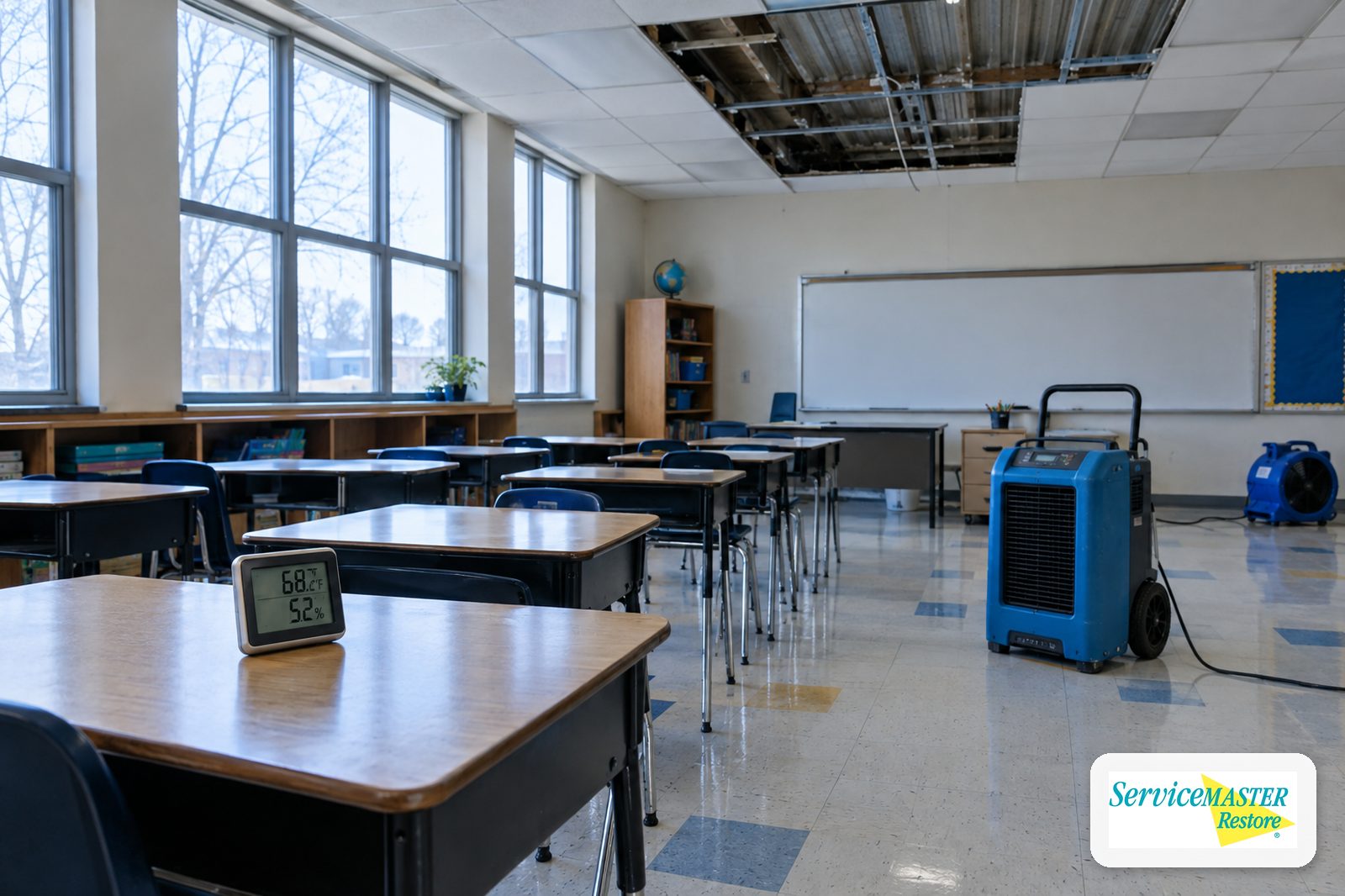
Secondary damage is what happens after the water is gone: swelling, delamination, odor, condensation on cold surfaces and mold. It is driven by moisture left in materials and air. The EPA's mold prevention tips for schools and commercial buildings set the targets: maintain indoor relative humidity below 60%, ideally 30 to 50%, and clean and dry wet or damp spots within 48 hours.
The same guidance explains how. To lower humidity, repair leaks, increase ventilation when outside air is cold and dry, or dehumidify when outdoor air is warm and humid, which describes most Chicago-area summers. To stop condensation, raise surface temperatures with insulation or air circulation. Keep HVAC drip pans clean and draining. On larger buildings, our large-scale structural drying team manages these conditions zone by zone.
What does the sanitizing and moisture control process look like?
- Confirm source and category. The restorer inspects and makes a preliminary determination of the water's category, which sets the scope.
- Protect occupants. Containment and controlled access keep contaminated work areas separate from operating spaces.
- Remove what can't be cleaned. Saturated porous materials from Category 2 or 3 areas are bagged and removed.
- Clean surfaces. Silt, residue and debris are removed with HEPA vacuums and detergent before any product is used.
- Apply antimicrobials where justified. EPA-registered products go on listed surfaces at label rates and contact times.
- Dry and hold humidity. Dehumidification brings materials to drying goals and keeps RH in the EPA range.
- Verify and document. Final moisture readings and product records go in the file; an indoor environmental professional may be used where contamination needs to be assessed.
Where this matters most
Restaurants, medical and dental offices, schools, daycare centers and multi-tenant buildings carry the highest stakes because of who uses them. Sewage backups are Category 3 by definition; see our guide to sewage backup cleanup.
If growth is already visible, the work becomes commercial mold remediation; our guide on mold removal vs. mold remediation explains the difference. Homeowners should see odor, sanitizing and mold prevention instead.
From our Lisle headquarters, certified technicians serve businesses across DuPage and Will County, including Elmhurst, Downers Grove and Naperville. This work is part of our commercial water damage restoration, damage mitigation for businesses and broader water damage restoration services.
Need product documentation for a past job or a plan for your building? Contact us. For an active loss, call 24/7 at (630) 241-1111.
Frequently asked questions
Is bleach a good choice for sanitizing a building after water damage?
Usually not as a routine step. The EPA's commercial mold guidance says routine use of a biocide such as chlorine bleach is not recommended during mold remediation, because the goal is to remove growth, and dead mold is still allergenic. Where disinfection is justified after Category 2 or 3 water, an EPA-registered product listed for that surface and used per its label is the standard approach, with ventilation.
How can we confirm a disinfectant is EPA-registered?
Look for the EPA registration number on the product label. The EPA says that number is the only way to accurately identify a product, since the same formula can be sold under different brand names. You can check it against EPA's lists of registered disinfectants and confirm the label covers your surface type and the organisms of concern. Ask your restorer to record the number in the job file.
What is contact time, and why does it matter?
Contact time, sometimes called dwell time, is how long a disinfectant must stay on a surface to work as tested. EPA guidance says to find it in the label directions and keep the surface wet the whole time. Spraying and wiping immediately can leave a surface looking clean but not disinfected. Contact times vary by product and organism, so they belong in the application record.
Do we need air or surface testing after a Category 3 loss?
Not always. The IICRC S500 notes that in many water damage projects an indoor environmental professional is not necessary, but one should be retained when risks are elevated: high-risk occupants, a public health setting such as childcare or elder care, likely health effects on workers or occupants, aerosolized contaminants, or a need to identify a contaminant or confirm the water was contaminated.
Why is condensation forming on windows and pipes after a water loss?
Drying puts a lot of water vapor into the air, and it condenses on any surface colder than the air's dew point. EPA guidance for commercial buildings says to prevent condensation by raising surface temperatures with insulation or air circulation, or by lowering humidity through repairs, ventilation when outside air is cold and dry, or dehumidification when it is warm and humid. Persistent condensation means humidity control needs adjusting.
Sources
- IICRC: Category of Water Damage and Weather-related Events (S500 Consensus Body Position Statement, 2026)
- IICRC: ANSI/IICRC S500 Standard for Professional Water Damage Restoration
- U.S. EPA: What Are Antimicrobial Pesticides?
- U.S. EPA: Introduction to Pesticide Labels
- U.S. EPA: Six Steps for Safe & Effective Disinfectant Use
- U.S. EPA: Selected EPA-Registered Disinfectants
- U.S. EPA: Mold Remediation in Schools and Commercial Buildings, Chapter 2 (Mold Prevention)
- U.S. EPA: Mold Remediation in Schools and Commercial Buildings, Chapter 3 (Remediation and Biocides)
- Restoration & Remediation magazine: The IICRC S500 Approach to Determining Initial Equipment Usage